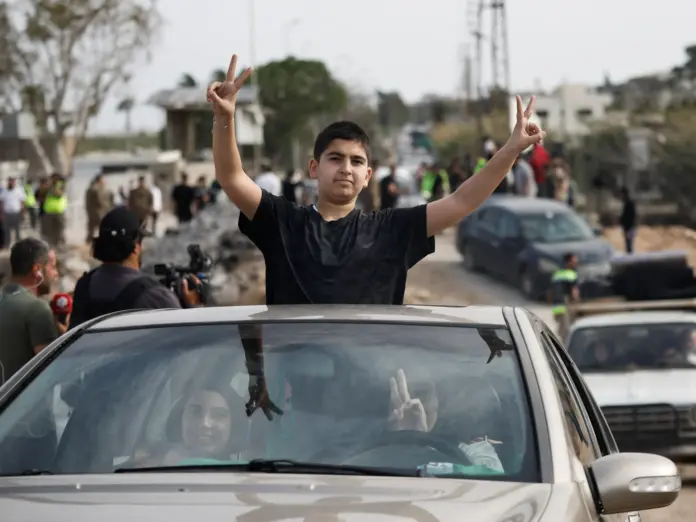
Tens of thousands of displaced Lebanese families pushed south on Saturday, their cars piled high with mattresses, bags and salvaged belongings, even as Israeli artillery continued to shell villages near the border and bulldozers pressed ahead with demolition and land-clearing operations.
The mass movement came despite a 10-day ceasefire that took effect Thursday night, ending 46 days of intensified Israeli military operations in Lebanon. The scale of destruction greeting returning residents was staggering. A preliminary assessment by Lebanese authorities found that nearly 40,000 homes had been destroyed or damaged, with Beirut’s southern suburbs among the worst-affected areas.
Fadel Badreddine, who fled his home in Nabatieh, described returning to find destruction and conditions that made the property unliveable. His experience was far from unique. Samia Lawand, a resident of Beirut’s southern suburbs, discovered her house had sustained severe damage — a second blow after it was also hit during a previous conflict.
On the ground, the ceasefire appeared tenuous at best. Israeli forces shelled areas around Beit Lif, al-Qantara and Toul, while Israeli bulldozers continued demolition operations in several areas of southern Lebanon. Bridges linking communities south of the Litani River with the rest of the country were damaged in Israeli attacks, further complicating the return of civilians.
Israeli Defence Minister Israel Katz stated that the zone between Israel’s newly established security perimeter and the Litani River had not yet been cleared of fighters and weapons, signalling that Israeli military activity in the area was unlikely to cease in the near term. Israel has declared it will retain control of 55 towns and villages and has established what it calls a ‘yellow line’ security zone extending up to 10 kilometres from the border in some locations. Israeli forces also conducted a ground invasion several kilometres into Lebanese territory during the conflict.
Diplomatic efforts to consolidate the ceasefire and address its underlying tensions were accelerating. Lebanese President Joseph Aoun met Prime Minister Nawaf Salam at Baabda Palace on Saturday to discuss the latest security and diplomatic developments. Aoun has also been in contact with US President Donald Trump and Secretary of State Marco Rubio regarding the ceasefire framework. Rare face-to-face talks between Lebanese and Israeli officials are expected to resume within days.
At the heart of the political dispute is the question of Hezbollah’s weapons. Both Israel and the Lebanese government have called for the group to disarm. Hezbollah has rejected that demand outright, insisting its arsenal is essential for defending Lebanon and southern communities, and that any disarmament would require agreement on a broader national defence strategy. The group has also tied the ceasefire to wider regional diplomacy involving Iran, with parallel US-Iran negotiations expected to take place in Islamabad in the coming days.
The humanitarian picture across southern Lebanon remains dire. Entire neighbourhoods have been reduced to rubble, infrastructure has been severed, and families are returning to homes that in many cases no longer exist. The destruction is not confined to residential areas — the damage to bridges and roads south of the Litani River threatens to isolate communities even as people attempt to rebuild their lives.
The ceasefire, while halting the most intense phase of hostilities, has not produced a stable or clearly defined end to Israeli military activity along the border. With Israel maintaining a significant security zone, Hezbollah refusing to disarm, and diplomatic negotiations still in their early stages, the path toward a durable resolution remains deeply uncertain — even as Lebanese families, with nowhere else to go, continue the journey home.