A fragile 10-day ceasefire between Israel and Lebanon took effect Thursday evening, offering a tentative pause to a conflict that has killed thousands, levelled entire neighbourhoods and driven more than a million people from their homes — even as violations emerged within hours of the guns falling silent.
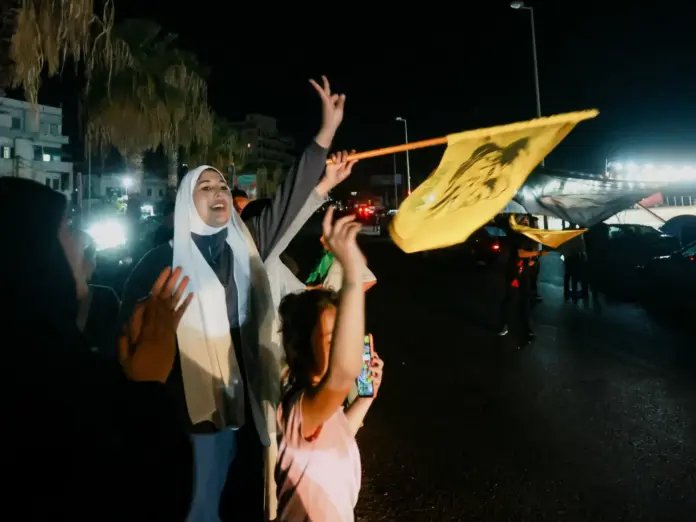
US President Donald Trump announced the truce, which came into force at 21:00 GMT, following direct negotiations in Washington on Tuesday between Israeli and Lebanese officials. Hezbollah was excluded from those talks and opposed the process entirely. Celebratory gunfire rang out across Beirut as news of the agreement spread Thursday night.
By Friday morning, however, Lebanon’s army had already accused Israeli forces of multiple violations, including intermittent shelling targeting villages in the south. An unexploded ordnance killed a boy in the town of Majdal Selem, and rescuers in Tyre uncovered the bodies of at least a dozen people killed in earlier strikes. French President Emmanuel Macron warned that the ceasefire ‘may already be undermined by ongoing military operations.’
![Displaced people make their way back to their homes, in Qasmiyeh, Lebanon, on April 17, 2026 [Louisa Gouliamaki/Reuters]](https://world-tension.s3.us-east-2.amazonaws.com/articles/451/9e21ea7f6e5843daa04ea9a47de82814.webp)
Despite the warnings, tens of thousands of displaced Lebanese poured back toward the south on Friday morning. Many found their homes unliveable and turned back. Lebanon’s army urged residents to delay their return, citing the dangerous and unstable conditions on the ground.
The human toll of the 46-day conflict is staggering. Lebanese authorities recorded more than 3,768 deaths and the displacement of some 1.2 million people since Israeli air strikes and a ground invasion began. Nabatieh was among the hardest-hit areas. On the Israeli side, Hezbollah attacks killed two civilians and 13 soldiers.
The ceasefire terms reflect deep asymmetries in the agreement. Under the deal, Israel agreed to halt offensive military operations but retained the right — affirmed by the US State Department — to take all necessary measures in self-defence. Israeli military spokesperson Avichay Adraee warned residents of southern Lebanon to remain north of the Litani River, underscoring that Israeli forces have no immediate plans to withdraw. Prime Minister Benjamin Netanyahu confirmed Israeli troops would stay in Lebanon within an extensive security zone stretching to the Syrian border.
Hezbollah’s posture remains combative. On Thursday night alone, the group said its fighters launched 38 attacks on Israeli forces inside Lebanese territory and 37 strikes in northern Israel — activity it characterised as occurring before the ceasefire deadline. Hezbollah politician Ali Fayyad said the group would approach the truce ‘with caution and vigilance,’ while the organisation warned its fighters ‘will keep their finger on the trigger because they are wary of the enemy’s treachery.’ Sirens across Israel were silent Friday morning, a marked contrast to weeks of near-constant alerts.
Israel has demanded the Lebanese government disarm Hezbollah as a condition for any lasting settlement. Hezbollah flatly refuses to surrender its weapons while Israeli forces remain on Lebanese soil — a standoff that renders the underlying political dispute unresolved. Lebanese Prime Minister Nawaf Salam welcomed the ceasefire, and Trump revealed that Netanyahu and Lebanese President Joseph Aoun could meet at the White House within the next week or two for what he described as ‘meaningful talks.’
The current truce is not the first attempt to halt the fighting. A previous ceasefire had been in place since November 27, 2024, but the United Nations documented more than 10,000 Israeli violations of that agreement before the latest round of hostilities escalated into full-scale war. The conflict traces its origins to October 2023, when Hezbollah began firing rockets at Israel in solidarity with Palestinians in Gaza, drawing a sustained Israeli military response that gradually intensified into the devastating campaign now paused by Thursday’s deal.
The diplomatic backdrop extends well beyond the Israel-Lebanon border. Trump also declared that a deal to end the war with Iran was ‘very close,’ suggesting peace talks with Tehran could resume in Islamabad as early as this weekend. Pakistani Prime Minister Shehbaz Sharif, who hosted US-Iran ceasefire negotiations last week, welcomed the Lebanon truce on Friday. Iran and Pakistan had previously argued that Lebanon should be addressed within a separate US-Iran framework; Israel maintained the Lebanon agreement was distinct from any arrangement with Tehran.
Whether the 10-day window translates into a durable settlement remains deeply uncertain. The gap between Israeli demands, Hezbollah’s red lines, and the Lebanese state’s limited capacity to enforce any disarmament is vast. For now, the silence of air raid sirens over northern Israel and the sight of families returning — however cautiously — to the south offer a fragile, contested reprieve from one of the region’s most destructive recent conflicts.