A Libyan businessman with deep ties to the Haftar family helped orchestrate hundreds of millions of dollars in financing for a military campaign that killed hundreds of people and displaced hundreds of thousands more, according to a new investigative report that traces a web of financial manipulation stretching from eastern Libya to the United Arab Emirates.
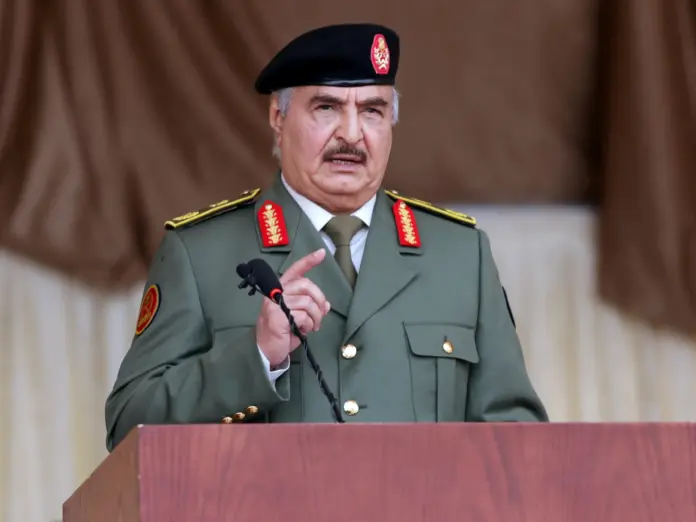
Ahmed Gadalla served as a critical enabler for members of the Haftar family, helping secure $300 million in loans from a minor Abu Dhabi-based bank to help fund Khalifa Haftar’s ill-fated assault on Tripoli between 2019 and 2020. The offensive, which also drew support from Russia’s mercenary Wagner Group, required an estimated $700 million mobilised upfront, according to the report published Tuesday by The Sentry, an investigative and policy organisation focused on conflict financing.
Haftar’s Libyan National Army ultimately failed to seize the capital. Forces loyal to the internationally recognised Government of National Accord pushed the LNA back from Tripoli and recaptured several western towns. The loans used to bankroll the campaign have since remained largely unpaid, and Gadalla has faced no legal consequences for his role in enabling the offensive.
The report paints a portrait of Gadalla as far more than a passive financier. Operating under the protection of Haftar’s son Saddam Haftar, he has expanded his grip over eastern Libya’s financial architecture, wielding control over three institutions: the Bank of Commerce and Development, Wahda Bank, and the National Commercial Bank. Through these institutions, he is alleged to have facilitated large-scale letter-of-credit fraud, laundered illicit profits, and participated in the circulation of counterfeit Russian-printed Libyan dinars.
Neither Gadalla nor the banks named in the report responded to requests for comment.
The report also links Gadalla to efforts to procure and transfer military equipment to Sudan in violation of a United Nations arms embargo — allegations that carry significant weight given the catastrophic conflict currently engulfing that country. Plans were reportedly hatched to source Chinese drones, ammunition, and armoured vehicles for onward transfer.
In a particularly striking episode detailed by The Sentry, a 145-metre container ship operated by Gadalla loaded hundreds of containers of ammunition and military vehicles at a UAE port before setting course for Benghazi. European authorities intercepted the vessel off the Greek island of Crete. A subsequent search uncovered military cargo aboard the ship despite shipping documents that listed only civilian goods.
The alleged arms transfers to Sudan carry grave humanitarian implications. Hostilities between the Rapid Support Forces and Sudan’s national army erupted in April 2023, triggering what has become the world’s largest displacement and hunger crisis. Tens of thousands have been killed and approximately 11 million people have been forced from their homes. The worst devastation has been concentrated in Darfur, where the RSF has entrenched its dominance.
The broader context is one of entrenched instability. Libya has been mired in turmoil since 2011, when longtime ruler Muammar Gaddafi was overthrown and killed, fracturing the country into competing armed factions and rival administrations. That power vacuum has allowed figures like Gadalla to embed themselves within financial institutions and operate with near-total impunity, using the architecture of legitimate banking to serve the interests of warlords and fuel conflicts far beyond Libya’s borders.
The Sentry’s findings underscore how the financing of armed conflict in fragile states rarely stays contained within a single country’s borders — and how the absence of accountability for financial enablers can perpetuate cycles of violence long after the guns fall silent.