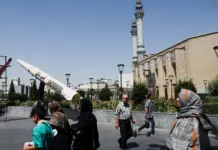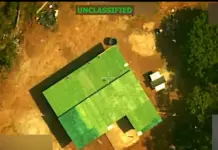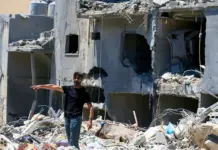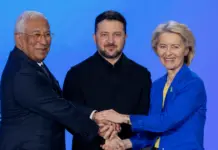
The US-Israeli military campaign against Iran has entered its second month in a spiral of mass civilian casualties, alleged war crimes, and explicit statements from senior officials rejecting the constraints of international law — a posture that legal experts and humanitarian organisations say represents an unprecedented breakdown in the global rules-based order.
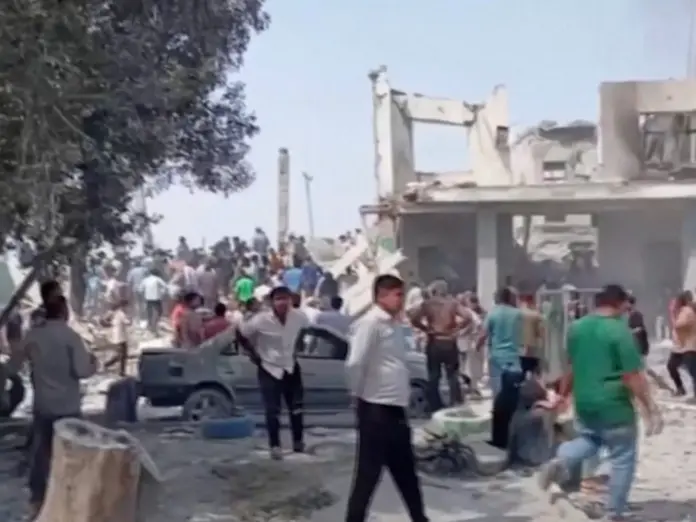
More than 2,000 people have been killed in Iran since the conflict began, with over 1,200 dead in Lebanon and 17 killed in Israel. Several million people across the Gulf, Israel and Lebanon have been displaced or forced to flee their homes, generating one of the region’s most acute humanitarian crises in decades.
The most devastating single incident to emerge publicly is a strike on an elementary school in Minab, Iran, in which more than 170 children and staff were killed. A preliminary US military report indicated that American forces were responsible for the attack — a finding that, if confirmed, would constitute one of the deadliest strikes on a civilian educational facility in modern warfare.
Rather than distancing themselves from such incidents, senior US officials have made statements that appear to celebrate or excuse the use of maximum force. President Donald Trump told a television interviewer that the US had "demolished" Iran’s Kharg Island — a critical oil export terminal — and added, regarding further strikes on Iran, "We may hit it a few more times just for fun." In a separate interview, Trump declared he does not "need international law," asserting that the only restraint on his power was his "own morality."
Defense Secretary Pete Hegseth has echoed that posture, publicly dismissing what he called "tepid legality" in favour of "maximum lethality." Hegseth also declared that "no quarter" would be given to enemies in Iran — language that, under the Geneva Conventions, constitutes an explicit war crime when applied to combatants who are hors de combat, and is categorically prohibited when directed at civilian populations.
The Geneva Conventions oblige every signatory state not only to follow the laws of war but to ensure global respect for them — an obligation that legal scholars argue makes third-party states complicit if they fail to act in the face of documented violations.
Alleged violations are not confined to one side. Iran’s Islamic Revolutionary Guard Corps has declared US banks, investment firms and commercial ships valid military targets, and has attacked vessels in the Strait of Hormuz, one of the world’s most critical maritime chokepoints. Iran has also launched internationally banned cluster munitions at Israeli cities, weapons whose indiscriminate fragmentation effect is prohibited under international humanitarian law in populated areas.
In Lebanon, Israeli Defence Minister Israel Katz has threatened to demolish homes across the south of the country and block hundreds of thousands of civilians from returning — a threat that, if carried out, would constitute collective punishment under international law. The Israeli military has already fired white phosphorus on Lebanese homes, despite a clear prohibition on its use as a weapon in civilian areas under the laws of armed conflict.
The information environment surrounding the conflict has been aggressively restricted by multiple parties. Iran has imposed a nationwide internet shutdown. Israel has banned live broadcasts and detained journalists. Gulf states have arrested citizens for posting images online. In the United States, the Federal Communications Commission has threatened broadcasters’ licences over coverage of the war deemed unfavourable to the Trump administration — a move that press freedom advocates have condemned as an attempt to suppress independent reporting on a conflict in which the US is a direct belligerent.
The combined effect of these restrictions has made independent verification of casualty figures and battlefield events exceptionally difficult, raising concerns that the true scale of civilian harm may be substantially higher than current tallies reflect.
The conflict has exposed a profound tension at the heart of the international system: the laws of war were designed precisely for moments like this, yet the most powerful military actor involved has publicly declared those laws irrelevant. Whether international institutions retain the capacity — or the political will — to respond remains an open and urgent question.