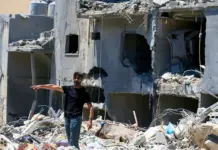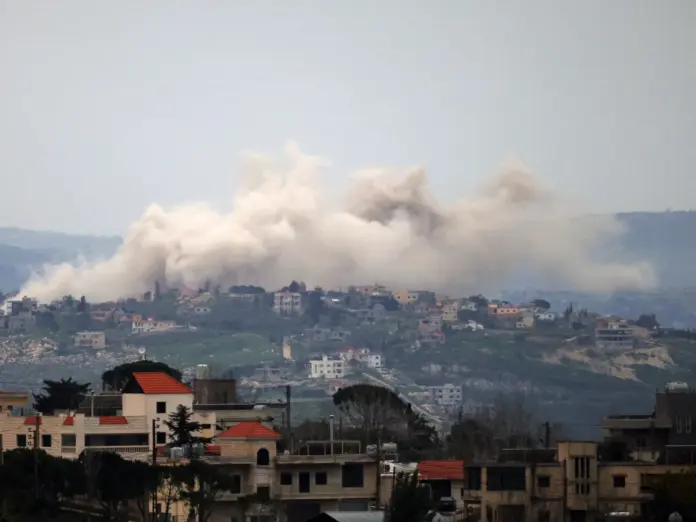
Israeli air strikes killed at least seven people across southern Lebanon on Thursday, striking residential buildings and destroying homes in multiple towns as the conflict between Israel and Hezbollah entered a new phase of intensity.
In the Tyre district, an air raid on the town of Ramadiyeh killed four people and wounded three others. Hours earlier, in the pre-dawn darkness, a strike on a two-storey building in Kfarsir in the Nabatieh district claimed three lives. Among the dead in the Nabatieh district was an entire family — a man, his wife, and their two daughters — wiped out in a single attack. Additional Israeli raids struck the towns of Yater, Harouf, and Zebdine, levelling several homes.
The Israeli military claimed Thursday to have killed 40 Hezbollah fighters within a 24-hour period, as ground operations continued around the southern Lebanese town of Antara, where Israeli troops remained engaged in active fighting with Hezbollah forces.
Hezbollah mounted a significant counter-response, launching a barrage of more than 30 rockets into the Galilee region within minutes in a single coordinated attack. The group also fired rockets at Israeli military infrastructure in the Kiryat Ata area, east of Haifa, and struck the northern border town of Metula, where some projectiles were intercepted while others landed in open areas. Hezbollah claimed a series of additional rocket attacks targeting Israeli troops and military infrastructure throughout northern Israel and border zones.
Lebanese Prime Minister Nawaf Salam described the situation in his country as ‘very critical’ on Thursday, as the human toll of the conflict continued to mount. More than one million Lebanese have been displaced since Israel launched its offensive on March 2, which has killed 1,318 people in Lebanon and left 3,935 injured. Israel escalated further by launching a ground operation on March 16.
The conflict has also drawn in broader regional dimensions. At least 24 people have been killed in Israel since the country began its war on Iran on February 28. The United States has suffered 13 military fatalities in the region since the fighting began.
Israeli Defence Minister Israel Katz signalled this week that the military campaign carries long-term territorial ambitions, stating that Israel intends to occupy a swath of southern Lebanon following the current war, establishing what he described as a ‘security zone.’ The declaration echoes Israel’s previous occupation of southern Lebanon, which lasted from 1985 until 2000 and remains deeply contentious in the region.
Political analysts have noted that domestic pressures are shaping Israeli strategy. With elections expected before the end of the year, Prime Minister Benjamin Netanyahu faces mounting pressure to deliver on pledges of ‘absolute victory,’ according to political commentator Abed Abou Shhadeh. The combination of military objectives and electoral calculations has raised concerns that the conflict could be prolonged well beyond any near-term diplomatic resolution.
The scale of destruction across southern Lebanese villages and the displacement of more than a million civilians has drawn renewed international attention to the humanitarian crisis unfolding in the country. With no ceasefire in sight and both sides escalating their operations, Lebanon’s fragile state — already burdened by years of economic collapse — faces an increasingly dire trajectory.