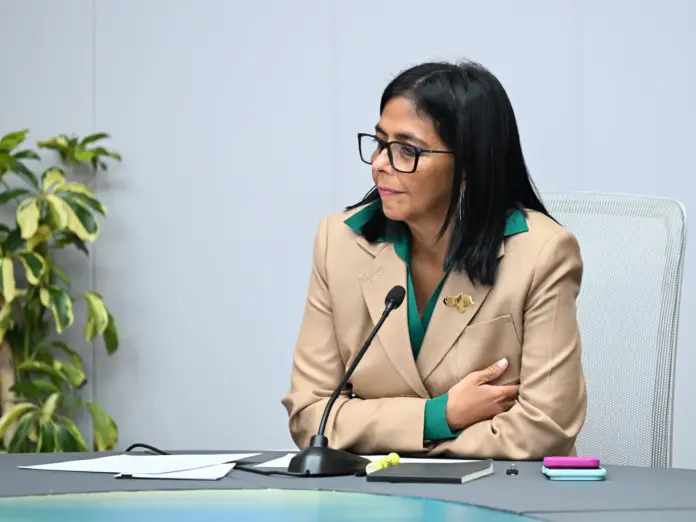
The US Department of the Treasury has lifted sanctions against Delcy Rodriguez, Venezuela’s interim president, removing her from the Specially Designated Nationals List — a sweeping reversal that signals a dramatic recalibration of American policy toward Caracas.
Rodriguez had been designated under the Office of Foreign Assets Control (OFAC) since 2018, when Washington accused her of participating in the destruction of Venezuelan democracy and enriching herself at the public’s expense. Those sanctions froze any assets she held in the United States and barred American entities from conducting business with her. That designation is now void.
The delisting comes amid a turbulent period in US-Venezuela relations shaped largely by the fate of Nicolas Maduro. A US military operation on January 3 resulted in Maduro’s abduction and capture, along with his wife, Cilia Flores. Both now await trial in the United States on charges of drug trafficking and weapons possession. Legal experts have widely condemned the operation as a violation of international law, though Washington has pressed forward with prosecutions.
Rodriguez, who had been serving as vice president when the 2018 sanctions were imposed, was sworn in as Maduro’s replacement following his removal. She has publicly called for Maduro and Flores to be returned to Venezuela, even as she navigates a complex and coercive relationship with the administration of President Donald Trump.
Trump made his expectations of Rodriguez explicit in a January 4 interview, warning that she would face consequences — including a potential second wave of military action — if she failed to comply with his demands. He has since held up Venezuela as a template for the kind of regime change he would like to engineer in Iran and Cuba, and has pledged to effectively ‘run’ the country.
Rodriguez has moved quickly to reshape Venezuela’s economic landscape since taking office. In January, she signed legislation designed to open the country’s vast oil reserves to private investment — a significant departure from the nationalisation policies that defined the Maduro and Chávez eras. A bill aimed at attracting foreign investment into Venezuela’s mining sector received an initial legislative vote in March, signalling that economic liberalisation is continuing apace.
The diplomatic dimension of the reset became tangible earlier this week when the US Department of State officially reopened its embassy in Caracas after a seven-year closure. The resumption of full embassy operations represents the most concrete institutional signal yet that Washington views Rodriguez’s government as a functional, if conditional, partner.
The trajectory of the relationship, however, remains fraught. The United Nations has noted that human rights violations have persisted in Venezuela despite the change in leadership, raising questions about whether the political transition has produced meaningful improvements for ordinary Venezuelans. Critics argue that Washington’s approach — combining military coercion, economic incentives, and selective sanctions relief — prioritises geopolitical leverage over democratic accountability.
Rodriguez’s position is delicate. She governs under the shadow of an imprisoned predecessor whose return she has demanded, while simultaneously enacting the economic reforms that Washington has long sought. The removal of her OFAC designation removes a significant legal barrier to international business dealings and may ease Venezuela’s access to foreign capital, but it also cements her administration’s dependence on American goodwill.
For Trump, the Venezuela gambit represents an audacious — and legally contested — exercise of executive power. Whether the model he has championed can be replicated elsewhere, as he has suggested, will depend in large part on whether the Rodriguez government delivers the stability and compliance Washington is seeking.