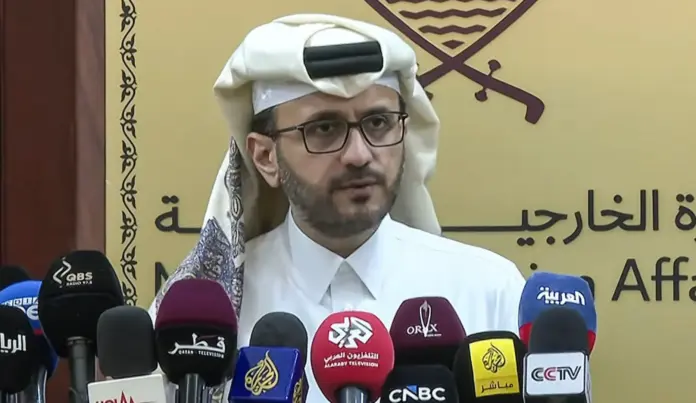
Doha — Qatar delivered one of its sharpest public rebukes to Iran on Tuesday, with the Foreign Ministry’s spokesperson warning that Tehran’s military campaign across the Gulf region has pushed relations between the two countries to a breaking point and risks dragging the entire Middle East into deeper catastrophe.
Majed al-Ansari, speaking at a news conference, said Iran had crossed ‘many red lines’ through its attacks on neighbouring states, and that the strikes were having a ‘catastrophic effect on the relationship between the two countries.’ He called on all parties to refrain from targeting nuclear or energy infrastructure, and cautioned that ‘any further escalation will mean more losses for all parties.’
The warning marks a significant shift in tone from Qatar, a small but diplomatically influential Gulf state that has historically maintained working relations with Tehran while simultaneously hosting a major US military presence. Qatar has played a central role in past regional mediation, including efforts tied to the war on Gaza, and al-Ansari confirmed the country continues to maintain open communications with all parties to the current conflict, including mediators and regional players.
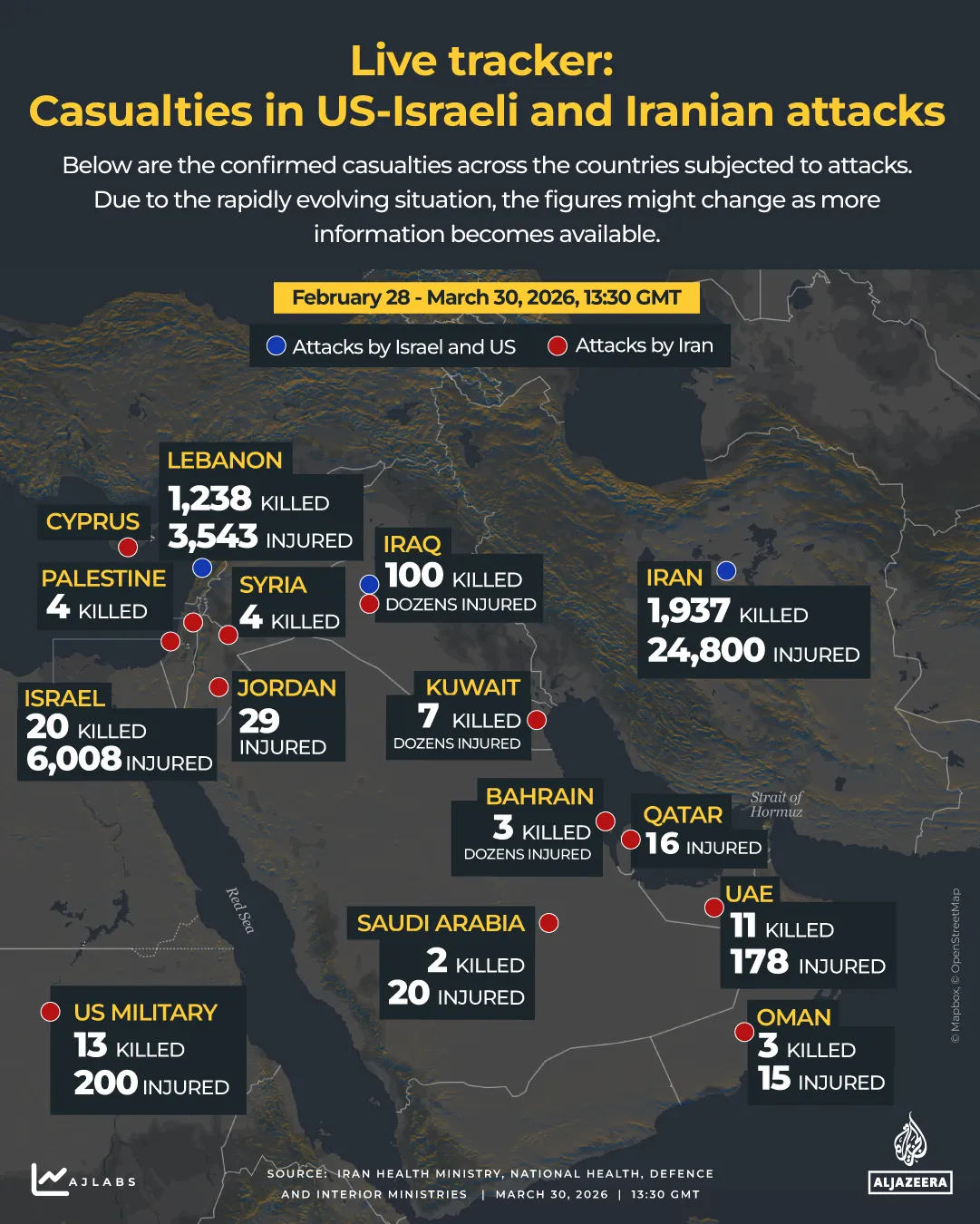
The crisis was ignited when the United States and Israel launched joint strikes against Iran at the end of February. Since then, Iran has conducted retaliatory attacks across a sweeping arc of the region, striking targets in Qatar, Iraq, Syria, the United Arab Emirates, Saudi Arabia, Bahrain, Oman, Jordan, and Kuwait. The strikes have caused damage to civilian infrastructure — including airports, energy facilities, and ports — and have resulted in casualties across multiple affected countries.
Tehran maintains that its operations are directed at US assets in the region rather than at its neighbours, a position that has done little to mollify governments whose territory and populations have borne the consequences. Qatar’s public rebuke underscores the growing frustration among Gulf states caught between the two warring powers.
The diplomatic response to the conflict has accelerated sharply. Pakistan convened four-way talks last Sunday, bringing together the foreign ministers of Turkiye, Saudi Arabia, and Egypt to explore pathways toward ending the war, with discussions including the critical question of reopening the Strait of Hormuz — a chokepoint through which a significant share of the world’s oil supply passes.
On Tuesday, Pakistan and China jointly released a five-point initiative calling for an immediate cessation of hostilities, the protection of nonmilitary targets, the security of shipping lanes including the Strait of Hormuz, and a lasting peace grounded in the United Nations charter and international law. The joint statement represents Beijing’s most direct public engagement with the crisis to date and signals growing concern among major powers over the conflict’s economic and strategic spillover.
Qatar, notably, is not part of Pakistan’s mediation track, reflecting the complex and fragmented nature of the diplomatic landscape. Multiple parallel initiatives are now in motion, with no single framework commanding broad consensus.
In Washington, US Defense Secretary Pete Hegseth confirmed on Tuesday that the United States is actively pursuing talks with Iran, while simultaneously keeping military escalation on the table as a viable option. The dual-track posture reflects the administration’s attempt to apply maximum pressure while leaving space for a negotiated off-ramp — a strategy that carries significant risks given the volatile conditions on the ground.
The convergence of Qatar’s public warning, the Pakistan-China initiative, and Hegseth’s remarks on the same day suggests that pressure for a diplomatic resolution is mounting from multiple directions. Yet the breadth of Iranian strikes — spanning nine countries and targeting critical civilian and economic infrastructure — and the continued US military posture indicate that the path to de-escalation remains narrow and fraught.
Al-Ansari’s remarks serve as a reminder that even states with established channels to Tehran are reaching the limits of their tolerance. For a region already strained by years of conflict and economic uncertainty, the stakes of further miscalculation are severe.