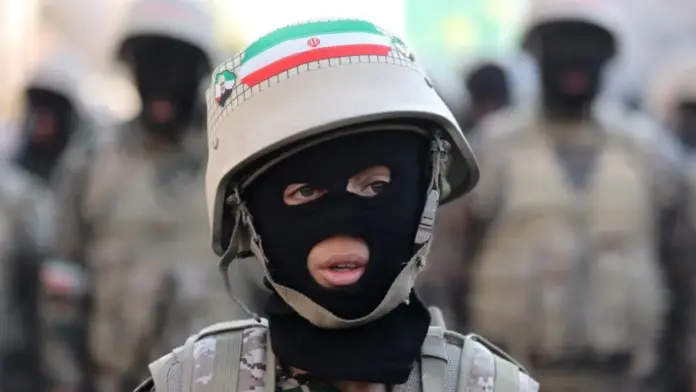
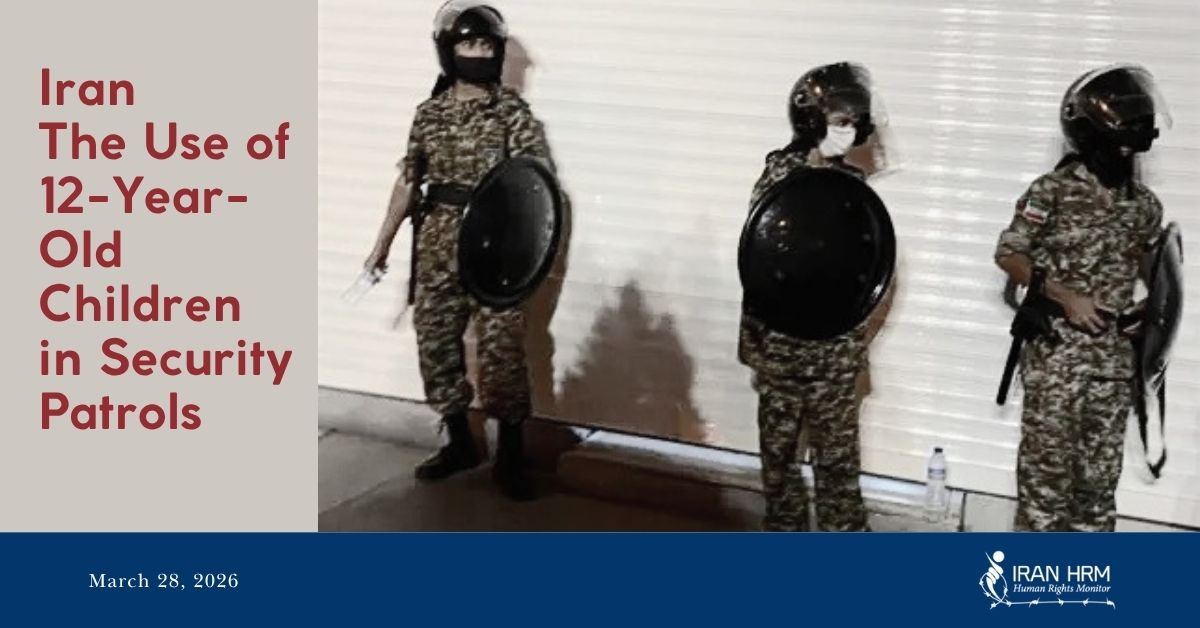
Iran’s Islamic Revolutionary Guard Corps has begun formally recruiting children as young as 12 to staff military checkpoints and conduct security patrols across the country, a practice that human rights organisations say constitutes a grave violation of international law and, in certain circumstances, a war crime.
The programme, named Homeland Defender Fighters for Iran — also referred to as the ‘For Iran’ campaign — was publicly announced on state television by Rahim Nadali, cultural deputy of the IRGC’s Greater Tehran Muhammad Rasulollah Corps. On 26 March, Nadali confirmed that the minimum participation age for intelligence patrols, operational patrols, and checkpoint duties had been formally lowered to 12. He acknowledged that children aged 12 and 13 were already taking part in security operations. Volunteers can register through mosques affiliated with the Basij militia — the IRGC’s roughly one-million-strong volunteer force — as well as in city squares where pro-establishment rallies have been organised.
The human cost of deploying minors in active security roles became starkly visible on 11 March, when Alireza Jafari, an 11-year-old fifth-grade student, was killed in an Israeli drone strike while manning a checkpoint in Tehran alongside his father. His mother, Sadaf Monfared, told the municipality-run newspaper Hamshahri that both she and her husband had been assisting Basij volunteer militia patrols. She said her husband reported that only four people were present at the checkpoint when the strike occurred. The Kurdish human rights group Hengaw independently confirmed the boy’s identity and circumstances of his death. The Israel Defense Forces said they were unable to verify the strike without specific co-ordinates, though Israel has publicly acknowledged recently targeting several Basij checkpoints.
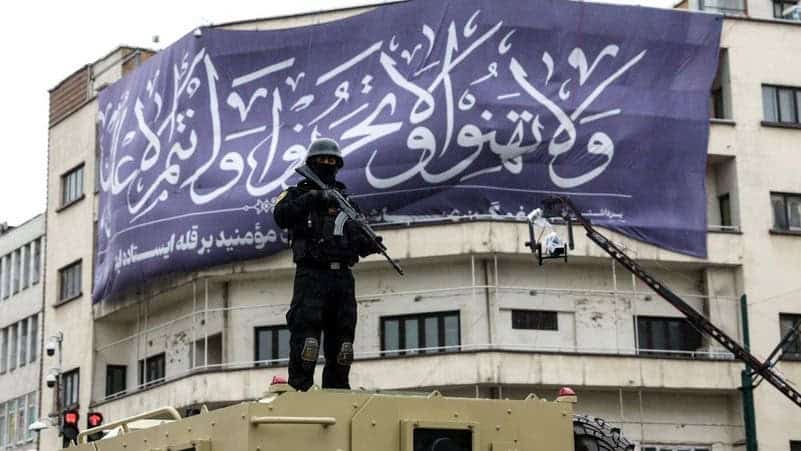
Eyewitness accounts gathered from multiple cities paint a consistent picture of armed minors deployed across Iran’s urban landscape. A woman in her 20s from east Tehran reported seeing armed teenagers participating in Basij operations on 9 March. Another resident from west Tehran observed a teenager holding a gun at a checkpoint on 25 March. In Karaj, a witness saw a teenage boy carrying a Kalashnikov on 30 March. In Rasht, masked young people were seen on duty in a public square on 14 March. Separately, residents of Tehran have described teenagers carrying Uzis stopping traffic, while heavily armed military pickup trucks block roads and conduct vehicle checks throughout the capital.
Human Rights Watch issued a sharp condemnation. Bill Van Esveld, a senior researcher at the organisation, stated there is no justification for a military recruitment drive that targets 12-year-olds, calling it a grave violation of children’s rights. Under international law, the recruitment or use of children under 15 for active participation in hostilities is classified as a war crime. Pegah Banihashemi, a constitutional law and human rights expert at the University of Chicago Law School, noted that the use of children in security or military roles is tightly constrained under international legal frameworks and unlawful in many contexts.
Accountability, however, faces significant structural obstacles. Iran has not signed or ratified the Rome Statute and is not a member of the International Criminal Court. Any investigation into alleged crimes committed on Iranian territory would require a separate authorisation by the UN Security Council, a politically fraught process given current geopolitical alignments.
Holly Dagres, an Iran specialist at The Washington Institute for Near East Policy, offered a broader strategic reading of the development, arguing that the deployment of children at security checkpoints reflects the desperation of the Islamic Republic as it confronts mounting military and economic pressure.
The scale of Iran’s domestic security mobilisation is considerable. Saeed Montazerolmahdi, spokesperson for the Law Enforcement Command, announced the deployment of 1,463 special checkpoints across the country, supported by more than 129,000 police personnel operating around the clock across emergency, relief, special, and road policing units. Nearly 15,000 vehicle and motorcycle patrol units are reportedly in continuous operation in cities and on major roads.

The use of minors in conflict is not without precedent in Iran’s modern history. During the Iran-Iraq war of the 1980s, adolescents were documented in high-risk operations, including minefield clearing. The daily Ettela’at published an account as early as 1 May 1983 describing casualties among young people in such operations — a grim historical echo of the current recruitment drive.
A government-imposed internet outage remained in effect across Iran at the time of reporting, limiting independent verification of conditions on the ground and restricting the flow of information to the outside world.