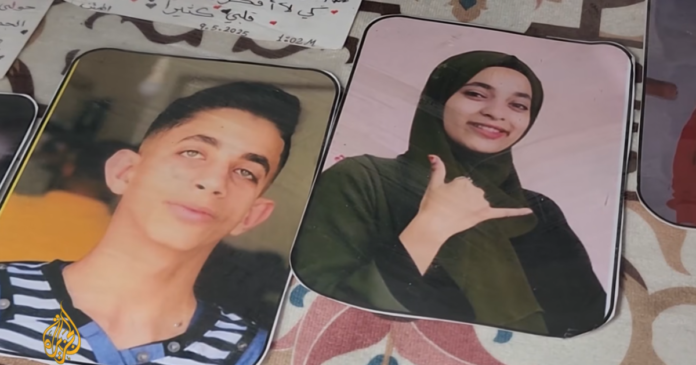
Tahrir Abu Mady keeps two documents that cannot both be true. One is a death certificate for her daughter Malak, issued by Gaza’s Ministry of Health. The other is a list of prisoners held in Israeli custody — and Malak’s name is on it.
Malak Abu Mady was 20 years old when she disappeared in Khan Younis in 2024. A university student and volunteer nurse at Nasser Hospital, she had been displaced with her family to the coastal area of al-Mawasi as Israeli ground forces advanced into the city. She and her 18-year-old brother Yousef made the decision to return to the family home to retrieve her university books. Neither came back.
When forensic teams later entered the blackened ruins of the partially destroyed house, they recovered human remains. On the basis of those remains, Gaza’s Ministry of Health issued a death certificate in Malak’s name. Her brother Yousef’s fate remained unknown.
Then came the prisoner list. Recently released Palestinian detainees circulated documentation of individuals believed to be held in Israeli custody. Malak’s name appeared on it. Beside her name, a single notation: ‘No information available.’
For Tahrir, the contradiction has become its own form of torment. She attempted to hire a lawyer based in Umm al-Fahm, inside Israel, to investigate her daughter’s whereabouts. The legal fees were beyond what the family could afford, and the effort stalled. Israeli authorities have provided no information.
Malak’s case is not isolated. Since the beginning of the war — now stretching beyond two years — Israeli forces have detained thousands of Palestinians from Gaza. Many are held in undisclosed locations, without formal charges and without access to legal representation. Families are routinely denied any confirmation of whether their relatives are alive, dead, or in custody.
Maha al-Husseini, a researcher at the Euro-Med Human Rights Monitor, says the organisation estimates approximately 3,000 people have been forcibly disappeared in the conflict. Israeli authorities have consistently refused to provide information about those individuals, leaving families in a legal and emotional void with no clear avenue for recourse.
The practice of detention without disclosure has drawn sustained criticism from human rights organisations, who argue it constitutes enforced disappearance under international law — a designation that carries specific legal obligations for the detaining power, including the duty to acknowledge custody and provide information to families.
For Tahrir Abu Mady, legal definitions offer little comfort. She holds a death certificate she cannot fully accept and a prisoner list entry that offers nothing beyond a name. Her son Yousef remains unaccounted for entirely — no document, no list, no remains.
The family home in Khan Younis stands partially destroyed, a physical marker of the moment two young people walked back into a war zone to retrieve books and did not return. What happened to them inside those walls — and what may have happened after — remains, for their mother, unanswered.