Israeli military operations and settler violence claimed at least 18 Palestinian lives across Gaza and the occupied West Bank last week, while Israeli authorities simultaneously barred a senior Catholic leader from one of Christianity’s holiest sites and pushed through sweeping legislation that human rights groups say will accelerate displacement and entrench occupation.
The majority of deaths occurred in Gaza, where a series of air strikes struck civilian infrastructure with lethal precision. A drone strike on Nuseirat camp in central Gaza on March 25 killed two Palestinians. Three days later, strikes on police checkpoints across the territory killed six people, with a separate March 28 strike killing three more. A further attack in Gaza City on March 30 killed two additional people. Since the beginning of what has been termed the October ceasefire, at least 705 Palestinians have been killed in Gaza, according to the Palestinian state news agency Wafa. Among the most recent victims was an infant, Alma Abu Rida, who died of acute pneumonia while awaiting medical evacuation from the territory.
In the West Bank, a combination of army shootings and settler attacks killed at least five Palestinians in a single day. On March 25, Yusri Abu Qbeita, 31, was shot dead when Israeli forces and settlers opened fire on his vehicle near Masafer Yatta, south of Hebron. The following day, Mohammed al-Malahi, a Palestinian from East Jerusalem, was shot and killed by settlers on his family’s agricultural land near Bethlehem. Also on March 26, Mustafa Hamed, 22, and Sufian Abu Layl, 46, were both shot dead by Israeli forces at the entrance to Qalandiya refugee camp. A 15-year-old, Adham Dahman, was killed by soldiers raiding Dheisheh refugee camp near Bethlehem the same day. In a separate incident, an elderly man named Abdallah Ghouri was severely beaten by settlers in Tayasir in the Tubas Governorate and left bleeding in a field for hours before receiving medical attention.
The scale of settler violence has reached alarming levels. The Israeli human rights organisation Yesh Din has recorded more than ten settler attacks per day in the West Bank since the war on Iran began. The UN’s Office for the Coordination of Humanitarian Affairs reports that 1,697 Palestinians in the West Bank were displaced by settler violence and access restrictions in the first three months of 2026 alone, with 38 communities emptied entirely since 2023. According to Peace Now, at least 191 illegal outposts have been established under the current government, roughly 130 of which are shepherding outposts using livestock to assert control over large swaths of West Bank land.
In occupied East Jerusalem, Israeli authorities forcibly evicted at least 15 Palestinian families — approximately 70 residents — from the Batn al-Hawa neighbourhood of Silwan on March 25. Days later, four Palestinian homes in the nearby al-Bustan neighbourhood were demolished, leaving 20 people without shelter. The human rights group B’Tselem warns that approximately 2,200 people in Silwan now face imminent forced displacement.
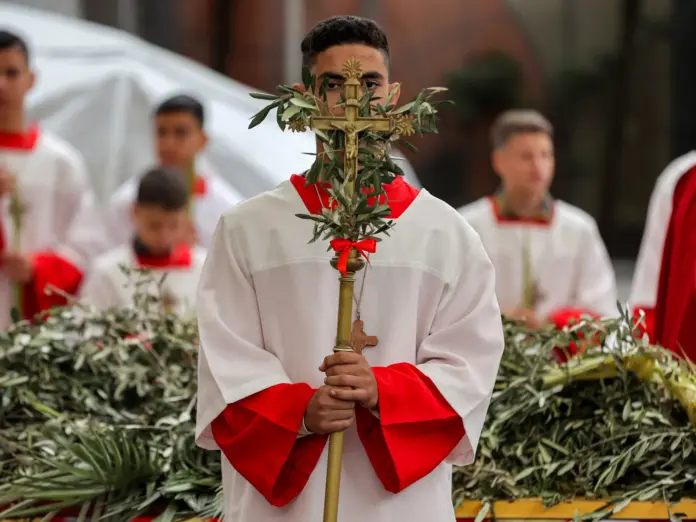
The week also produced an extraordinary confrontation at one of Christianity’s most sacred sites. On Sunday, Israeli forces prevented Cardinal Pierbattista Pizzaballa, the Latin Patriarch of Jerusalem, from entering the Church of the Holy Sepulchre to celebrate Palm Sunday mass. The Latin Patriarchate described it as the first time in centuries that the head of the church had been denied access for the occasion. The incident drew swift international condemnation, prompting Prime Minister Benjamin Netanyahu to promise a plan enabling church leaders to worship at the site in the coming days. The Al-Aqsa Mosque compound has remained closed to Muslim worshippers since late February, with authorities extending the state of emergency governing the site through mid-April.
Against this backdrop, the Knesset approved Israel’s 2026 budget, allocating a record $45.8 billion to the Ministry of Defence — nearly 17 percent of the entire government budget. An additional $129.5 million was directed to the Settlements and National Missions Ministry, and Israeli media reported a further allocation of 50 million shekels ($16 million) for security equipment at illegal settlement outposts. The Knesset also passed legislation imposing the death penalty on Palestinians convicted of terrorism, empowering military courts in the West Bank — where 96 percent of cases result in convictions — to hand down death sentences without prosecutorial request or judicial unanimity.
On the diplomatic front, Nickolay Mladenov, the Board of Peace’s high representative for Gaza, outlined a framework for disarming Hamas over an eight-month timeline, though the prospects for implementation remain uncertain amid the ongoing military campaign and deepening humanitarian crisis.