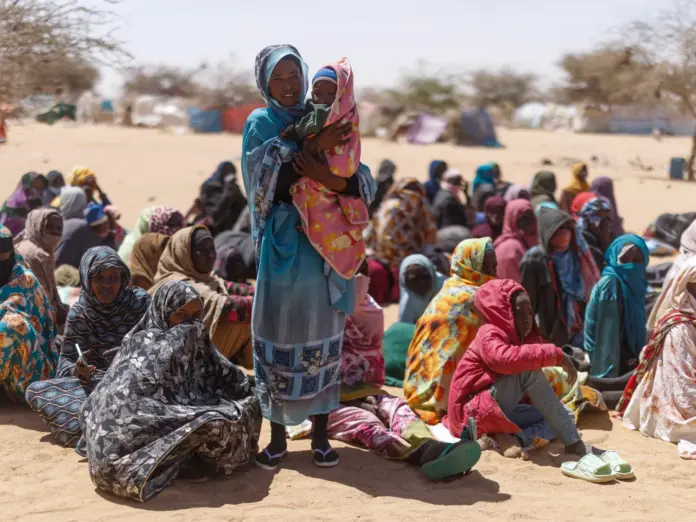
Hanaan was 18 years old when four men on motorbikes intercepted her and a female friend as they walked through a displacement encampment in South Darfur. Members of the Rapid Support Forces (RSF) raped her before she could reach her makeshift home. Her account is one of thousands now documented in a damning new report by Doctors Without Borders (MSF) that lays bare the systematic use of sexual violence as a weapon of war in Sudan’s devastating civil conflict.
The report, titled ‘There is Something I Want to Tell You…’, was released Tuesday and details the scale of sexual abuse recorded across North and South Darfur since the beginning of 2024. Between January 2024 and November 2025, MSF registered 3,396 survivors of sexual violence who sought treatment at its supported health facilities — a figure made all the more alarming by the fact that it covers only two of Sudan’s 18 states.
Women and girls bore the overwhelming burden of this violence, accounting for 97 percent of all survivors treated in MSF programmes. In South Darfur alone, one in five survivors was under the age of 18. Among the most disturbing findings: 41 children younger than five years old were recorded as survivors in that state. Survivors described being attacked in fields, markets, and inside displacement camps — spaces that should offer refuge but have instead become sites of terror.
The RSF and allied militias were identified as primarily responsible for the systematic abuse. The assaults were found to deliberately target non-Arab communities as a mechanism of humiliation and collective terror, a pattern consistent with atrocities documented in Darfur during earlier waves of conflict in the region.
The situation deteriorated sharply following the RSF’s seizure of el-Fasher, the capital of North Darfur, on October 26, 2025. In the immediate aftermath, MSF treated more than 140 survivors who had fled to the town of Tawila. Among those fleeing el-Fasher, 94 percent reported being attacked by armed men. The fall of el-Fasher marked a significant strategic and humanitarian turning point, cutting off one of the last major urban centres in Darfur that had remained outside RSF control.
Months earlier, in April 2025, the RSF seized Zamzam camp in western Darfur following two days of sustained shelling and gunfire. The camp had sheltered hundreds of thousands of internally displaced people and its fall sent waves of civilians fleeing deeper into an already overwhelmed humanitarian corridor.
Ruth Kauffman, MSF’s emergency health manager, has been central to documenting and responding to the crisis. The organisation stressed that the figures in its report represent only a fraction of the true scale of sexual violence, given the barriers survivors face in accessing care — including stigma, insecurity, and the near-total collapse of health infrastructure across much of Darfur.
Sudan’s civil war, now approaching its third year, erupted in April 2023 when fighting broke out between the Sudanese Armed Forces and the RSF. The conflict has since triggered one of the world’s worst humanitarian emergencies, displacing millions and leaving vast swaths of the country without functioning medical or civilian services. Darfur, a region with a long and painful history of mass atrocities, has once again become an epicentre of violence against civilians.
MSF is calling on the United Nations, international donors, and humanitarian actors to immediately scale up health and protection services across Darfur and Sudan more broadly. The organisation warned that without urgent intervention, survivors will continue to face life-altering physical and psychological consequences with little or no access to care.
The report’s title — drawn from the words of survivors themselves — reflects both the courage it takes to speak and the profound silence that has surrounded this crisis for too long. For Hanaan and thousands like her, that silence is no longer an option.