Iranian lawmakers moved Saturday to formally withdraw from the Nuclear Non-Proliferation Treaty (NPT), declaring the international framework worthless as United States and Israeli forces continued striking nuclear installations, industrial facilities, and academic institutions across the country.
Ebrahim Rezaei, spokesman for parliament’s national security commission, said Friday night that remaining in the NPT "has had no benefit for us." Fellow legislator Malek Shariati, a representative from Tehran, confirmed that priority legislation to withdraw from the treaty had been uploaded to an online parliamentary portal — a significant procedural step toward a formal vote. The proposed law would revoke restrictions tied to the 2015 nuclear deal and establish a new framework for nuclear cooperation with aligned nations, including members of the Shanghai Cooperation Organization and BRICS, focused on developing peaceful nuclear technologies.
Any legislation approved by parliament would still require ratification by the Guardian Council, a 12-member constitutional body, before taking effect. Iranian politicians have not convened formal parliamentary sessions since the war began on February 28.
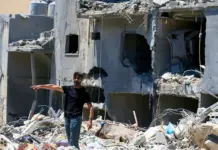
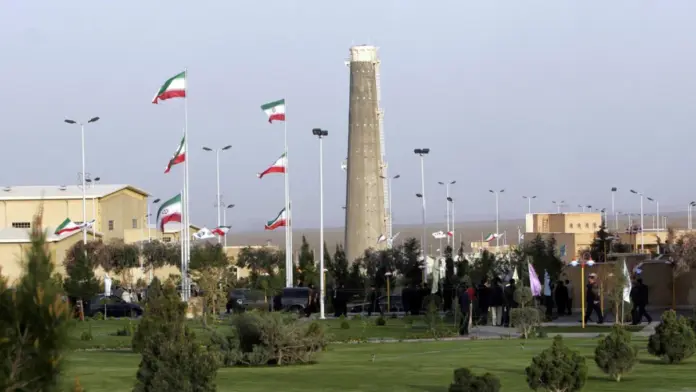
The legislative push came as strikes intensified across the country. On Friday, US and Israeli forces bombed a yellowcake processing facility in Yazd and the Khondab Heavy Water Complex near Arak — a reactor site long considered central to Iran’s nuclear programme. At least three projectiles also landed in the vicinity of the Bushehr Nuclear Power Plant, raising fears of radiological risk at one of the country’s most sensitive installations.
Beyond nuclear infrastructure, the air campaign struck deep into Iran’s industrial base. The Mobarakeh steel complex in central Isfahan and the Khuzestan steel complex in western Ahvaz both sustained heavy damage. The Khuzestan facility announced a suspension of all production until further notice on Saturday. Steel companies represent the backbone of Iran’s non-oil export economy — a sector of critical importance given the country’s approximately 70 percent inflation rate.
Overnight strikes also hit the Iran University of Science and Technology, and air raids were reported across at least six cities — Karaj, Shahr-e Rey, Yazd, Shiraz, Tabriz, and Bushehr — within a single 24-hour period.
Mohammad Mohkber, a senior adviser to the late Supreme Leader Ayatollah Ali Khamenei, escalated rhetoric against the international nuclear watchdog on Saturday, labelling International Atomic Energy Agency Director Rafael Grossi a "partner in crime." The accusation reflects deepening Iranian hostility toward multilateral institutions perceived as complicit in the military campaign.
President Donald Trump announced a delay in launching what were described as destructive attacks against Iran’s power plants, pushing that phase of operations to April 6. The announcement signals a deliberate, staged escalation strategy targeting successive layers of Iranian infrastructure — from nuclear and industrial sites to the energy grid sustaining a population of at least 90 million people.
Inside Iran, the government has moved aggressively to suppress information and dissent. Internet connectivity has been completely severed for one month, leaving only a domestic intranet operational. The blackout echoes a 20-day total internet shutdown imposed in January during nationwide demonstrations. Armed state forces are deployed in Tehran and other major cities, with strict warnings issued against further protests.
State media released a video Saturday showing a young girl who said she had been apprehended after filming missile strikes and transmitting footage to foreign-based media — an apparent warning to citizens against documenting the conflict.
The convergence of military strikes, economic devastation, and domestic repression marks a critical inflection point. Should parliament advance the NPT withdrawal and the Guardian Council approve it, Iran would become the first country to formally exit the treaty — a move that would fundamentally reshape the global nuclear non-proliferation architecture and eliminate remaining diplomatic off-ramps in the conflict.