Israel dramatically escalated its military campaign against Lebanon on March 2, 2025, after Hezbollah broke more than a year of relative restraint and launched a retaliatory strike, citing the assassination of Iranian Supreme Leader Ayatollah Ali Khamenei two days earlier as justification. The exchange shattered what remained of a fragile ceasefire and plunged Lebanon into a new phase of devastating conflict.
A formal ceasefire between Israel and Hezbollah had been in place since November 27, 2024, but it existed largely on paper. The United Nations documented more than 10,000 Israeli ceasefire violations in the months that followed, a relentless campaign that claimed hundreds of Lebanese lives even as diplomats spoke of a pause in hostilities. By the time Hezbollah fired back on March 2, the ceasefire had long ceased to function as anything more than a diplomatic fiction.
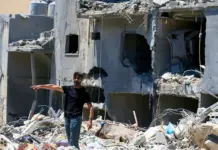
Since the latest phase of the war began, Lebanon’s Ministry of Public Health has recorded 1,094 deaths and 3,119 injuries. Among the dead are 121 children and 81 women killed in just over three weeks — figures that underscore the toll on civilian populations far from any battlefield. Israel has issued sweeping forced evacuation orders covering areas of southern Lebanon, the southern suburbs of Beirut, and villages throughout the eastern Bekaa Valley, and has declared its intention to occupy southern Lebanon and establish a permanent security zone.
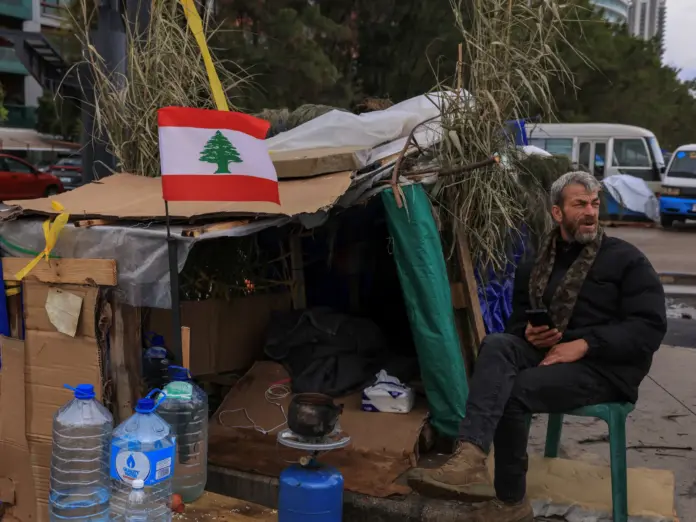
The displacement crisis is staggering. The Lebanese government reports at least 1.2 million people have been forced from their homes — roughly a quarter of the country’s entire population. Before March 2, the International Organization for Migration had already counted approximately 64,000 displaced persons; that number has since surged dramatically as Israeli military operations intensified across multiple regions simultaneously.
Among those uprooted is Samiha, a Palestinian teacher who had been living near Tyre in southern Lebanon before fleeing to Beirut. Her story reflects a broader pattern of compounding displacement — communities already living on the margins pushed further into uncertainty by each new wave of violence. Volunteer Rena Ayoubi, who has been coordinating aid distribution near Beirut’s waterfront at Biel, describes the scale of need as overwhelming, with families arriving with little more than what they could carry.
The humanitarian consequences extend well beyond physical displacement. A March 2025 report from Lebanon’s National Mental Health Programme found that three in five people across the country screen positive for depression, anxiety, or post-traumatic stress disorder. The National Lifeline 1564 — a crisis hotline operated jointly by the National Mental Health Programme and the nonprofit Embrace — received roughly 30 calls per day during the peak of Israel’s 2024 attacks. That figure has now climbed to nearly 50 calls per day.
"The psychological burden on this population is unlike anything we have seen," said Jad Chamoun, operations manager at the National Lifeline 1564 in Beirut. The hotline has become a critical lifeline for a population with few other places to turn.
Anandita Philipose, the UNFPA‘s representative in Lebanon, has warned that sexual and reproductive health services for displaced women are severely strained, with clinics overwhelmed and supply chains disrupted by the ongoing military operations. Heidi Diedrich, national director of World Vision in Lebanon, has similarly raised alarms about the condition of children caught in the conflict, many of whom have experienced repeated displacement and trauma.
Lebanon was already among the world’s most fragile states before the latest escalation. An economic crisis that began in 2019 gutted the country’s financial system and wiped out the savings of millions. The years that followed brought the COVID-19 pandemic, the catastrophic Beirut port explosion, and a wave of mass emigration that drained the country of much of its professional class. Each successive blow left Lebanon less equipped to absorb the next.
Now, with a quarter of its population displaced, its health system under acute strain, and a military occupation of its southern territory declared by a neighbour, Lebanon faces a convergence of crises with no clear resolution in sight. International calls for restraint have so far produced little tangible change on the ground, and the assassination of Khamenei — the event Hezbollah cited as the trigger for its March 2 strike — has introduced a volatile new dimension into an already deeply unstable regional equation.
Whether the latest escalation leads to a broader regional conflagration or eventually forces a return to negotiations remains uncertain. What is not in doubt is the human cost already being paid — measured in the dead, the displaced, and the millions of Lebanese quietly unravelling under the weight of a crisis that shows no sign of ending.