Six years after Senior General Min Aung Hlaing seized control of Myanmar in a coup that shattered a decade of fragile democratic progress, the country of approximately 55 million people remains locked in a devastating civil war with no clear path to resolution. More than 96,000 people have been killed, according to estimates from the Armed Conflict Location and Event Data Project, while the United Nations reports at least 3.6 million have been driven from their homes.
The 2021 military takeover ended the elected government and resulted in the detention of Aung San Suu Kyi, the Nobel Peace Prize laureate who had led Myanmar’s civilian administration. The coup reversed years of tentative democratic opening and ignited a resistance movement that has since grown into a multi-front insurgency spanning the country’s rugged borderlands and central heartland alike.
The military — known as the Tatmadaw — traces its origins to forces trained under Japanese imperial tutelage during the Second World War, predating Myanmar’s independence from Britain in 1948. Its ideology frames the armed forces as guardians of a predominantly Buddhist nation centred on the ethnic Bamar majority, a worldview that has long marginalised the country’s numerous ethnic minorities. Today, the Tatmadaw fields between 150,000 and 250,000 soldiers, according to Morgan Michaels of the International Institute for Strategic Studies, a figure bolstered by up to 100,000 conscripts rushed into service after draft laws were enacted in 2024. The military deploys fighter jets, attack helicopters, tanks, and drones against opposition forces, and has received arms from both China and Russia. It also controls a vast commercial empire spanning natural resource extraction and consumer industries including beer production.
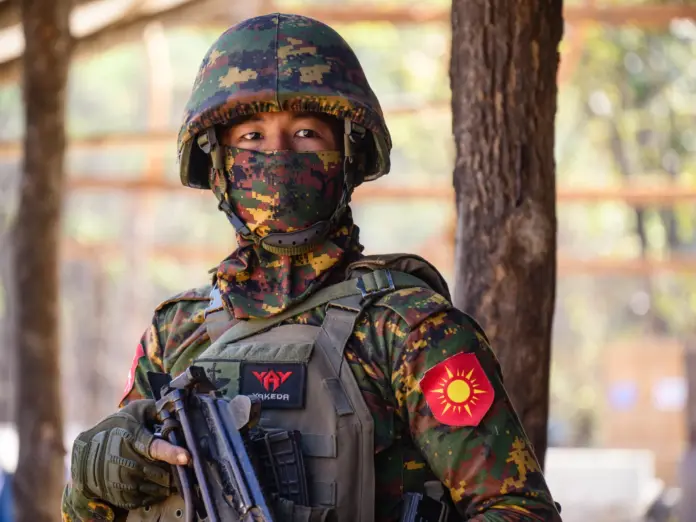
Opposing the junta is a diverse and decentralised constellation of armed groups. The National Unity Government, a shadow administration formed by lawmakers ousted in the coup, claimed roughly 250 battalions of its People’s Defence Force as of 2022 — suggesting a combined strength of around 100,000 fighters. Alongside the PDF, a range of long-established ethnic armed organisations have intensified their campaigns against the military.
The Arakan Army has emerged as one of the most formidable, building a force of approximately 40,000 fighters equipped with artillery, armoured vehicles, and drone capabilities. The Kachin Independence Army fields up to 30,000 troops and draws revenue from rare earth mining in the country’s north. The United Wa State Army, operating along the Myanmar-China border, maintains roughly 30,000 fighters, making it one of the largest non-state armed forces in Southeast Asia. The Karen National Union, with around 15,000 troops positioned along the Myanmar-Thai border, has fought the central government intermittently for decades.
The Myanmar National Democratic Alliance Army, a Mandarin-speaking ethnic Kokang force of between 8,000 and 10,000 fighters, demonstrated the resistance’s offensive capability when it captured the strategically significant city of Lashio during a 2023 offensive. The city was subsequently returned to military control under pressure from Beijing, underscoring China’s complex role as both arms supplier to the junta and influential broker over some ethnic armed groups operating near its border.
In a significant development in November 2025, nineteen independent fighting forces merged to form the Spring Revolution Alliance, a coalition with a combined strength of approximately 10,000 fighters. The consolidation signals an effort to coordinate resistance efforts, though the broader opposition landscape remains fragmented across competing interests and geographies.
The human cost of the conflict extends well beyond the battlefield. The crisis compounds a longer history of displacement: more than 750,000 Rohingya fled to refugee camps in Bangladesh’s Cox’s Bazar following a 2017 military campaign, a mass exodus that drew international condemnation and allegations of ethnic cleansing. The current war has added millions more to the ranks of the displaced, straining humanitarian capacity across the region.
Myanmar gained independence from Britain in 1948 and has spent much of its post-colonial history under military dominance. The latest chapter of that history — marked by industrial-scale violence, a shattered economy, and a resistance that has proven far more durable than the junta anticipated — shows little sign of reaching a conclusion. With powerful armed groups controlling swaths of territory, a shadow government claiming legitimacy, and international actors pursuing competing interests, the war that began with a single coup has evolved into one of the world’s most intractable conflicts.