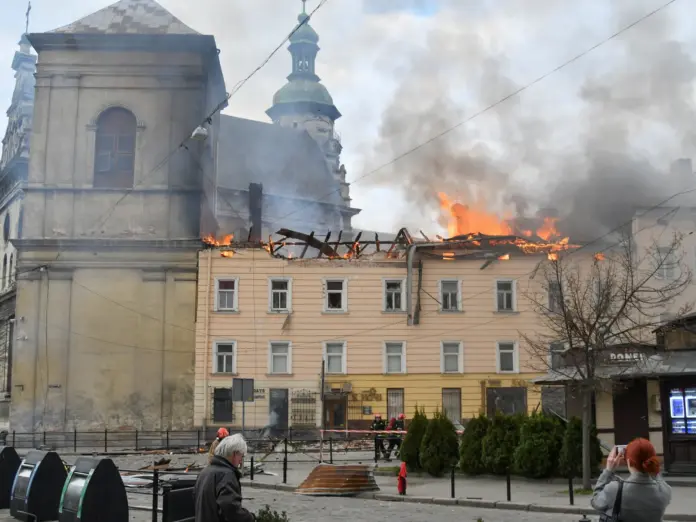
Russia launched 948 drones against Ukraine in a single 24-hour period on Tuesday, killing at least eight people across multiple regions and striking a UNESCO World Heritage Site in the western city of Lviv in one of the most intense aerial bombardments of the war.
The assault unfolded in two waves. An overnight bombardment struck 11 regions, killing five people — two in Poltava and one each in Zaporizhia, Kherson, and Kharkiv. Daytime attacks followed, a tactic that has remained relatively rare throughout the conflict. Two people died in the western city of Ivano-Frankivsk and one in the Vinnytsia region as strikes continued into daylight hours.
In Lviv, a drone crashed into an old building adjacent to a church in the city’s historic centre, damaging part of the area surrounding the 17th-century St Andrew’s Church — a site protected under UNESCO’s World Heritage designation. Governor Maksym Kozytskyi confirmed the damage to the heritage zone, drawing international attention to the cultural cost of the campaign.
Prime Minister Yulia Svyrydenko condemned the strikes in stark terms, stating that Russia was deliberately attacking a crowded city centre in broad daylight. The assault on Lviv, located in Ukraine’s far west and long considered relatively distant from the front lines, underscored the reach and ambition of Russia’s aerial campaign.
The scale of Tuesday’s attack comes as Ukraine faces mounting pressure on multiple fronts. General Oleksandr Syrskii, commander-in-chief of Ukraine’s armed forces, reported on Monday that Russia had launched 619 separate attacks in just four days. The Institute for the Study of War has noted that Russia has moved heavy equipment and additional troops to the front line — a pattern consistent with the seasonal escalation that typically accompanies the spring thaw, when melting snow improves conditions for ground operations.
Despite the intensity of its aerial and ground campaigns, Russia has been unable to capture major Ukrainian cities and has made only incremental gains across rural areas. Moscow currently occupies approximately 20 per cent of Ukrainian territory, a figure that has shifted little despite sustained military pressure.
The timing of the attacks carries diplomatic weight. Ukraine-US talks opened in the state of Florida on Saturday, with air defence topping Kyiv’s agenda. President Volodymyr Zelenskyy has been explicit about Ukraine’s dependence on American-supplied systems to intercept ballistic missiles, warning that Kyiv is facing a growing deficit of interceptor missiles at a moment when Washington’s attention is partly consumed by the US-Israeli conflict with Iran.
The air defence gap is not a new concern. Zelenskyy stated in January that a security guarantees agreement between Ukraine and the United States was "100 percent ready" and awaiting only a signature. As of this week, no such agreement has been finalised, leaving Ukraine’s long-term security architecture unresolved even as Russian strikes intensify.
The drone campaign reflects a broader Russian strategy of grinding attrition — exhausting Ukrainian air defences, disrupting civilian infrastructure, and demoralising the population ahead of anticipated spring offensives. With nearly 1,000 drones deployed in a single day, the operational tempo signals that Moscow is prepared to sustain and potentially escalate that pressure in the weeks ahead.