As Muslims worldwide celebrated Eid al-Fitr, marking the end of Ramadan, Palestinians in the occupied West Bank faced some of the most intense settler violence in recent memory — while Israeli authorities took the unprecedented step of emptying the Al-Aqsa Mosque compound of worshippers, a move with no recorded precedent since Israel seized the holy site in 1967.
Israeli police deployed sound grenades and physical force against Palestinians who attempted to pray outside the gates of Jerusalem’s Old City, barring access to one of Islam’s holiest sites on one of its most sacred days.
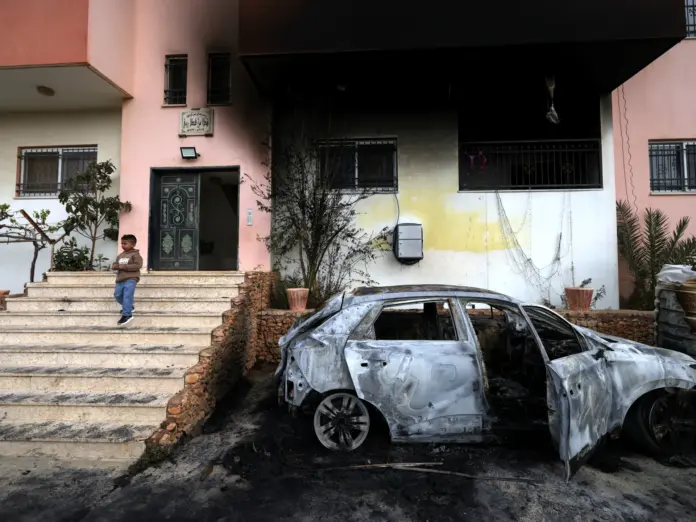
The surge in settler attacks followed the death of Yehuda Sherman, an 18-year-old settler from Beit Imrin, who died on Saturday. By Sunday, approximately 100 masked settlers had descended on the villages of Jalud and Qaryut, south of Nablus, in the early morning hours. They torched at least five vehicles, set fire to more than 10 homes, burned the Jalud village council building, and attempted to set a mosque alight. A fire truck responding to the blazes was attacked and its driver injured. Israeli Finance Minister Bezalel Smotrich attended Sherman’s funeral on Sunday, using the occasion to declare that the Israeli government was actively working to dismantle the Palestinian Authority.
The violence was not confined to a single day or location. On Saturday night, settlers raided al-Fandaqumiya, south of Jenin, setting fire to homes and vehicles before moving to the neighbouring village of Silat al-Dhaher, where at least two more homes were torched and six residents injured. Since March 17, settlers have been massing nightly at more than 10 road junctions, systematically attacking Palestinian vehicles. Route 60 from Sinjil to Homesh was closed entirely on Sunday for Sherman’s funeral procession.
The destruction extended to Palestinian livelihoods. Israeli bulldozers uprooted olive trees over multiple days in Nilin along the separation wall. In the Huwara area of the Nablus governorate, more than 100 dunams of land containing over 1,500 olive trees were bulldozed. In Khirbet Mughayir al-Abeed in Masafer Yatta, settlers destroyed more than 130 olive trees by releasing livestock into cultivated land. Settlers also blocked gates at entrances to numerous Palestinian communities across the West Bank, restricting movement during the holiday period.
On March 17, settlers raided the home of Yousef Muzahim in Jiljiliya, northeast of Ramallah, summoning Israeli soldiers to arrest him along with his two sons, aged 12 and 14. Israeli authorities also issued military orders on March 16 to seize 268 dunams in Tubas and Tammun for military purposes — the same area where, just one day earlier, four members of a Palestinian family, including two children, were killed by Israeli forces while travelling by car.
Israeli forces additionally demolished the last remaining home in Fasayel al-Wusta in the Jordan Valley, and the Israeli Civil Administration carried out a further demolition in Khirbet al-Marajim, southwest of Duma in the Nablus governorate. Settlers were simultaneously reported to be rebuilding a demolished outpost southwest of Nablus under Israeli military protection.
Human rights organisation B’Tselem documented at least 14 Palestinian deaths in the West Bank since February 28, when the US-Israel war on Iran began — now in its fourth week. Eight of those killed were shot by the Israeli military; six were killed by armed settlers. Two of the 14 victims were minors. Four Palestinian women were also killed by rocket debris in Beit Awwa on March 18.
Rare public criticism emerged from within the Israeli establishment. Israeli military Chief of Staff Eyal Zamir publicly condemned settler violence on March 18, calling attacks on Palestinian civilians morally and ethically unacceptable. Former Prime Minister Naftali Bennett echoed that condemnation — though critics noted that Israeli forces continued to provide protection to settlers rebuilding illegal outposts even as the condemnations were issued.
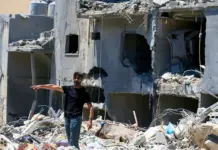
In Gaza, the fragile October ceasefire continued to fray. Israeli air attacks killed at least three people, including a child, in Khan Younis on March 17. Drone strikes killed four more in the Gaza City area on March 19. Four additional people were killed on Sunday, among them three police officers struck in the Nuseirat refugee camp. Heavy tank fire was reported east of Gaza City on Monday morning, and Israeli artillery shelled the Bureij refugee camp. Since the October ceasefire, Palestinian health officials have recorded 680 Palestinian deaths in Gaza.
The Rafah crossing with Egypt reopened Thursday under severe restrictions on the movement of people. The World Health Organization warned that hospitals across Gaza face critical shortages of medicines, medical supplies, and fuel. US officials have presented Hamas mediators with a formal proposal to disarm in exchange for large-scale reconstruction of Gaza — a proposal tied to the US-led Board of Peace, established in part to implement the October ceasefire agreement.