PORT SHUAIBA, Kuwait — Six United States Army Reserve soldiers are dead after an Iranian unmanned aircraft struck a logistics command centre at Port Shuaiba, Kuwait, on Sunday, March 1, marking the deadliest single attack on American forces since President Donald Trump ordered a military campaign against Iran on February 28.
The Pentagon initially reported three fatalities following the strike, which targeted a supply base supporting more than 13,000 US troops stationed in Kuwait. By Monday, the toll had risen to six — one soldier succumbed to injuries sustained in the blast, while two more bodies were recovered from the rubble of the destroyed facility.
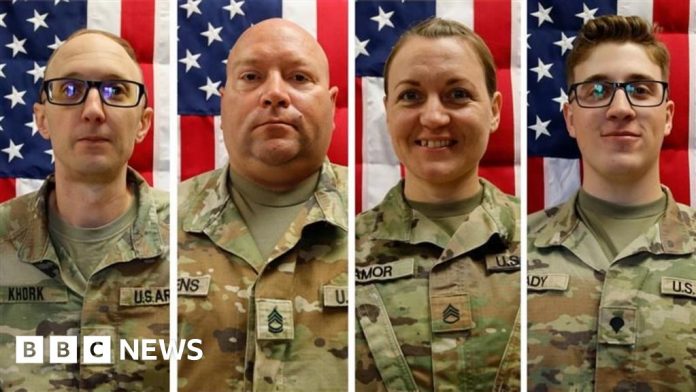
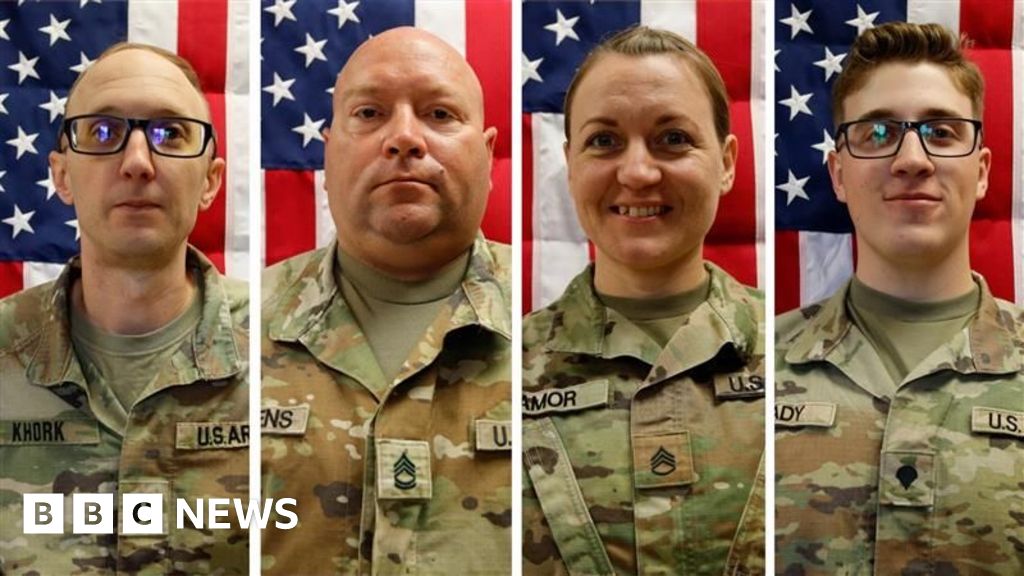
Four of the six killed soldiers have been identified, all members of a Des Moines-based Army Reserve unit. They are Captain Cody Khork, 35, of Winter Haven, Florida; Sergeant First Class Noah L. Tietjens, 42, of Bellevue, Nebraska; Sergeant First Class Nicole M. Amor, 39, of White Bear Lake, Minnesota; and Specialist Declan J. Coady, 20, of West Des Moines, Iowa, who was posthumously promoted to sergeant.
The drone struck what three US military officials described as a makeshift office — a trailer used as a workspace, shielded by 12-foot steel-reinforced concrete barriers on its sides. The facility lacked a fortified roof, leaving it critically vulnerable to an aerial attack. The structure was part of the broader logistics base at Port Shuaiba that supplies American forces across the region.
President Trump has indicated he intends to attend the dignified transfer of the fallen soldiers, according to White House Press Secretary Karoline Leavitt.
The four identified soldiers each carried distinguished service records. Khork enlisted in the National Guard in 2009 as a fire direction specialist before transitioning to the Army Reserve as a military police officer in 2014. A graduate of Florida Southern College’s ROTC programme with a degree in political science, he had previously deployed to Saudi Arabia, Guantanamo Bay, and Poland.
Tietjens, a mechanic who joined the Army Reserve in 2006, had deployed to Kuwait twice before — in 2009 and again in 2019. A black belt in both Taekwondo and Philippine Combatives, he would have turned 43 on Wednesday, March 5.
Amor joined the National Guard in 2005 as an automated logistics specialist before transferring to the Army Reserve the following year. Assigned to the 103rd Sustainment Command on her latest deployment, she had previously served in Kuwait and Iraq in 2019. She was the mother of a high school-aged son and a primary school-aged daughter, and was just days away from returning home when she was killed.
Coady, the youngest of the four, had enlisted in the Army Reserve three years before his death and served as an information technologies specialist while studying at Drake University in Des Moines. He was 20 years old.
The attack on Port Shuaiba brings the total number of US military deaths to six since Trump ordered joint strikes with Israel against Iran on February 28. The broader regional conflict has seen Iranian strikes reach across the Gulf, with Bahrain, the United Arab Emirates, Saudi Arabia, Oman, and Qatar all targeted.
Monday brought further turbulence when three US fighter jets were downed in what officials described as a friendly fire incident. All pilots ejected safely and survived. Iranian state media claimed its military had shot down the aircraft, though no supporting evidence was provided.
US Central Command has not publicly attributed the Port Shuaiba drone strike to a specific Iranian-linked group, but the attack fits a pattern of precision strikes on American logistics infrastructure that has intensified since the opening of hostilities last month. The vulnerability of the makeshift command centre — protected on its sides but open above — has drawn scrutiny over force protection standards at forward operating positions across the region.
Six American families now await the return of their loved ones. Among them, the Coady family of West Des Moines, whose youngest son enlisted three years ago and never came home.