WASHINGTON, DC — President Donald Trump declared Monday that the US military campaign against Iran is running ahead of its projected timeline, even as the conflict’s death toll climbed across the Middle East and four American service members were confirmed killed in the fighting.
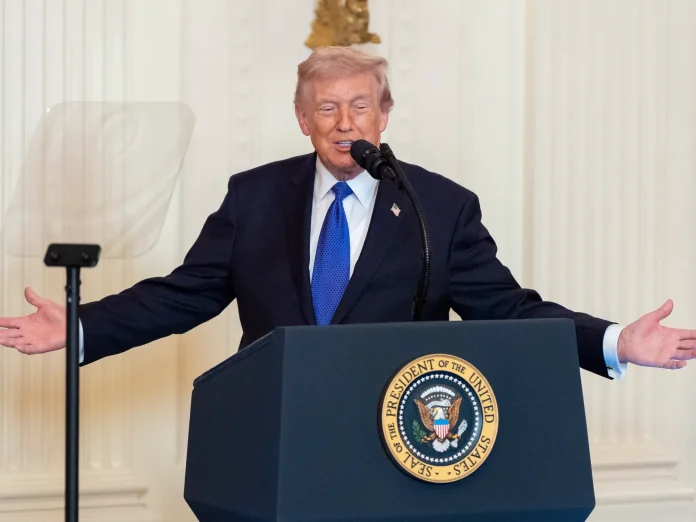
Speaking from the White House during a Medal of Honor ceremony in the East Room — where construction noise from a nearby ballroom renovation was audible throughout — Trump made his most extensive public remarks yet on the war, laying out four explicit objectives: destroying Iran’s ballistic missile capabilities, annihilating its navy, preventing Tehran from developing nuclear weapons, and cutting off Iranian support for militant proxy groups across the region.
‘We are already substantially ahead of our time projections,’ Trump said, noting that military planners had originally estimated the campaign would take four to five weeks. He added that the US military possessed the capacity to sustain operations ‘far longer than that’ if necessary.
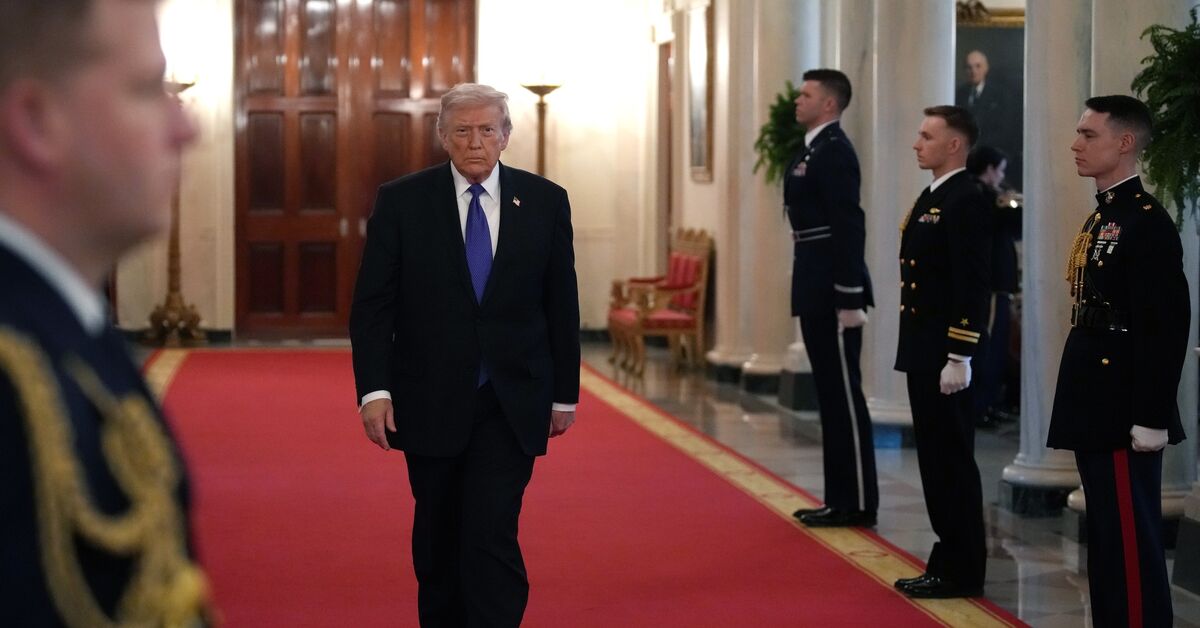
The intervention, which began Saturday, has already produced one of its most dramatic outcomes: the confirmed deaths of Supreme Leader Ayatollah Ali Khamenei and the head of Iran’s Islamic Revolutionary Guard Corps (IRGC) in joint US-Israeli strikes. Trump had previously stated that planners projected roughly four weeks to eliminate Iran’s military leadership — a target the president now claims has been substantially met.
The human cost of the conflict is spreading rapidly across the region. At least 555 people have been killed in Iran. Thirteen deaths were recorded in Lebanon, ten in Israel, three in the United Arab Emirates, and two in Iraq. Oman, Bahrain, and Kuwait each reported a single fatality linked to Iranian retaliatory strikes. The Pentagon confirmed the deaths of three US service members on Sunday, with a fourth confirmed dead on Monday.
Trump framed the military action as a necessary pre-emption of an existential threat, arguing that Iran’s ballistic missile programme was ‘growing rapidly and dramatically’ and posed ‘a very clear, colossal threat to America and our forces stationed overseas.’ He claimed Iran already possessed missiles capable of striking Europe and US military bases in the region, and asserted that Tehran ‘would soon have had missiles capable of reaching our beautiful America.’
Those claims drew immediate pushback from national security experts, who disputed the characterisation of an imminent Iranian missile threat to the continental United States. US government officials have not publicly presented evidence to substantiate the assertion of an immediate threat sufficient to justify Saturday’s attack.
Trump also revisited longstanding grievances over the 2015 Iran nuclear agreement, which he described as ‘a horrible, horrible, dangerous document,’ claiming Iran would have possessed nuclear weapons three years ago had the deal remained in force. He took credit for withdrawing from the accord during his first term, framing Monday’s military action as the culmination of a years-long effort to neutralise Iranian nuclear ambitions. He also cited Iran’s history of targeting American personnel, including through the use of roadside bombs.
Pentagon chief Pete Hegseth sought to draw a sharp distinction between the current operation and the prolonged conflicts in Iraq and Afghanistan. ‘This operation is not like Iraq,’ Hegseth said. ‘It is not endless.’ His remarks appeared designed to address concerns among Trump’s political base, given that the president campaigned explicitly on ending US military interventionism and redirecting resources toward domestic priorities.
The operation has the tacit backing of Israeli Prime Minister Benjamin Netanyahu, who has long advocated for the dismantling of Iran’s government. Trump noted that other nations had also expressed support for efforts to prevent Iran from acquiring nuclear weapons, though he did not name specific allies.
The confluence of the war’s early developments — the killing of Iran’s supreme leader, the rapid pace of operations, and the mounting casualties on all sides — has transformed a conflict that began Saturday into one of the most consequential US military engagements in decades. Whether the campaign remains within its projected timeline, or expands into the prolonged operation Trump himself acknowledged as possible, will define the next phase of an already volatile regional crisis.
Four American service members have now paid the ultimate price in the opening days of the fight. Their deaths underscore that whatever the strategic calculus driving the intervention, its human consequences are already being felt on both sides of the conflict.