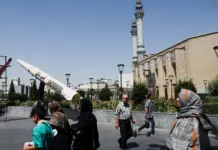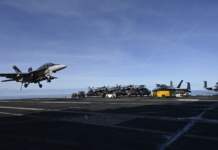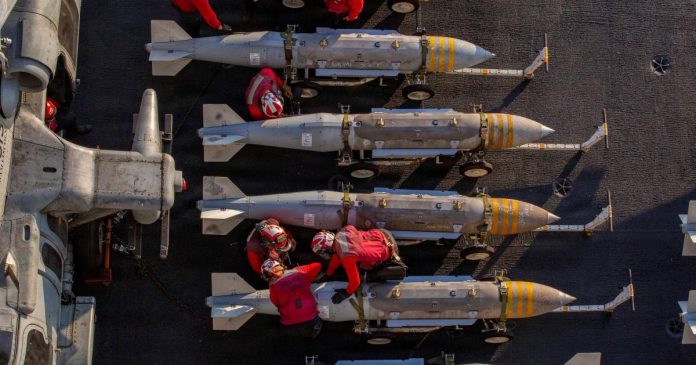
Bombs began falling on Iran even as diplomats from Washington and Tehran remained at the negotiating table — a sequence of events that encapsulates a fundamental shift in how the United States wages war. The Trump administration launched strikes against Iranian territory in 2026 without a congressional vote, without a public ultimatum, and without articulating a specific military objective before the first munitions were dropped.
The operation has no ground component and no identifiable domestic allies inside Iran, distinguishing it sharply from previous American military campaigns. In his State of the Union address, President Trump devoted only a few sentences to the conflict, stating the goal was ‘to defend the American people by eliminating imminent threats from the Iranian regime.’ On social media, he framed the bombing in sweeping terms, writing that it aimed at achieving ‘PEACE THROUGHOUT THE MIDDLE EAST AND, INDEED, THE WORLD!‘
Those stated objectives sit uneasily alongside the facts on the ground. At the time of the strikes, Tehran was neither enriching uranium nor in possession of ballistic missiles capable of reaching the United States. Trump separately indicated that regime change in Iran was a goal, with plans to negotiate with whatever leadership might follow. In 2025, he had already boasted about obliterating Iran’s nuclear facilities at Fordow and Natanz; in 2026, the danger of Tehran acquiring a nuclear weapon was cited as the formal justification for renewed strikes.

The contrast with established American doctrine for the use of force is stark. The Powell Doctrine, developed by General Colin Powell during the Gulf War of 1990–91 and later refined during his tenure as Secretary of State, established that military force should be employed only as a last resort, after all nonviolent options have been exhausted. It demanded clear objectives, defined exit strategies, and demonstrated public support — principles themselves derived from the painful lessons of Vietnam. Defense Secretary Caspar Weinberger had laid similar groundwork in the 1980s, and Powell built upon that foundation into a coherent framework that shaped American military thinking for a generation.
That framework has been progressively eroded. The Clinton administration’s interventions in Somalia, Haiti, and the former Yugoslavia tested its boundaries. The invasions of Afghanistan in 2001 and Iraq in 2003 under President George W. Bush at least attempted to apply Powell’s criteria: Afghanistan combined a lean ground presence with airpower and support for the Northern Alliance, which entered Kabul and overthrew the Taliban; Iraq deployed 160,000 troops in a conventional ground invasion to topple the regime. Both campaigns, whatever their failures, were preceded by public debate and congressional authorisation.
Under Trump, the architecture of deliberation has been stripped away entirely. Missile strikes against Bashar al-Assad‘s regime in Syria in 2017 and 2018 were launched in response to chemical weapons attacks on Syrian civilians — yet Assad used chemical weapons again the following year, illustrating the limits of punitive airpower without a coherent strategy. A U.S. raid killed ISIS leader Abu Bakr al-Baghdadi. In January 2020, American forces killed Iranian General Qasem Soleimani without any public ultimatum. Trump launched a bombing campaign against the Houthis in Yemen, which ended after roughly a month when his administration cut a deal to halt their attacks. He struck militants in northern Nigeria. His administration invaded Venezuela in an effort to remove President Nicolás Maduro — Maduro is now gone, though his regime remains intact.
Not one of these conflicts was preceded by a campaign to build public support. Congress has not voted to authorise a single one. No ultimatums were issued to Soleimani, to Maduro, or now to Tehran. The pattern reveals a coherent, if undeclared, military philosophy: short, sharp actions employing airpower and special operations forces, almost always excluding conventional ground troops, executed without the institutional checks that once governed American decisions to go to war.
The Iran operation represents the most ambitious application of this approach yet — and the most legally and strategically ambiguous. Negotiations were actively underway when the strikes began, a timeline that inverts the Powell Doctrine’s requirement that force be a last resort. The absence of domestic Iranian allies and any ground component leaves the endgame undefined. Regime change through airpower alone has no modern precedent of success.
The broader consequences of dismantling the deliberative framework built after Vietnam extend beyond any single conflict. When force becomes a first resort rather than a last, when objectives shift from operational clarity to aspirational slogans, and when the constitutional requirement of congressional authorisation is treated as optional, the institutional guardrails that once constrained American military power cease to function. The bombs falling on Iran are the latest, and perhaps most consequential, test of what remains when those guardrails are gone.