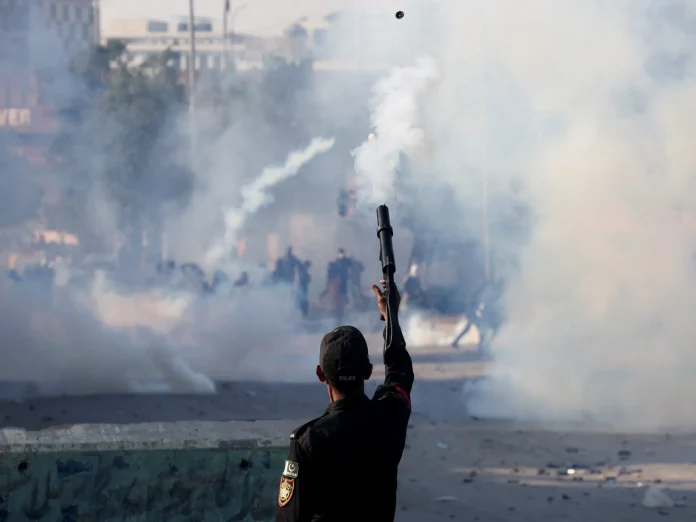
At least 20 people were killed and dozens more injured across Pakistan on Sunday as mass protests erupted in response to the confirmed deaths of Ayatollah Ali Khamenei, Iran’s supreme leader, in coordinated air strikes carried out by the United States and Israel on Tehran. The demonstrations, driven largely by Pakistan’s substantial Shia Muslim population, turned deadly in multiple cities, overwhelming security forces and prompting emergency curfews.
The bloodiest single incident unfolded in Karachi, where at least 10 people were killed and 60 wounded as protesters converged on the US consulate. Police surgeon Summaiya Syed confirmed the casualty figures as clashes intensified after demonstrators attempted to breach security barriers. A group of young men scaled the consulate’s outer gate and smashed windows inside the main building before security forces intervened with tear gas and rubber bullets. Sindh Chief Minister Murad Ali Shah ordered an impartial investigation into the violence.
In the northern city of Skardu, at least eight people died after protesters set fire to offices of the United Nations Military Observer Group in India and Pakistan, along with other government and international facilities. Authorities imposed a three-day curfew in the city in an effort to restore order.
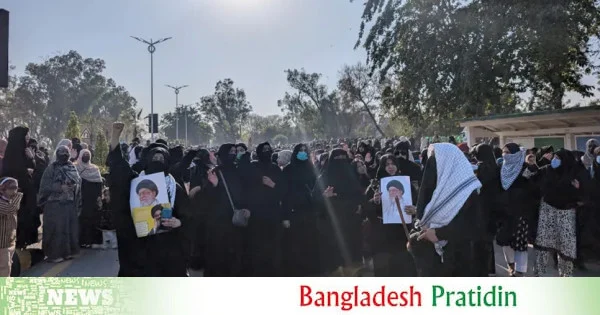
The capital, Islamabad, saw some of the most dramatic scenes as between 5,000 and 8,000 demonstrators assembled near one of the city’s largest hotels, chanting slogans against the United States and Israel and carrying placards bearing Khamenei’s image. Crowds attempted to march toward the Red Zone — the fortified district housing parliament, key government ministries, and the US Embassy — before security forces sealed approach roads and deployed tear gas and rubber bullets to push them back. Two people were killed in the capital. Islamabad’s Poly Clinic, a government-run hospital, received at least two bodies and treated more than 35 injured.
Interior Minister Mohsin Naqvi toured affected areas of Islamabad to assess the security situation, ordering reinforcements around the diplomatic enclave. He urged citizens to remain calm and refrain from taking the law into their own hands. The US Embassy issued an advisory warning American citizens to avoid large gatherings throughout the country.
Protests also took place in Lahore, outside the US Embassy, as well as in Peshawar, Multan, and Faisalabad, though no fatalities were immediately reported in those cities.
The scale of the unrest reflects deep religious and geopolitical sensitivities within a country of more than 250 million people, where Shia Muslims constitute over 20 percent of the population. Pakistan shares a border of more than 900 kilometres with Iran and has never recognised Israel, long advocating for a two-state solution to the Israeli-Palestinian conflict.
Prime Minister Shehbaz Sharif expressed grief and sorrow over Khamenei’s death on social media, condemning what he described as a violation of international norms regarding the targeting of heads of state. Deputy Prime Minister and Foreign Minister Ishaq Dar spoke directly with Iranian Foreign Minister Seyed Abbas Araghchi following the strikes. Pakistan’s Foreign Ministry stated that Dar strongly condemned the attacks and called for an immediate halt to escalation through diplomatic channels.
The violence drew immediate historical comparisons. In November 1979, a mob stormed and burned the US Embassy in Islamabad, killing two Americans and two Pakistani staff members — an episode that underscored how regional conflicts can rapidly translate into domestic upheaval in Pakistan. Sunday’s unrest, while not reaching that scale in the capital, demonstrated the continued volatility surrounding US and Israeli actions in the Muslim world.
With a curfew in place in Skardu, reinforced security around Islamabad’s diplomatic quarter, and investigations under way in Karachi, Pakistani authorities face the dual challenge of containing further violence while managing a diplomatic crisis triggered by events far beyond their borders. The full political and security consequences of the strikes on Tehran — and their reverberations across a nuclear-armed, deeply divided nation — are only beginning to emerge.