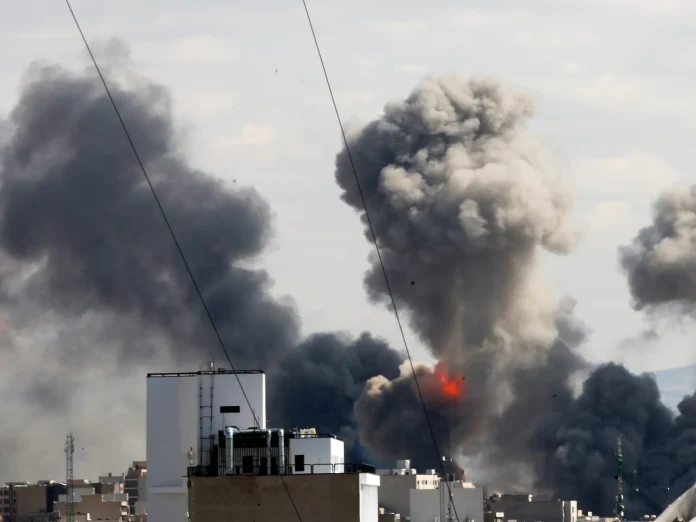
Tehran — Iran’s supreme leader, Ayatollah Ali Khamenei, was killed Saturday when the United States and Israel launched coordinated air strikes on Tehran and other Iranian cities, triggering the most severe political and military crisis the Islamic Republic has faced since its founding in 1979. Khamenei, who had governed Iran for 36 years, was among a sweeping list of senior officials and commanders killed in the assault.
The strikes, which continued into Sunday across multiple Tehran neighbourhoods, targeted military infrastructure, according to the Israeli army. Iranian authorities have largely avoided public comment on the extent of missile impacts, while internet connectivity across the country remained almost entirely severed for a second consecutive day, severely limiting the flow of information.
The human toll extended far beyond the country’s leadership. More than 150 people — many of them children — were killed when a school in the southern city of Minab was struck. In eastern Tehran’s Narmak neighbourhood, at least two children died in a separate school strike, adding a devastating civilian dimension to what Iranian officials have characterised as an act of war.
Among the military figures killed alongside Khamenei were Mohammad Pakpour, commander-in-chief of the Islamic Revolutionary Guard Corps (IRGC), who had been appointed to the role less than a year ago following the assassination of his predecessor; Abdolrahim Mousavi, chief of staff of Iran’s armed forces; Ali Shamkhani, head of the Defence Council; and Gholam-Reza Rezaeian, the police intelligence chief. The simultaneous elimination of so many senior figures represents an unprecedented blow to Iran’s command structure.
Iran moved swiftly to project continuity. President Masoud Pezeshkian announced the formation of a three-member governing council, declaring that it ‘has begun its work.’ The council includes Pezeshkian himself, judiciary chief Gholam-Hossein Mohseni-Ejei, and Ayatollah Alireza Arafi, a clerical member of the Guardian Council, whose appointment was confirmed Sunday. Foreign Minister Abbas Araghchi stated the process of selecting a permanent supreme leader should be concluded within days, with the task constitutionally assigned to the Assembly of Experts, the clerical body created after the 1979 Islamic Revolution for precisely this purpose.
The government declared seven days of public holidays and 40 days of national mourning for Khamenei. Hassan Khomeini, grandchild of founding Supreme Leader Ayatollah Ruhollah Khomeini, offered public praise for the slain leader, underscoring the symbolic weight of the moment for the Islamic Republic’s founding ideology.
Despite the catastrophic losses, Iran’s military and security apparatus signalled defiance. The IRGC vowed revenge and announced what it described as ‘the heaviest offensive operations in the history of the armed forces of the Islamic Republic,’ with the Iranian army claiming its fighter jets had completed bombing runs against US bases across the region. Army chief Amir Hatami pledged to continue defending the country, while police chief Ahmad-Reza Radan declared his forces ready to fight for ‘public safety.’
Security chief Ali Larijani drew a pointed distinction in his public remarks, stating that Tehran has no desire to strike neighbouring countries but regards US military bases on their soil as ‘American territory’ — a formulation that signals Iran’s intent to hold Washington directly accountable while seeking to avoid a broader regional conflagration involving Arab neighbours.
The strikes mark a dramatic escalation in the long-running confrontation between Iran and the US-Israeli alliance, transforming what had been a shadow war of assassinations, proxy conflicts, and sanctions into an open military campaign targeting the Islamic Republic’s highest echelons of power. The full scope of the strikes, the international response, and the identity of Iran’s next supreme leader will shape the trajectory of one of the most volatile geopolitical crises in decades.