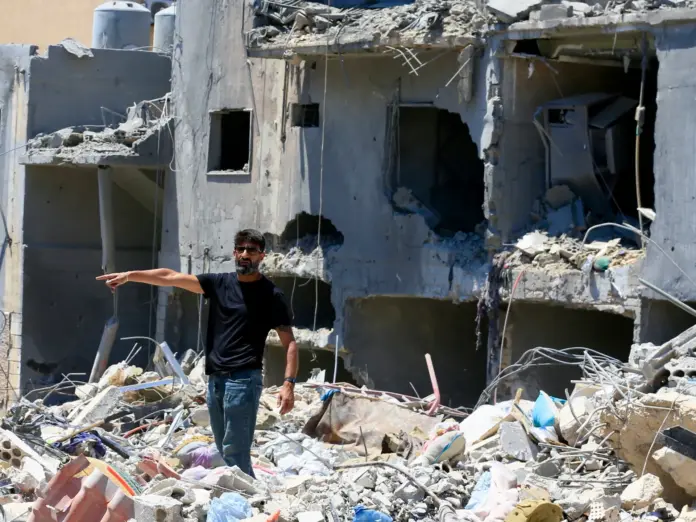
Southern Lebanon — Israeli forces pressed ahead with air strikes across southern Lebanon and ordered the immediate evacuation of 20 towns and villages, defying a United States-brokered ceasefire and complicating diplomatic efforts to broker a broader regional settlement involving Washington and Tehran.
Israel Strikes Lebanon — One person was killed when an Israeli air raid struck the municipality of Maarakeh in the Tyre district of southern Lebanon. Lebanon’s National News Agency confirmed the death. The strikes continued through Friday and into the evening, targeting towns and villages situated north of the Israeli-designated ‘Yellow Line’ — a boundary Israel has unilaterally drawn across Lebanese territory.
At dawn, Israeli attacks demolished homes and government buildings in Bint Jbeil, one of southern Lebanon’s most prominent towns. The Israeli military subsequently ordered residents of 20 named communities to relocate immediately, instructing civilians to move north of the Zahrani River. The affected towns include Deir al-Zahrani, al-Namirieh, al-Sharquieh, al-Dewayr, Harouf, Habboush, Kfarjoz, Zibdine, Nabatieh al-Tahta, Nabatieh al-Fawqa, Kfar Rouman, Al-Mahmoudieh, Sajed, Reihan, Aaramta, Kfarchouba, Mlki, Al-Lawiza, Jarjouh and Arab Salim.
Recommended Reading
On Saturday, an air raid alert was activated in the northern Israeli town of Metula. The Israeli military attributed the alert to what it described as the ‘infiltration of a hostile aircraft’ from Lebanese territory, though it stopped short of naming Hezbollah in its statement.
The sustained military activity stands in direct tension with a ceasefire agreed earlier this month between Israeli and Lebanese officials, which mandated a ‘complete cessation’ of fire by Hezbollah. Israeli leaders have made clear they do not intend to withdraw from Lebanese soil, and the next scheduled round of talks between Israel and Lebanon is not expected until June 22.
The strikes also arrive at a delicate diplomatic moment. Pakistani Prime Minister Shehbaz Sharif announced Friday that the United States and Iran had agreed on the wording of a deal aimed at ending their conflict. Iranian media reported that the initial agreement would declare an end to the war ‘on all fronts, including Lebanon.’ Mediators continued working with both sides to finalise the arrangement following the announcement.
Critically, Israel is not a party to those negotiations. The exclusion raises immediate questions about whether any US-Iran framework can translate into a durable halt to Israeli military operations in Lebanon, particularly given Jerusalem’s stated position on remaining in Lebanese territory. The gap between the emerging diplomatic architecture and conditions on the ground is stark: even as Washington and Tehran moved toward a textual agreement, Israeli jets were demolishing buildings and forcing tens of thousands of Lebanese civilians from their homes.
Israel Strikes Lebanon: Regional Implications
The situation underscores the fragmented nature of the current conflict landscape. A ceasefire exists on paper between Israel and Lebanon, a separate diplomatic track is advancing between the United States and Iran, and yet Israeli military operations continue at a pace and scale that renders both frameworks effectively inoperative for the communities bearing the brunt of the strikes.
Southern Lebanon has endured sustained Israeli military pressure since the broader regional conflict escalated. The destruction of government buildings alongside residential structures in Bint Jbeil signals an intent to degrade civilian infrastructure, not merely military targets. For the residents of the 20 communities now under evacuation orders, the immediate reality is displacement — regardless of what is agreed in diplomatic corridors far from the Zahrani River.