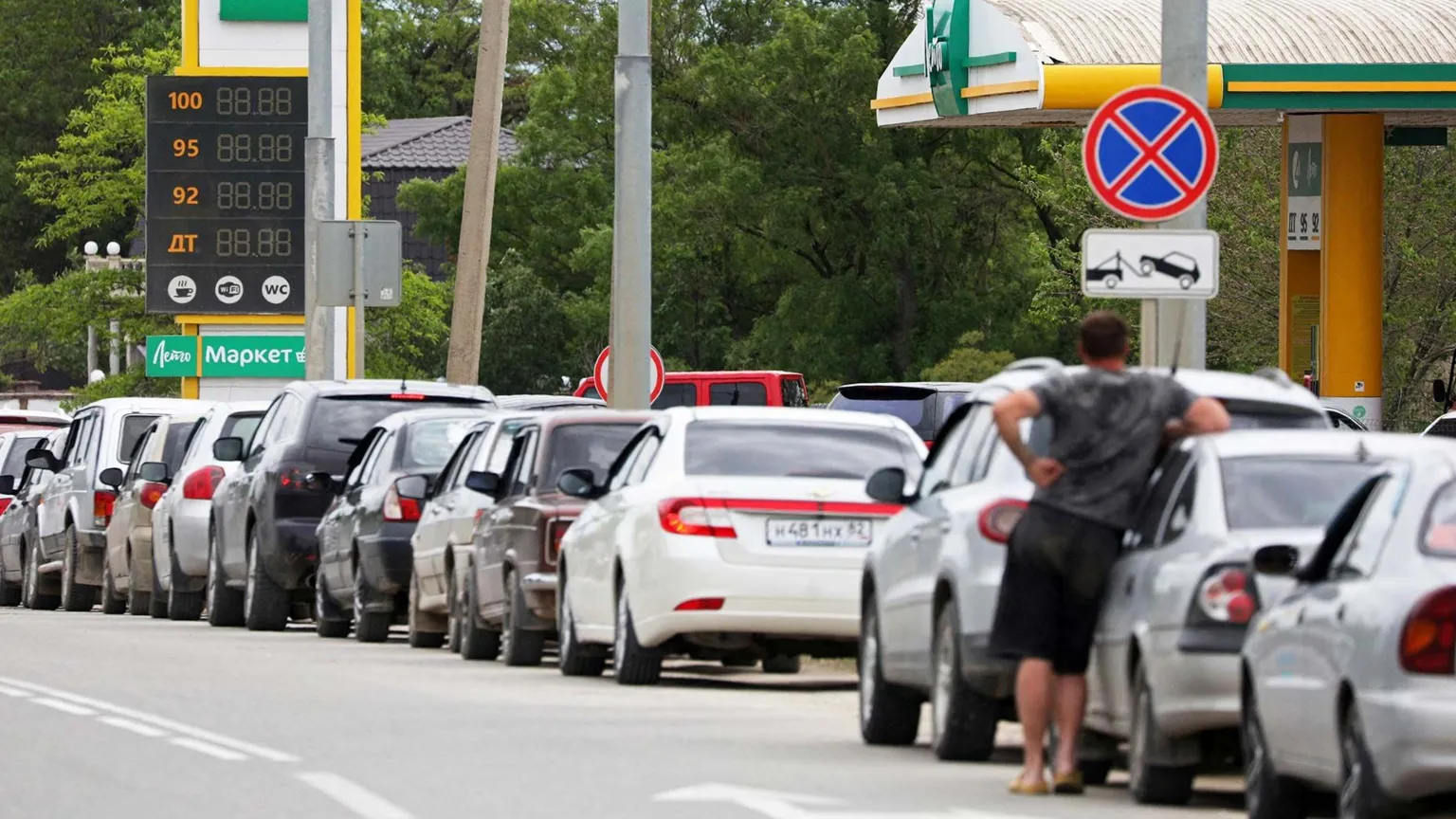
Ukraine Drone Campaign — A relentless Ukrainian drone campaign is strangling the fuel lifeline into Russian-occupied Crimea, forcing residents to queue for up to ten hours at petrol stations and prompting Moscow’s energy ministry to establish an emergency headquarters to manage what it acknowledged on 8 June as serious supply disruptions across southern Russia.
Since the start of May, Ukrainian forces have conducted 300 drone strikes on trucks travelling supply routes into Crimea, destroying 30 tankers among them. The campaign has concentrated on the key motorway and bridge corridor running from Rostov through Mariupol and into the occupied peninsula — a route that has become Moscow’s primary overland artery since previous Ukrainian strikes severely restricted traffic on the Kerch bridge connecting Crimea to mainland Russia.
The results have been dramatic. Robert Brovdi, Ukraine’s drone forces commander, said military cargo traffic along the route dropped by 71% between late May and early June. On the ground in Crimea, the consequences are visible at every fuel station: local residents are limited to purchasing no more than 20 litres each using prepaid vouchers, and shortages have cascaded into public transport. Sergei Aksyonov, the Kremlin-appointed regional head of Crimea, conceded on 5 June that it was impossible to fully satisfy fuel demand, and warned that hundreds of buses would not be leaving depots because of the crisis.
Recommended Reading
The strikes have also severed alternative supply options. Several ferries serving Crimea have been taken out of action by Ukrainian attacks, while the 413th separate battalion ‘Raid’ of Ukraine’s Unmanned Systems Forces — commanded by Yevhen Karas — carried out drone strikes on the strategically vital Chonhar bridge in northern Crimea on two consecutive nights, 6–7 June and 8–9 June, suspending all traffic across the crossing. The ripple effects have spread beyond Crimea: Moscow-installed authorities in occupied Luhansk banned bus and coach services on two motorways leading toward Mariupol and Crimea, urging residents to avoid those roads entirely for what they described as security reasons. Drone attacks have similarly disrupted occupied regions including Kherson.
Russia has also reported a Ukrainian drone striking a passenger train in Crimea, killing the assistant driver and injuring the driver — an indication of how broadly the campaign is affecting civilian and military infrastructure alike.
Clément Molin, an analyst at the French-based think tank Atum Mundi, has noted that the drone offensive represents a significant evolution in Ukraine’s ability to project sustained pressure deep into occupied territory without committing ground forces. The campaign exploits Russia’s dependence on a narrow set of supply corridors, corridors that have become increasingly difficult to protect against low-cost, high-volume drone attacks.
The broader strategic picture is equally striking. President Volodymyr Zelensky stated that Ukrainian strikes disabled nearly 40% of Russia’s primary oil refining capacity during May alone — a figure that, if sustained, would compound the logistical difficulties already visible in Crimea. Craig Kennedy, an expert in Russia’s oil industry and associate at Harvard University’s Davis Center, has highlighted how Ukraine’s targeting of refining infrastructure creates compounding pressure on Moscow’s ability to sustain military operations across a vast front.
Ukraine Drone Campaign: The Wider European Impact
Russia illegally annexed Crimea in 2014, and the peninsula has since served as a critical staging ground for Moscow’s broader war against Ukraine. Its geographic position — connected to mainland Russia primarily via the Kerch bridge and to occupied southern Ukraine via the Mariupol corridor — makes it acutely vulnerable to the kind of sustained interdiction campaign Ukraine is now waging.
The fuel crisis unfolding across Crimea underscores a central tension in Russia’s occupation: maintaining civilian normalcy while simultaneously sustaining a major military operation across hundreds of kilometres of contested territory. With ferry links disrupted, bridge crossings suspended, and overland truck convoys under constant aerial threat, Moscow’s ability to manage both demands simultaneously is being tested as never before.
Ukraine’s drone forces show no sign of easing the pressure. The 413th battalion’s operations, combined with the broader campaign coordinated through Brovdi’s command, suggest Kyiv views the interdiction of Crimean supply lines as one of its most effective tools for degrading Russian military capacity without the prohibitive cost of conventional ground offensives in heavily fortified terrain.