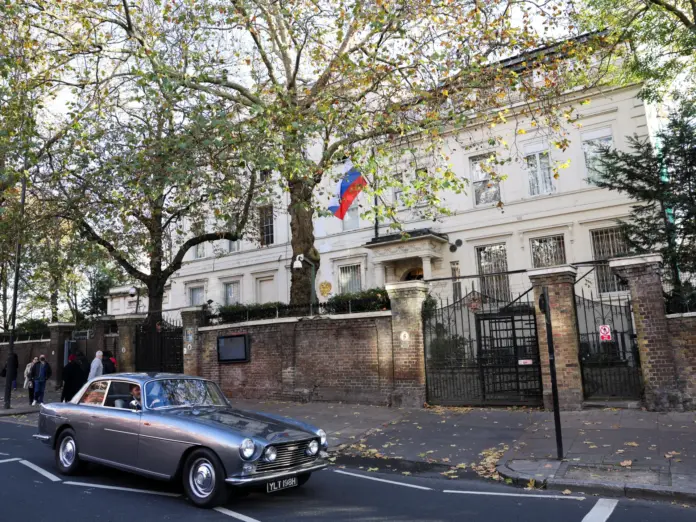
The United Kingdom has expelled a Russian diplomat, revoking the individual’s accreditation in a direct response to Moscow’s earlier removal of a British embassy employee it accused of spying. The British government informed Russia’s ambassador on Wednesday of the decision, describing the original Russian expulsion as wholly unjustified and part of a broader pattern of hostile behaviour.
Russia’s Federal Security Service had ordered the British official to leave the country in March, alleging the employee had attempted to gather intelligence on Russia’s economy. London flatly denied the accusation. A UK government spokesperson condemned what officials characterised as a ‘malicious public smear campaign’ targeting its diplomatic staff, stating: ‘This behaviour is wholly unacceptable, and we will not tolerate harassment or intimidation of our diplomatic staff.’
Moscow had not issued any immediate public response to the British expulsion. The tit-for-tat exchange is the latest episode in a prolonged deterioration of relations between the two countries, a process that accelerated sharply four years ago when Russia launched its full-scale invasion of Ukraine. Since then, both governments have expelled multiple diplomats from each other’s missions in a series of escalating confrontations.
The diplomatic rupture is unfolding against a backdrop of wider security concerns. UK Defence Secretary John Healey revealed that British forces had intercepted a Russian mission operating in the North Atlantic, which appeared to be monitoring vital undersea infrastructure. Healey confirmed there was no evidence that any UK undersea assets had been physically damaged, but the incident underscored the vulnerability of critical communications networks.
The stakes are considerable. An estimated 60 undersea cables carry the vast majority of the United Kingdom’s internet traffic, forming the backbone of the country’s digital connectivity to the rest of the world. Any disruption to that network would carry significant economic and security consequences. Russia has repeatedly denied any involvement in targeting such infrastructure.
The expulsion of diplomats and the surveillance of undersea cables reflect a broader contest between London and Moscow that has intensified since the Ukraine invasion. Britain has been among the most vocal and active supporters of Kyiv, supplying weapons, training, and financial assistance throughout the conflict. Russia has responded with a range of measures, including the harassment of British officials and what Western governments describe as a sustained campaign of hybrid warfare across Europe.
The naming of the expelled Russian diplomat was withheld by the British government, consistent with standard diplomatic practice in such cases. The move nonetheless carries symbolic and practical weight, signalling that London intends to respond in kind to what it views as provocations rather than absorb them without consequence.
Analysts note that the cycle of expulsions, while damaging to bilateral relations, has become a familiar instrument of statecraft between Russia and Western nations since 2022. The United Kingdom, along with its European allies and the United States, has collectively expelled dozens of Russian diplomats — many identified as intelligence operatives — in coordinated actions tied to specific incidents, including the poisoning of Sergei Skripal in Salisbury in 2018 and subsequent hostile acts attributed to Russian state actors.
With no diplomatic resolution to the Ukraine conflict in sight and tensions over undersea infrastructure rising, the relationship between Britain and Russia shows little prospect of stabilisation in the near term. Wednesday’s expulsion is unlikely to be the last such exchange.