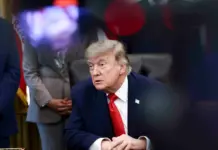
TEHRAN / WASHINGTON, April 3, 2026 — President Donald Trump issued a stark escalatory warning on Friday, declaring that the United States military had ‘not even started’ dismantling Iran’s remaining infrastructure, even as diplomatic signals emerged that could offer a path toward de-escalation after five weeks of devastating conflict.
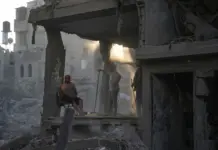
The warning came hours after US and Israeli forces struck Iran’s largest bridge near Tehran — a structure Washington says was used to transport materials for Iranian military drones, though Tehran insists it was purely civilian infrastructure. The same wave of strikes hit the Pasteur Institute, a century-old medical research centre in downtown Tehran that produced vaccines including those for COVID-19. Iran’s Foreign Ministry says more than 600 schools and education centres have been struck since hostilities began on February 28.
The human toll continues to mount. At least 2,076 people have been killed in Iran since the start of US-Israeli operations, with more than 26,500 wounded. American forces have also suffered losses: 13 service members killed in combat, two in non-combat incidents, and more than 200 injured.
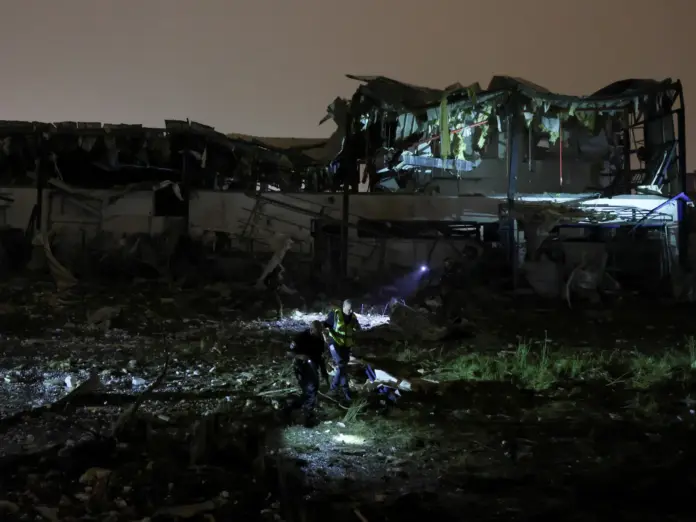
![People walk near a cordoned-off area, as members of the Iranian Red Crescent Society work at the site of a reported strike, amid the US-Israeli war on Iran [Reuters]](https://world-tension.s3.us-east-2.amazonaws.com/articles/351/4f76a6b15ce24e7a92339d595b52f6d4.webp)
Against this backdrop of intensifying violence, a potential diplomatic opening emerged. Iran is in active talks with Oman to jointly manage the Strait of Hormuz and draft a formal protocol governing the waterway, which carries roughly 20 percent of the world’s oil and liquefied natural gas in peacetime. Asian markets responded cautiously but positively to the news — South Korea’s KOSPI rose approximately 3 percent and Japan’s Nikkei 225 gained around 1 percent on Friday.
Iran’s former Foreign Minister Javad Zarif went further, publicly calling on Tehran to declare victory and end the war. Zarif proposed that Iran offer to place limits on its nuclear programme and reopen the Strait of Hormuz in exchange for the lifting of all sanctions, and suggested Tehran should be prepared to accept a mutual non-aggression pact with the United States. Iran’s current Foreign Minister Abbas Araghchi, meanwhile, warned against any ‘provocative action’ ahead of a United Nations Security Council vote on the Strait, which was postponed from Friday to Saturday.
The Strait’s closure has inflicted severe economic damage globally. Brent crude oil surged approximately 8 percent on Friday, topping $109 a barrel — a near-50 percent increase since the war began. Before February 28, roughly 130 vessels transited the Strait daily; that figure collapsed to near zero before edging back up to 16 transits on Wednesday, the third consecutive daily rise. The Philippines secured a diplomatic concession, with Iran designating it a ‘non-hostile’ state and granting its ships safe passage through the waterway.
Australian Foreign Minister Penny Wong condemned Iran’s closure of the Strait as ‘deliberately inflicting economic pain’ on the world. The United Kingdom convened a virtual meeting of 40 nations to coordinate a response to the blockage, though the United States declined to participate in those talks. Pakistan has been among the hardest-hit nations outside the immediate conflict zone, shifting from an LNG surplus to a shortage, with demand falling from a peak of 8.2 million tonnes in 2021 to 6.1 million tonnes by late 2025.
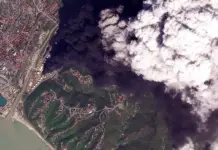
Iranian retaliatory strikes spread across the Gulf on Friday. Iran announced attacks on US-owned steel plants in the United Arab Emirates and an arms factory in Israel. The UAE said its air defences were actively battling a wave of incoming missiles and drones. A Bangladeshi farmworker was killed by falling shrapnel in the UAE. In Kuwait, a drone strike on an oil refinery in Al Ahmadi operated by Kuwait Petroleum Corporation ignited fires in operational units, though no employees were reported injured; emergency services also extinguished a separate fire at Kuwait’s airport. Saudi Arabia’s Ministry of Defence reported intercepting and destroying six drones, and warning sirens sounded multiple times in Bahrain, with residents ordered to seek shelter.
Iran’s Islamic Revolutionary Guard Corps claimed it shot down a second American F-35 fighter jet over central Iran, a claim that could not be independently verified. The USS Gerald R. Ford departed Croatia after a five-day port call, returning to operational deployment.
On the US domestic front, Defense Secretary Pete Hegseth dismissed Army Chief of Staff General Randy George on Thursday, effective immediately. General David Hodne and Major-General William Green Jr. were also removed. The firings signal continued turbulence within the US military’s senior leadership during an active multi-front conflict.
A survey of Iranian Americans found that more than 66 percent oppose the US-Israeli war on Iran, while 32.7 percent express support — a domestic political dimension that adds complexity to any future negotiating posture in Washington.
With Trump threatening further destruction, Iran striking targets across the Gulf, and oil markets in turmoil, the Iran-Oman diplomatic channel represents the most concrete prospect yet for halting a conflict that has reshaped global energy markets and drawn in nations far beyond the immediate theatre of war.