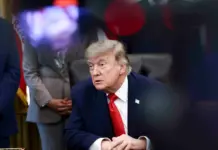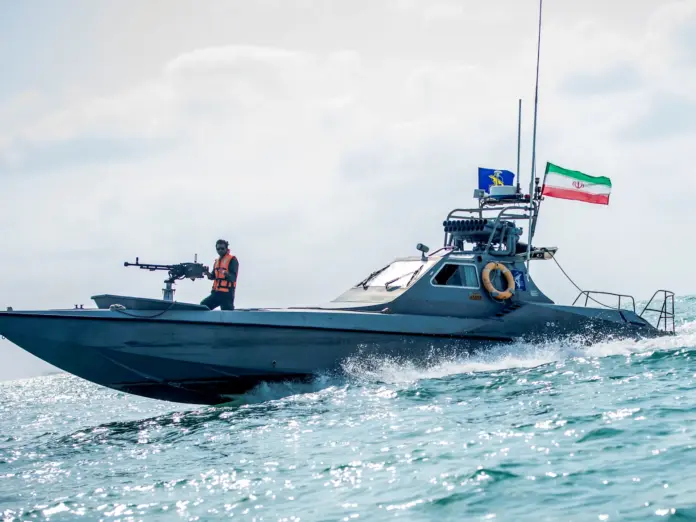
STRAIT OF HORMUZ — President Donald Trump has directed the United States Navy to shoot and kill any Iranian vessel caught laying mines in the Strait of Hormuz, dramatically raising the stakes in a maritime standoff that has already disrupted global energy markets and reshaped the balance of power in the Persian Gulf.
Trump simultaneously ordered US minesweepers to operate at triple their normal capacity to clear the strategic waterway, and declared that Washington holds ‘total control over the Strait of Hormuz’, describing it as ‘sealed up tight.’ He also claimed that 159 Iranian naval vessels now sit at the bottom of the sea — a figure the Pentagon has not independently confirmed.
The confrontation has its roots in Iran’s decision to close the strait in retaliation for a joint US-Israeli military campaign that killed Supreme Leader Ali Khamenei and several senior Iranian officials. Before the conflict erupted, the strait carried roughly 20 percent of the world’s oil and natural gas, making its closure a seismic event for global energy supply. American consumers felt the impact almost immediately: the price of a gallon of petrol in the United States climbed past $4, up from approximately $3 before hostilities began.
A two-week ceasefire between Washington and Tehran came into effect last month, and Trump extended it this week ahead of its Wednesday expiration. Iran had agreed to reopen the strait after Lebanon was included in the truce terms — a concession that Tehran framed as a diplomatic achievement. Yet Washington maintained its naval blockade on Iran-linked shipping throughout the ceasefire period, a move Iran’s leadership has condemned as a violation of the spirit of the agreement.
The Pentagon conducted what it described as a ‘maritime interdiction and right-of-visit’ operation against a tanker carrying Iranian oil in the Indian Ocean on Thursday. Earlier in the week, US forces seized an Iranian vessel outright and ordered dozens of additional ships to reverse course. Iran, in turn, captured several foreign commercial vessels near the Hormuz Strait, alleging they had violated naval regulations.
The White House confirmed on Wednesday that Trump is ‘satisfied’ with the siege on Iran. Tehran has set the lifting of the US blockade as a precondition for resuming any formal negotiations — a demand Washington has so far refused to meet.
Iran’s political landscape has been thrown into turmoil by the strikes. Mojtaba Khamenei, son of the slain Supreme Leader, was elevated to replace his father last month, but the Pentagon has confirmed he was wounded in US attacks. He has made no public appearance since assuming the role, fuelling uncertainty about who is effectively governing the country. Trump has characterised Iranian leadership as split between hardliners and moderates, a framing that Tehran’s surviving officials have pushed back against.
Foreign Minister Abbas Araghchi and Parliament Speaker Mohammad Bagher Ghalibaf have presented a unified public front, jointly rejecting the US blockade and insisting Iran honoured its ceasefire commitments. Iran’s Foreign Ministry also used Thursday to publicly praise the Islamic Revolutionary Guard Corps on the anniversary of the IRGC’s founding — a signal, analysts note, that the revolutionary institution retains its central role even amid the leadership vacuum at the top.
The crisis has reverberated far beyond the Gulf. In Australia, Defence Minister Mark Butler acknowledged in a speech at the National Press Club on 22 April that Australians are ‘uneasy’ about cuts to the National Disability Insurance Scheme as the government commits A$53 billion to new defence spending — a budget shift driven in part by the deteriorating security environment in the Middle East and broader Indo-Pacific concerns. The Australian government separately signed a memorandum of understanding with Microsoft, which announced a A$25 billion investment in artificial intelligence infrastructure, security, and skills across the country.
For now, the Strait of Hormuz remains the central flashpoint. The waterway, which had operated without interruption before the war, is now the site of daily confrontations between US naval forces and Iranian vessels. With a wounded and largely invisible new Supreme Leader, a ceasefire holding by the thinnest of margins, and American warships enforcing a blockade that Tehran calls illegal, the conditions for a rapid escalation remain firmly in place.