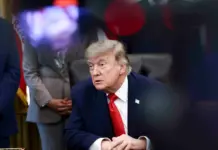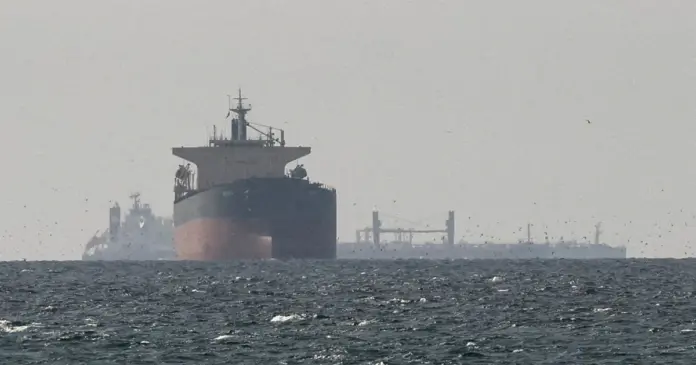
Washington / Strait of Hormuz — President Donald Trump on Monday floated the idea of imposing American-controlled tolls on the Strait of Hormuz, declaring he would rather the United States collect passage fees than allow Iran to profit from ships navigating the critical chokepoint. The proposal came as Iran’s blockade of the waterway — through which roughly 20 percent of the world’s oil and liquefied natural gas once flowed — continues to disrupt global energy markets.
Trump, who has repeatedly claimed the United States is the ‘winner’ of its war with Iran, told reporters he has ‘a concept’ for levying tolls on commercial vessels transiting the strait. He framed the idea as a direct counter to reports that Tehran is already charging fees for ships it selectively permits to pass. ‘I’d rather charge the tolls than let Iran take fees from ships,’ Trump said, without elaborating on a formal mechanism.
The strait, which connects the Persian Gulf to the Indian Ocean, lies predominantly within Omani and Iranian territorial waters — a geographic reality that complicates any unilateral American toll regime. Nevertheless, Trump insisted that any negotiated settlement with Tehran must include the unconditional reopening of the waterway and what he described as ‘free traffic of oil.’
In parallel, Trump issued what he characterised as a ‘final’ ultimatum to the Iranian government, threatening strikes against civilian infrastructure — including bridges and power plants — if Tehran refuses to comply with Washington’s terms. The warning represents a significant escalation in rhetoric even as diplomatic channels remain nominally open.
Despite Trump’s declarations of victory, Iran has sustained drone and missile operations across the region, and its blockade of the strait remains in force. The White House confirmed last week that Trump is also exploring whether Arab nations should contribute financially to offset Washington’s military expenditures in the conflict — a proposal that signals the administration is seeking to distribute the economic burden of the campaign.
Iranian officials have been equally unambiguous about their intentions for the strait’s future. Iranian Parliament Speaker Mohammad Bagher Ghalibaf wrote on X last month that the waterway ‘will not return to its pre-war status,’ a statement that aligns with broader signals from Tehran that it views the crisis as an opportunity to reshape the strait’s governance permanently.
Foreign Minister Abbas Araghchi has gone further, calling for ‘new arrangements’ to manage the Strait of Hormuz in the post-war period. Speaking to Al Jazeera in March, Araghchi argued that a new protocol governing the waterway should be negotiated among the countries bordering both sides of the strait — a formulation that would give Iran, along with Oman and Gulf Arab states, a formal role in determining access rules, potentially sidelining Washington.
The competing visions for the strait’s future underscore the depth of the impasse. Trump envisions an American-administered toll system that would effectively monetise U.S. military dominance in the region. Tehran, by contrast, is pushing for a multilateral framework that would institutionalise its leverage over one of the world’s most strategically vital sea lanes — and potentially legitimise the very fees it is already collecting.
Before the conflict, the Strait of Hormuz served as the transit point for approximately one-fifth of global oil and liquefied natural gas supplies, making its closure one of the most consequential disruptions to energy markets in decades. Prolonged blockage has sent commodity prices surging and placed significant pressure on importing nations across Asia and Europe.
The toll proposal, while still described by Trump as a concept rather than policy, reflects a broader administration instinct to extract tangible economic returns from U.S. military engagements. Whether such a scheme is legally or diplomatically viable — given the strait’s jurisdictional complexity and the interests of Oman, a nation that has historically played a mediating role in U.S.-Iran tensions — remains deeply uncertain. What is clear is that both Washington and Tehran are preparing for a post-war order in which control of the Strait of Hormuz sits at the centre of a new geopolitical contest.