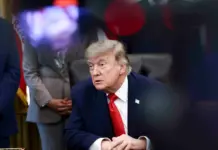
WASHINGTON/BEIRUT — President Donald Trump extended the fragile ceasefire between Israel and Lebanon by three weeks on Thursday, following direct talks at the White House with Israeli and Lebanese envoys, even as fresh violence along the Lebanese border and escalating maritime confrontations in the Strait of Hormuz deepened fears of a broader regional conflagration.
The extension prolongs an agreement that had originally been set for just ten days. Yet within hours of the announcement, the Lebanese health ministry confirmed that an Israeli strike on southern Lebanon had killed three people, and Hezbollah claimed it had fired a rocket salvo at the Israeli settlement of Shtula in retaliation for Israeli strikes on the town of Yater — accusing Israel of violating the ceasefire terms.
Israeli Defence Minister Israel Katz made clear that Jerusalem was not standing down. Israel was prepared to resume full-scale war, he said, and was awaiting a green light from Washington. An Israeli security source separately confirmed that airstrikes were not currently being carried out inside Iran, signalling a deliberate pause rather than a permanent de-escalation.
Trump, for his part, struck a notably restrained tone on the nuclear question, stating for the first time publicly that the United States would not deploy a nuclear weapon against Iran. He also said he could reach a deal with Tehran immediately but was prepared to wait for what he called an "everlasting agreement." Whether that patience holds is increasingly in doubt.
Hormuz on the Brink
The most volatile flashpoint remains the Strait of Hormuz, the narrow waterway through which roughly a fifth of the world's traded oil passes. Trump ordered the US Navy to shoot and destroy any vessel caught laying mines in the strait, and US forces boarded an oil tanker in the region. The USS George H.W. Bush aircraft carrier arrived in the Middle East, bringing the total number of American carriers operating in the region to three — an extraordinary concentration of naval firepower.
Energy markets reacted sharply. Brent crude climbed nearly five percent to $106.80 a barrel by 01:00 GMT, surpassing $100 for the first time in two weeks after reports of vessel captures in the strait. The price spike underscored how quickly the standoff can translate into economic pain far beyond the region.
Senior Iranian officials blamed Washington for the breakdown in nuclear negotiations, pointing specifically to what they described as a US naval blockade of Iranian ports. Former US Ambassador to Bahrain Adam Ereli cautioned that Tehran has demonstrated resilience under economic pressure, arguing the country is prepared for further sanctions and retains the capacity to store or sell oil through alternative channels.
Analyst Hassan Ahmadian offered a sharper reading of American intentions, arguing that the US push in the Strait of Hormuz functions as a strategic cover — a means of repositioning forces for a possible new round of conflict rather than a purely defensive maritime operation.
Tehran Pushes Back
Iran's leadership mounted a unified public front against Trump's characterisation of the country as internally fractured. President Masoud Pezeshkian, parliament speaker Mohammad Bagher Ghalibaf, and judiciary head Gholamhossein Mohseni Ejei all denied Trump's assertions, presenting a rare display of cross-institutional solidarity. Trump had claimed American forces could rapidly neutralise any rebuilt Iranian military capacity, a statement Iranian officials dismissed as bluster.
Pope Leo XIV added an unexpected voice to the crisis, condemning the killing of protesters inside Iran and calling on all parties to exercise restraint — a rare papal intervention in an ongoing geopolitical standoff.
On the diplomatic margins, Secretary of State Marco Rubio confirmed the United States would not bar Iran's national football team from competing in the upcoming World Cup, a small but deliberate signal that Washington is preserving some channels of non-confrontational engagement. Meanwhile, more than a dozen Democratic lawmakers urged the Trump administration to pause deportations of Iranians, warning that nearly 12,000 students and other Iranian nationals face removal.
A Region Holding Its Breath
The convergence of a shaky Lebanon ceasefire, an armed maritime standoff, surging oil prices, and three US carrier groups in close proximity has produced a regional environment that analysts describe as the most combustible since the 2006 Lebanon war. Each individual element — the rocket exchange near Shtula, the tanker boarding, the carrier deployment — might be manageable in isolation. Together, they form a pattern that leaves little margin for miscalculation.
Trump's stated willingness to negotiate a comprehensive deal with Iran sits uneasily alongside his simultaneous authorisation of lethal force against Iranian-linked maritime activity. Whether the three-week Lebanon extension buys meaningful diplomatic space or simply delays the next escalation remains the central question hanging over the Middle East.