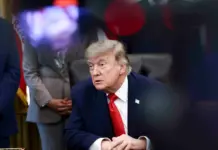
WASHINGTON — President Donald Trump announced an extension of the ceasefire with Iran on Wednesday, offering no timeline for the resumption of diplomatic talks even as a legally mandated deadline for congressional authorisation of military operations draws near.
Under the War Powers Resolution, Trump must secure approval from both chambers of Congress by May 1 to continue any ongoing military deployments against Iran. The 1973 federal law — enacted specifically to curtail unilateral presidential war-making — requires the commander-in-chief to notify Congress within 48 hours of initiating military action and limits deployments to 60 days without legislative authorisation. A single 30-day extension is permitted, but only if the president certifies in writing that continued armed force is the result of unavoidable military necessity.
Both the House of Representatives and the Senate must pass a joint resolution by simple majority to authorise any continuation of hostilities. That path appears increasingly fraught. On April 15, a fourth bipartisan attempt in the Senate to curtail Trump’s military authority over Iran was defeated by a vote of 52 to 47 — a narrow margin that nonetheless underscores the depth of unease within Congress over the administration’s conduct.
Republican Senator John Curtis declared he will not support ongoing military action beyond the 60-day window without explicit congressional approval. Republican Congressman Don Bacon was equally blunt, stating that by law, continued operations must either be authorised or halted.
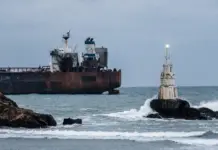
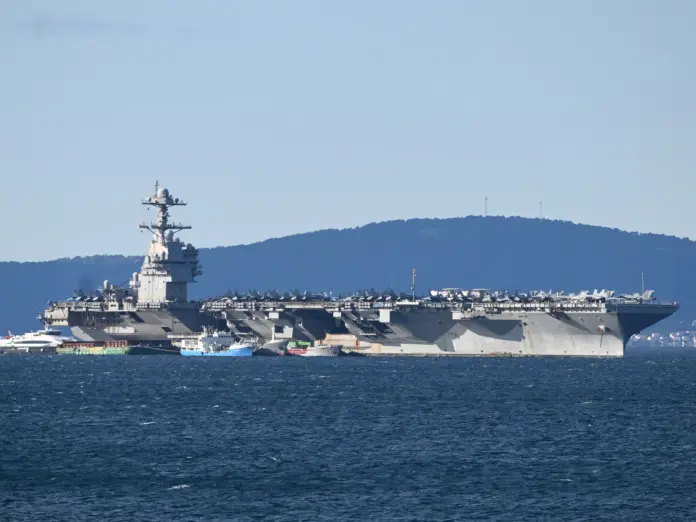
The political pressure comes against a backdrop of rapidly escalating naval confrontations. The United States imposed a naval blockade on all Iranian ports on April 13, a dramatic escalation that followed a two-week ceasefire declared on April 8. Days later, on Monday, US forces fired on and seized the Iranian-flagged container ship Touska in the northern Arabian Sea near the Strait of Hormuz. Trump stated the vessel had defied American orders to alter its planned transit through the strategically vital waterway.
Iran responded swiftly. Within two days of the US blockade, Iranian forces captured two foreign commercial vessels in the Strait of Hormuz and moved them to the Iranian coast. On Wednesday, the US military intercepted at least three Iranian-flagged tankers in Asian waters, reportedly redirecting them away from positions near India, Malaysia, and Sri Lanka. Trump also ordered the US Navy to shoot and kill any vessels attempting to lay mines in the Strait of Hormuz — a body of water through which a significant portion of the world’s oil supply flows.
The legal architecture underpinning the administration’s military posture remains contested. The Authorization for Use of Military Force (AUMF), first passed in the immediate aftermath of the September 11 attacks in 2001 and expanded in 2002 to authorise the invasion of Iraq and the removal of Saddam Hussein, has been repeatedly invoked by successive administrations to justify military action far beyond its original scope. Trump himself used the 2002 AUMF to order the assassination of Iranian General Qassem Soleimani in Baghdad in 2020.
The current standoff echoes a long history of presidents testing the boundaries of the War Powers Resolution. Former President Bill Clinton authorised multiple military operations during the 1990s without congressional approval, most notably deploying US forces against the former Yugoslavia in March 1999 in response to Serbian ethnic cleansing of Kosovar Albanians. That campaign lasted 79 days — exceeding the 60-day statutory limit. The Obama administration similarly argued during the US military campaign in Libya between March and June 2011 that the mission did not legally constitute "hostilities" under the War Powers Resolution, a position widely criticised by legal scholars. US forces were also first deployed to Syria in 2014 under Obama without a specific congressional authorisation for that theatre.
What distinguishes the current confrontation with Iran is its scale and directness. A naval blockade, the seizure of a flagged vessel, tanker interceptions across multiple maritime zones, and explicit shoot-to-kill orders represent a level of kinetic engagement that legal experts argue squarely triggers the War Powers Resolution’s requirements — regardless of whether a formal ceasefire is nominally in place.
With the May 1 deadline approaching and no clear diplomatic off-ramp in sight, the coming days will test whether Congress is willing to assert its constitutional authority over matters of war — or whether, as has so often been the case in recent decades, it will defer to the executive and allow the clock to run.