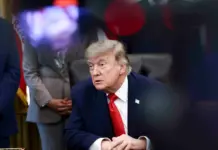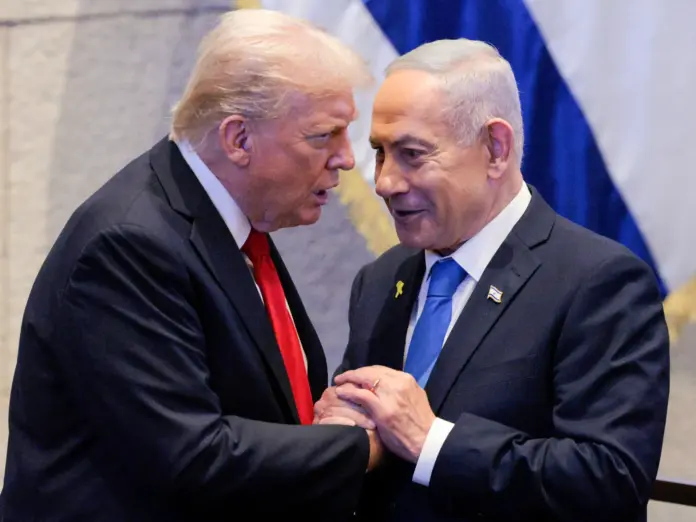
Washington — Donald Trump took to social media Monday to reject accusations that Israeli Prime Minister Benjamin Netanyahu had manoeuvred the United States into a war with Iran, insisting the decision was rooted in the October 7, 2023, Hamas attacks on Israel and his own decades-long conviction that Tehran must never acquire a nuclear weapon.
The denial comes at a precarious moment. A two-week ceasefire between Washington and Tehran is due to expire Wednesday, and both sides have threatened to resume hostilities if a permanent agreement is not secured. Further talks between American and Iranian officials may take place in Pakistan this week, though no formal schedule has been confirmed.
The war’s origins trace to February 28, when joint US-Israeli strikes killed Iranian Supreme Leader Ali Khamenei, a number of senior officials, and hundreds of civilians. Tehran responded by closing the Strait of Hormuz, the narrow waterway through which a significant share of the world’s oil passes, triggering an immediate spike in global energy prices. Iranian forces then sustained attacks across the Gulf for nearly six weeks before the ceasefire took hold.
American consumers have felt the consequences directly. The price of a gallon of petrol has remained above $4 — up from under $3 before the conflict began — and grocery prices are expected to climb further in the coming weeks, with staple items including milk and bread forecast to rise. Supermarket chains have faced criticism over their response to the supply pressures.
Trump’s justification for the war has drawn scrutiny on multiple fronts. His own intelligence director, Tulsi Gabbard, testified before Congress in March that Iran was not, in fact, building a nuclear weapon. Trump had also repeatedly claimed over the eight months preceding the conflict that US air strikes conducted in June had already "obliterated" Iran’s nuclear programme — a characterisation that sits uneasily alongside his stated rationale for further military action. Additionally, no public evidence has emerged directly linking Iran to the Hamas attacks of October 7, 2023.
Critics have seized on these contradictions. Kamala Harris, Trump’s Democratic opponent in the 2024 presidential election, accused him of allowing Netanyahu to pull the United States into a regional war — a charge Trump dismissed Monday alongside a broader attack on mainstream media coverage of the conflict. The criticism carries its own complications: Harris served as vice president under Joe Biden, whose administration provided sustained diplomatic and military backing for Israel’s 15-month campaign in Gaza.
Trump had campaigned in 2024 as a candidate who would end foreign wars rather than start them, a posture that makes the Iran conflict a politically sensitive liability. An NBC News poll found that roughly two-thirds of Americans disapprove of his handling of the war. Netanyahu visited Trump in the United States six times over the past year, a frequency that has fuelled perceptions of unusually close coordination between the two leaders.
The conflict also represents a sharp departure from Trump’s own stated foreign policy framework. His administration’s National Security Strategy, released last year, explicitly called for a pivot away from the Middle East toward the Western Hemisphere. That reorientation appeared to be underway in January, when US forces abducted Venezuelan President Nicolás Maduro; Venezuela has since remained stable and adopted a more cooperative posture toward Washington.
Whether the administration can now extract itself from the Middle East entanglement it sought to avoid remains the central question. With the ceasefire clock running down and negotiations at an early stage, the risk of renewed fighting is real. Both governments have made clear that the pause in hostilities is conditional, not permanent, and the economic and strategic costs of a resumption would fall heavily on an American public already strained by months of elevated prices.
The coming days in Pakistan may determine whether diplomacy can hold — or whether a conflict that reshaped the region’s power structure will enter a new and more dangerous phase.