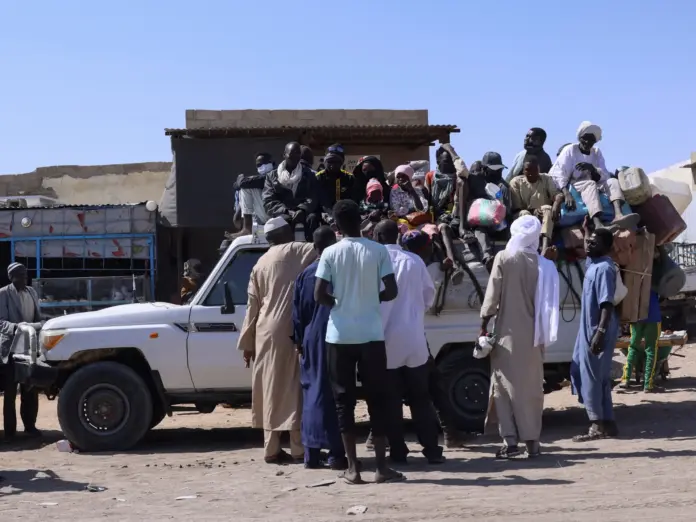
When Marasi Alfadil fled el-Fasher in North Darfur, she left six months before the city fell — a decision that likely saved her life. She arrived in Omdurman, the Sudanese Armed Forces-controlled city that forms part of the capital region of Khartoum, with her children in tow, taking shelter in a half-finished building inside a compound. Hundreds of thousands of others were not so fortunate.
The Rapid Support Forces (RSF) paramilitary group completed its seizure of el-Fasher following an 18-month siege, ending the Sudanese Armed Forces’ (SAF) hold on what had been the last major urban stronghold in Darfur. Thousands of people were killed during the takeover. A United Nations investigation subsequently determined the assault bore the ‘hallmarks of genocide’ — a finding that has drawn international condemnation but little concrete intervention.
Throughout the siege, the consequences for civilians were devastating. Goods could not enter the city, and those who attempted to bring food risked detention or death. Markets either collapsed entirely or became so expensive as to be functionally inaccessible to ordinary residents. The Integrated Food Security Phase Classification hunger-monitoring system declared a famine in el-Fasher in November, formalising what aid workers had long warned was inevitable.
The hunger crisis extends well beyond el-Fasher’s boundaries. Kadugli, the capital of South Kordofan State, has reported similar famine conditions, and at least 20 other areas across Darfur and Kordofan are now at risk. By September, approximately 375,000 people were classified at the most extreme level of hunger across North Darfur, South Kordofan and West Kordofan combined. Prolonged blockades have severed supplies of food, fuel and medicine to besieged communities across the region.
The 2026 Global Report on Food Crises, released by the European Union-funded Global Network Against Food Crises, identified conflict in Darfur and Kordofan as having severely constrained humanitarian access — a pattern that has persisted throughout the war and shows no sign of abating. Aid agencies have simultaneously flagged chronic funding shortfalls, compounding the difficulty of reaching those most in need.
The displacement toll is staggering. By the end of 2025, almost 12 million people had been internally displaced across Sudan, giving the country the distinction of hosting the world’s largest internal displacement crisis. The UN estimated that nearly 25 million people — more than half the country’s population — faced crisis levels of food shortages or worse. Among the most vulnerable are an estimated 4.2 million children under five confronting acute food insecurity.
For those who have managed to reach Khartoum and Omdurman, safety has not translated into security. Food remains scarce and expensive in the capital region despite the steady influx of displaced people seeking refuge there. Taqwa, who fled Heglig in West Kordofan after fighting between the SAF and the RSF, arrived in Omdurman carrying three-week-old twins — a journey undertaken under conditions that would test even the most resilient.
Violence continues to block humanitarian access to many regions of the country, trapping civilians in areas where relief organisations cannot safely operate. The combination of active conflict, deliberate obstruction and funding gaps has created conditions in which famine is not merely a risk but an unfolding reality for communities across Sudan’s war-ravaged west and south.
The war between the SAF and the RSF, which erupted in April 2023, has transformed Sudan into one of the world’s most acute humanitarian emergencies. International diplomatic efforts have so far failed to produce a durable ceasefire, and the RSF’s consolidation of control over vast swaths of Darfur has reshaped the conflict’s geography in ways that make humanitarian corridors increasingly difficult to establish or maintain.
For Marasi Alfadil and the millions like her who have been uprooted by the fighting, the immediate horizon offers little relief. The half-finished building in Omdurman is shelter, but it is not home — and for those still trapped in el-Fasher and the besieged towns of Kordofan, even that modest refuge remains out of reach.