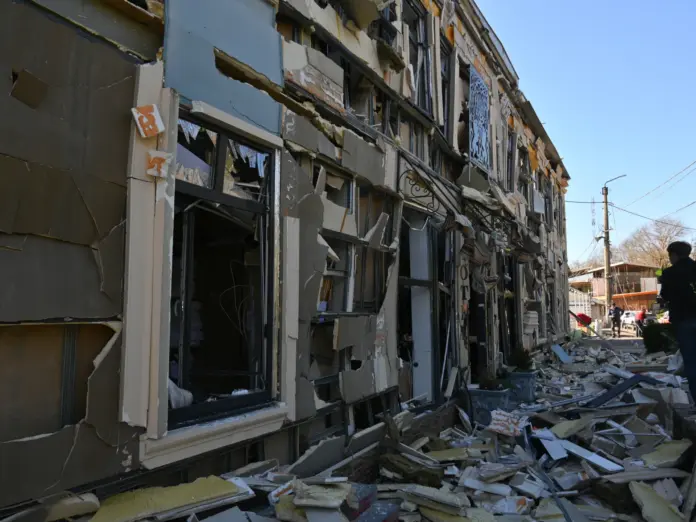
Russian forces carried out a sweeping wave of attacks across Ukraine, killing at least three people and injuring more than ten others over a 24-hour period, striking civilian infrastructure from the Donetsk front lines to the southern port city of Odesa. The assault drew a Ukrainian response deep inside Russian territory, with a drone striking an industrial facility in Perm Krai — one of the most distant targets hit since the war began.
The heaviest concentration of Russian fire fell on the Zaporizhia region, where 833 separate attacks were recorded. In the Donetsk region, at least 19 Russian strikes killed two people and wounded four others, according to regional military administration head Vadym Filashkin. The bombardment damaged dozens of houses and apartment buildings, destroyed an infrastructure facility, and wrecked a minibus. Amid the relentless shelling, 867 civilians — including 34 children — were evacuated from front-line communities in Donetsk within the same 24-hour window.
In the Sumy region, two deaths were attributed to Russian action. A woman was killed in a drone strike, while a 60-year-old resident died from carbon monoxide poisoning caused by Russian strikes on her home. Regional military administration head Oleh Hryhorov said the attacks deliberately targeted residential buildings, a pattern Ukrainian officials have repeatedly condemned as a war crime.
Russian strikes on Odesa hit a hospital, damaging its cardiological and surgical departments and triggering a fire in the facility’s reserve area. Two people were wounded in the attack. Oleh Kiper, head of the Odesa regional military administration, confirmed the strike on the medical facility, which represents a direct hit on protected civilian infrastructure under international humanitarian law.
While Russian forces pressed their assault across Ukrainian territory, Kyiv demonstrated its own capacity to strike far beyond the front lines. A Ukrainian drone hit an industrial facility in Perm Krai, a region situated approximately 1,500 kilometres inside Russia near the Ural Mountains — among the deepest strikes recorded since Russia launched its full-scale invasion in February 2022. Regional Governor Makhonin confirmed the strike, adding that workers were evacuated from the facility without injuries. Ukraine has increasingly targeted oil refineries, fuel depots, and port infrastructure inside Russian territory as part of a strategy to degrade Moscow’s logistical and energy capacity.
The strikes in Perm Krai underscore a significant shift in the conflict’s geography. What began as a ground war concentrated along eastern and southern Ukrainian front lines has evolved into a long-range exchange that now reaches deep into the Russian heartland. Ukrainian drone capabilities have expanded considerably over the past year, enabling Kyiv to threaten industrial and energy assets that Moscow had previously considered beyond reach.
The latest violence unfolds against a backdrop of stalled diplomacy. US-led peace efforts to broker a ceasefire or negotiated settlement have largely been placed on hold, leaving both sides locked in a grinding war of attrition with no immediate resolution in sight. Civilian populations on both sides of the conflict continue to bear the consequences, with Ukrainian communities facing near-daily bombardment and Russian border regions increasingly exposed to retaliatory strikes.
The scale of the Zaporizhia attacks — 833 incidents in a single day — reflects the intensity of pressure Russia continues to apply along the southern axis of the front, where control of the region remains bitterly contested. Donetsk, meanwhile, remains the epicentre of ground combat, with Russian forces pushing against Ukrainian defensive lines while systematically targeting civilian areas behind them.
Humanitarian organisations have raised alarm over the accelerating pace of civilian evacuations from front-line communities in Donetsk, warning that the logistical burden of moving vulnerable populations — including children and the elderly — is straining local resources. The nearly 900 people evacuated in a single day from Donetsk alone illustrates the scale of displacement still unfolding more than three years into the war.