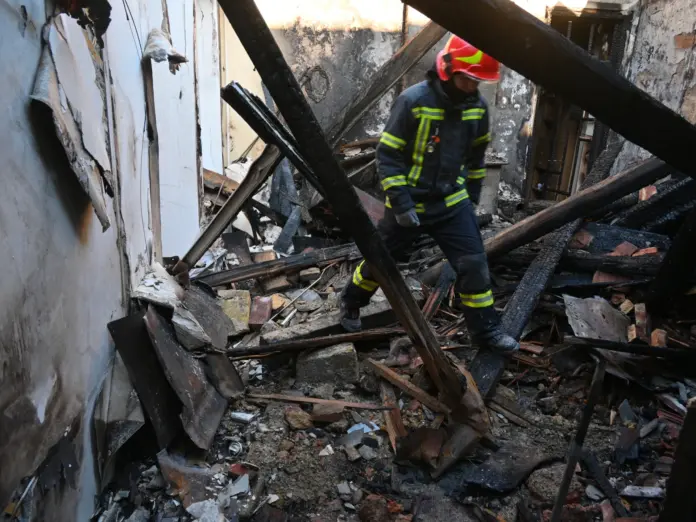
Russian drone strikes tore through three districts of the southern Ukrainian port city of Odesa overnight, wounding at least 11 civilians — among them two children — in an assault that damaged residential buildings, vehicles, a hotel, warehouses, and a funicular railway. Windows shattered across wide swaths of the city, and the port area sustained significant structural damage.
Odesa Governor Oleh Kiper confirmed that law enforcement agencies are documenting the strikes as war crimes, underscoring Kyiv’s position that deliberate attacks on civilian infrastructure constitute violations of international humanitarian law.
The assault on Odesa was part of a broader pattern of intensified Russian military activity. In the southeastern Zaporizhzhia region, Governor Ivan Fedorov reported that a 59-year-old man was killed as Russian forces launched a staggering 629 strikes across 45 settlements in a single day. At least 50 instances of damage to homes and infrastructure were recorded across the region.
Separately, Russia-installed authorities at the Zaporizhzhia nuclear power plant — seized by Russian forces early in the war and currently shut down — reported that a Ukrainian drone strike killed a worker at the facility. The plant, Europe’s largest nuclear station, has remained a focal point of international concern throughout the conflict, with repeated warnings from nuclear safety officials about the risks posed by military activity in its vicinity.
Ukraine also struck inside Russian territory. Authorities in the Belgorod border region reported Ukrainian drone attacks that killed at least one person and injured four women, with buildings and vehicles sustaining damage. The cross-border strikes reflect the increasingly reciprocal nature of the aerial campaign that has defined this phase of the war.
Against this backdrop of relentless violence, diplomatic signals emerged from multiple directions. U.S. President Donald Trump stated he has held productive conversations with both Russian President Vladimir Putin and Ukrainian President Volodymyr Zelenskyy, describing ongoing diplomatic efforts aimed at addressing the conflict. Trump offered few specifics but characterised the exchanges as constructive.
Zelenskyy, meanwhile, travelled to Baku, Azerbaijan, where he signed bilateral agreements covering security and energy cooperation. During the visit, Kyiv also discussed the possibility of future peace talks with Russia — a notable development given the near-total breakdown of formal diplomatic channels since the early weeks of the full-scale invasion in 2022. The choice of Azerbaijan as a venue carries symbolic weight; Baku has maintained ties with both Moscow and Western-aligned nations throughout the conflict, positioning itself as a potential neutral interlocutor.
The dual tracks of military escalation and tentative diplomacy illustrate the contradictions that have come to define the war’s current phase. On the ground, neither side has demonstrated a willingness to halt offensive operations, even as political leaders in Washington and Kyiv speak of pathways toward negotiation. The civilian toll continues to mount: in Odesa alone, the latest strikes add to months of attacks on a city that serves as Ukraine’s primary maritime gateway and a cultural hub of the country’s south.
The Zaporizhzhia nuclear plant remains one of the conflict’s most volatile flashpoints. Operating on emergency diesel generators for extended periods since its grid connections were severed, the facility has been the subject of repeated warnings from the International Atomic Energy Agency about the dangers of sustained military activity nearby. The reported death of a plant worker in a drone strike is likely to intensify those concerns.
With summer approaching and both militaries preparing for what analysts expect to be a renewed push along multiple front lines, the gap between battlefield realities and diplomatic aspirations shows little sign of narrowing.