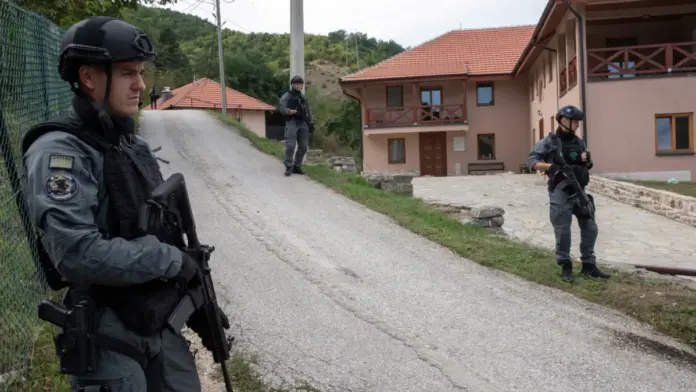
A Kosovo court delivered sweeping terrorism convictions on Friday against three ethnic Serbs for their roles in a 2023 armed assault near the country’s northern border, handing down two life sentences and a 30-year prison term in a case that has strained relations between Pristina and Belgrade to their most dangerous point in years.
The Basic Court in Pristina sentenced Blagoje Spasojevic and Vladimir Tolic each to life in prison, while Dusan Maksimovic received a 30-year jail term. The three men were the only defendants in custody out of 45 individuals initially charged in connection with the attack on the village of Banjska.
Presiding judge Ngadhnjim Arrni stated that the defendants had pursued an organised plan — using violence and heavy weaponry — to sever the northern part of Kosovo and incorporate it into Serbia. The assault resulted in the death of one Kosovo police officer and three gunmen.
Spasojevic rejected the charges during proceedings, telling the court he was not a terrorist and had not killed anyone during the incident. His denial did little to sway the tribunal, which found all three guilty on terrorism grounds.
The attack stands as the worst single violent incident since Kosovo unilaterally declared independence from Serbia in 2008, a declaration Belgrade has never recognised. The broader backdrop stretches further back: more than 10,000 people died during the 1998–99 Kosovo war, which erupted when ethnic Albanian separatists rose against Serbian rule and ended only after NATO launched a sustained bombing campaign that stripped Belgrade of control over the territory.
At the centre of the Banjska affair is Milan Radoicic, a Kosovo Serb businessman and politician who publicly admitted to leading and organising the attack. Kosovo security officials identified him in drone footage captured during the assault. Radoicic resides in Serbia and maintains close ties to the country’s ruling populist party and to President Aleksandar Vucic. He was not among those tried on Friday.
Kosovo has formally accused Serbia of being the driving force behind the operation. Belgrade categorically denies any state involvement, insisting the men acted independently. The Serbian government’s position is complicated by Radoicic’s acknowledged role and his proximity to the country’s political establishment.
The geopolitical fault lines exposed by the attack run deep. Approximately 50,000 Serbs live in northern Kosovo and refuse to recognise the authority of Pristina’s institutions, looking instead to Belgrade as their capital. Serbia itself does not acknowledge Kosovo’s courts, government, or statehood — a stance that has made cross-border accountability for the Banjska perpetrators a near-impossibility. Of the 45 people charged, the vast majority remain beyond the reach of Kosovo’s justice system.
Friday’s verdicts nonetheless carry significant symbolic weight. They represent Pristina’s most forceful judicial assertion yet that the Banjska attack was not a spontaneous act of communal violence but a deliberate, organised attempt to redraw borders by force. The life sentences handed to Spasojevic and Tolic signal that Kosovo’s institutions intend to treat such acts with the full severity of the law, even when the principal architect of the assault remains free across the border.
The case is likely to reverberate through ongoing European Union-mediated dialogue between Kosovo and Serbia, negotiations that have repeatedly stalled over issues of recognition, minority rights, and the status of Serb-majority municipalities in the north. With two life sentences now on the record and Radoicic still at large in Belgrade, the path toward any durable normalisation between the two sides appears as fraught as ever.