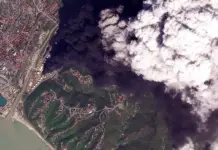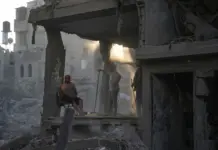
The southern Lebanese city of Bint Jbeil has been reduced to rubble, with more than 70 percent of its structures completely destroyed and a further 20 percent partially damaged — leaving over 90 percent of the city’s urban footprint affected by Israeli military operations. Approximately 3,000 housing units have been levelled, 2,000 families forcibly displaced, and a 400-year-old Great Mosque reduced to ruins, as Israel presses forward with a campaign it frames as essential to securing its northern border against Hezbollah.
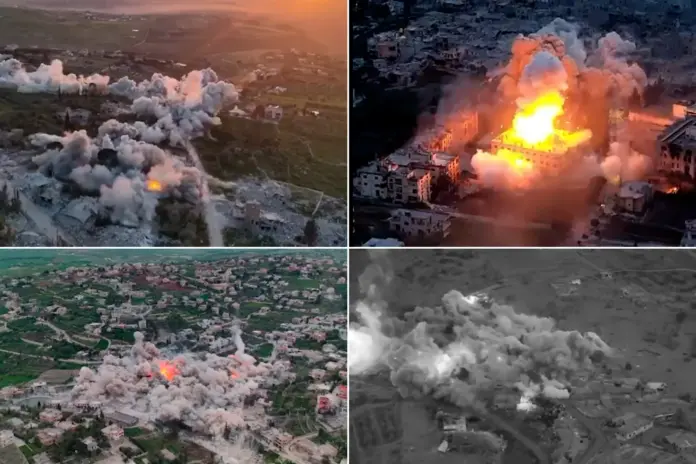
A visual investigation using satellite imagery and open-source intelligence tracked 14 distinct videos published by Israeli soldiers and journalists between April 16 and 24, documenting a pattern of systematic demolitions across the region. Of those incidents, 93 percent — 13 out of 14 — occurred within the Nabatieh governorate. Half of the most catastrophic explosions were concentrated in the Bint Jbeil district alone, while 43 percent of recorded blasts struck towns administratively linked to Nabatieh, including Khiam, Kfar Kila, and Rab el-Thalathine. A further significant demolition was recorded in the coastal town of Naqoura.
The destruction extends well beyond residential areas. Bint Jbeil’s commercial centre and historic neighbourhoods — including Ain al-Saghira and the Old Mosque Quarter — have been targeted, along with Salah Ghandour Hospital. Agricultural land has been subjected to incendiary weapons and white phosphorus munitions, compounding the humanitarian toll on a population already driven from their homes.
Mohammad Bazzi, the mayor of Bint Jbeil, has confirmed the scale of the devastation, describing a city that has been methodically dismantled. Israeli operations have also targeted civilian homes, residential neighbourhoods, and vital infrastructure across a broad swathe of southern Lebanon, with more than 1,500 buildings destroyed in total.
Israel’s military rationale centres on establishing a buffer zone to prevent future attacks from Hezbollah. The Israeli 98th Division completed the encirclement of the Bint Jbeil area as part of Operation Northern Arrows, with five Israeli military divisions deployed in the region and tasked with dismantling Hezbollah’s infrastructure. The strategic significance of the area is not lost on either side — Bint Jbeil and the nearby town of Maroun al-Ras sit at high altitudes overlooking Israeli settlements including Avivim, Yir’on, Dovev, Malkia, and Dishon.
Prime Minister Benjamin Netanyahu declared his forces were close to concluding the battle in Bint Jbeil and issued instructions to the military to continue expanding the security belt while intensifying their fortified presence in the buffer zone. The city carries symbolic weight for both sides — eight soldiers of the Golani Brigade were killed there during the 2006 war, a battle that became emblematic of Hezbollah’s capacity to resist Israeli ground forces.
A ceasefire between Israel and Hezbollah was announced in November 2024, but Israeli forces were violating that agreement almost daily before March, killing hundreds. The demolitions documented in April suggest the military campaign has continued unabated despite the nominal truce.
Hezbollah has responded defiantly. Secretary-General Naim Qassem declared that illegal Israeli settlements ‘will not be safe, even if the Israelis enter any area in Lebanon,’ and the group released a video message in both Arabic and Hebrew pledging to thwart Israel’s buffer zone ambitions. Hezbollah fighters continue to launch strikes using missiles and explosive drones against Israeli troop concentrations in the area.
The destruction in southern Lebanon unfolds against a broader regional backdrop of displacement and conflict. In Gaza, 2.3 million people remain forcibly displaced as Israeli military operations continue in that territory as well, underscoring the widening humanitarian consequences of Israel’s multi-front military posture across the region.
For the residents of Bint Jbeil, the prospect of return grows increasingly distant. With the city’s hospital damaged, its historic core demolished, its farmland scorched, and its housing stock largely erased, the reconstruction challenge — whenever conditions allow — will be generational in scale.