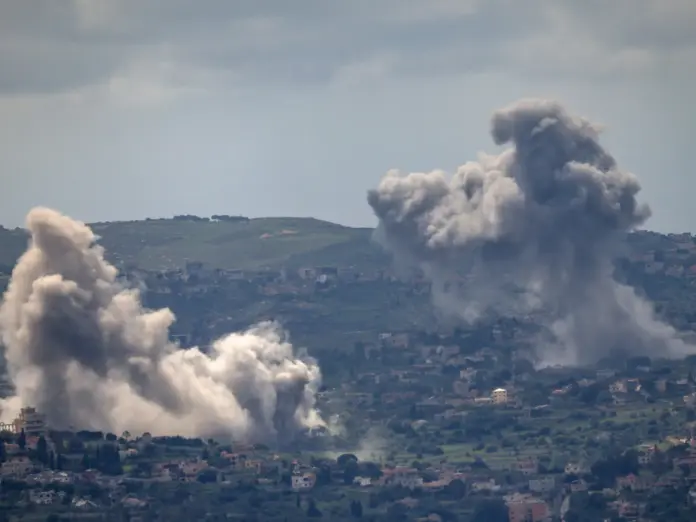
A double Israeli airstrike on the southern Lebanese village of Majdal Zoun killed five people Tuesday, three of them civil defence rescue workers who were struck down while attempting to save survivors of the first explosion — an attack that Lebanese officials and human rights groups swiftly condemned as a deliberate war crime.
The sequence of events followed a pattern increasingly documented in Lebanon’s south: an initial strike draws emergency responders to the scene, only for a second strike to target those same rescuers. In Majdal Zoun, the three civil defence workers were buried under rubble when the second Israeli airstrike hit, a Lebanese Civil Defence spokesperson confirmed. Two Lebanese army soldiers were also wounded in the follow-up strike, which targeted a military patrol that had been escorting the rescue team, along with two civilian bulldozers at the site.
Lebanese Prime Minister Nawaf Salam did not mince words in his response. He accused Israel of committing a ‘heinous crime’ and stated unequivocally that targeting civil defence personnel constitutes a violation of international humanitarian law. President Joseph Aoun echoed those condemnations, describing the killings as part of a broader pattern of attacks against relief workers, paramedics, and medical staff — groups afforded explicit protections under international law.
‘Israel continues to violate international laws protecting civilians, paramedics, civil defence personnel, and medical workers,’ Aoun said, calling Tuesday’s strike the latest in a series of deliberate assaults on first responders.
The Majdal Zoun attack was not an isolated incident. Lebanon’s Health Ministry reported at least eight people killed across the country on Tuesday alone. Since March 2, Israeli strikes have killed at least 2,534 people in Lebanon and wounded a further 7,863 — a toll that has continued to climb despite a US-mediated ceasefire nominally in effect between Israel and Lebanon. Israeli forces have continued to carry out daily airstrikes, concentrated primarily in southern and eastern Lebanon, in what Lebanese officials characterise as systematic violations of the truce agreement.
Hezbollah has responded to what it describes as Israeli ceasefire breaches by firing rockets and launching drones into Israel and Israeli-occupied areas of southern Lebanon, further straining the fragile agreement.
The international response has drawn sharp criticism from human rights organisations. Ramzi Kaiss, a Lebanon researcher at Human Rights Watch, argued that prolonged international silence over Israeli conduct has emboldened the military to escalate its operations with impunity. The organisation issued a formal call for the United States, United Kingdom, Germany, and European Union member states to immediately suspend all arms sales, arms transit, and military assistance to Israel.
‘The pattern is clear and the legal obligations are clear,’ Kaiss said, pointing to the targeting of rescue workers as emblematic of broader conduct that warrants accountability under international humanitarian law.
The strike on civil defence workers in Majdal Zoun adds to a growing body of documented incidents in which emergency responders have been killed while answering calls in conflict zones across Lebanon. International humanitarian law, including the Geneva Conventions, explicitly prohibits attacks on medical and rescue personnel, and the deliberate targeting of such workers can constitute a war crime under the Rome Statute of the International Criminal Court.
Israel has not publicly commented on the specific Majdal Zoun strike. Israeli military operations in Lebanon have been framed by Israeli officials as targeting Hezbollah infrastructure and personnel, though Lebanese authorities and independent monitors have repeatedly documented civilian and non-combatant casualties in the strikes.
The ceasefire, brokered with significant American diplomatic involvement, was intended to halt hostilities that escalated sharply in late 2024. Its durability has been questioned by Lebanese officials and international observers alike, as the daily rhythm of Israeli airstrikes has continued largely unabated since the agreement took effect.
For Lebanon’s civil defence corps — already stretched thin by years of economic collapse and the aftermath of the 2020 Beirut port explosion — the loss of three workers in a single strike represents both a human tragedy and a direct assault on the country’s emergency response capacity. President Aoun called on the international community to hold Israel accountable and to enforce the protections that international law affords to those who risk their lives to save others.