Israel has drawn a new military boundary in southern Lebanon it calls the ‘yellow line’ — a designation previously used only in Gaza — as artillery strikes struck Lebanese border communities and the fragile architecture of a 10-day ceasefire showed deepening cracks.
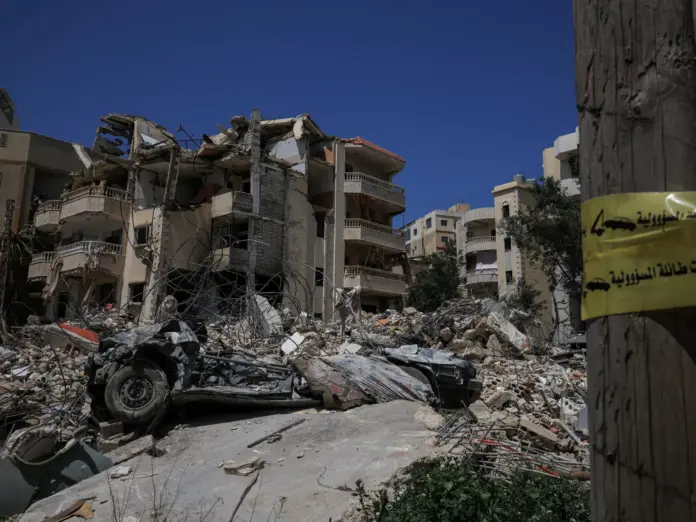
The announcement marks the first time Israel has applied the yellow-line concept to Lebanese territory. In Gaza, that boundary divides the Palestinian enclave into two zones: an eastern sector under full Israeli military control, where hundreds of homes have been demolished, and a western area where Palestinians face comparatively fewer restrictions. Israeli troops routinely open fire on anyone who approaches the line. Israeli Defence Minister Israel Katz has instructed the army to demolish Lebanese villages along the border using the same approach applied in Beit Hanoon and Rafah — a signal that the Gaza model is being deliberately exported northward.
Israeli forces said they identified fighters who violated ceasefire understandings by approaching from north of the yellow line in southern Lebanon. In response, Israeli artillery struck the towns of Beit Leif, Qantara and Touline on Saturday. The military framed the strikes as defensive, asserting that armed personnel had moved toward positions where Israeli soldiers are stationed.
Hezbollah Secretary-General Naim Qassem rejected that framing, warning that the 10-day truce cannot hold unless both parties honour its terms. Qassem demanded a full Israeli withdrawal from Lebanese territory, while Hezbollah stated that its fighters would remain deployed in the field and would respond to violations. The group’s position aligns with the terms of a broader ceasefire that came into force on November 27, 2024, under which Israel was expected to pull back from southern Lebanon in exchange for Hezbollah’s disarmament south of the Litani River.
That earlier agreement has been under severe strain. The United Nations has documented more than 10,000 Israeli ceasefire violations since November 27, and hundreds of Lebanese civilians have been killed in the intervening months. Since a separate Gaza ceasefire began in October, Israeli attacks there have killed at least 773 people and wounded more than 2,000.
The Lebanese government has taken steps to distance itself from Hezbollah’s military wing, outlawing it at the outset of the latest conflict and stating in December that it was close to completing the group’s disarmament south of the Litani ahead of a year-end deadline. Israel, for its part, has consistently maintained that lasting peace requires Hezbollah’s full disarmament — a condition Hezbollah rejects as a precondition, insisting Israeli forces must withdraw first.
The introduction of the yellow-line concept to Lebanon has drawn sharp commentary. The parallel to Gaza is not merely rhetorical: it suggests a strategic template in which Israel establishes enforced buffer zones, controls movement through the threat of lethal force, and systematically clears structures in areas it deems security-critical. Critics have described this approach as the ‘Gazafication’ of southern Lebanon — the imposition of the same restrictive, militarised geography that has reshaped life in the Palestinian enclave.
Diplomatic channels remain active despite the violence. US President Donald Trump announced Thursday that Israeli Prime Minister Benjamin Netanyahu and Lebanese President Joseph Aoun could meet in Washington within the next week or two for direct negotiations. The announcement is notable given that Aoun had previously declined to speak directly with Netanyahu. Whether such a meeting materialises — and whether it can produce a durable framework — remains uncertain as conditions on the ground continue to deteriorate.
The convergence of military escalation and diplomatic outreach reflects the broader contradiction at the heart of the Lebanon crisis: a ceasefire that exists on paper while artillery fire reshapes villages, a disarmament process that remains incomplete, and two parties whose core demands remain fundamentally incompatible. With Israel now institutionalising a yellow line in Lebanese territory and its defence minister invoking Gaza as a blueprint, the trajectory points toward prolonged military entrenchment rather than resolution.