Israel has extended its military control across roughly 60 percent of the Gaza Strip, adding 37 kilometres to the so-called yellow line that demarcates territory under Israeli military authority, even as a ceasefire nominally remains in effect and international pressure mounts over a severe shortfall in humanitarian aid.
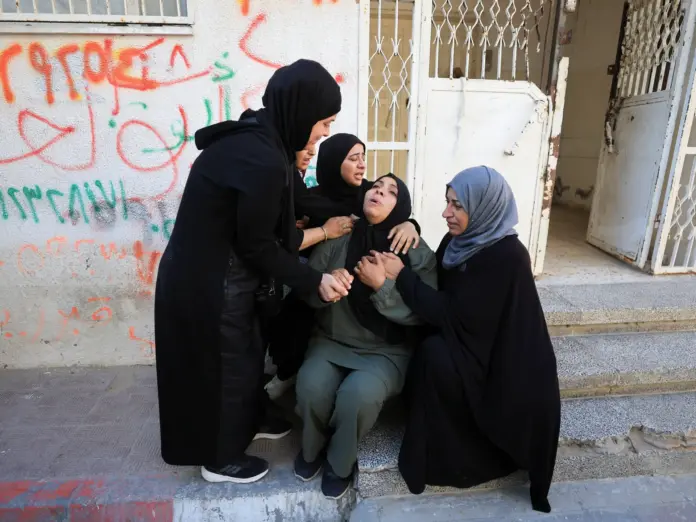
The territorial expansion comes amid a continuing toll on Palestinian civilians. Medics and local health officials report more than 25 Palestinians killed in the past week, including a 40-year-old woman in Khan Younis who died within the past 24 hours. The cumulative death toll since the October ceasefire took hold has surpassed 800 Palestinians — a figure that sits atop the more than 72,500 killed during over two years of full-scale war in Gaza.
The Israeli military acknowledged killing six Palestinian police officers, asserting they were involved in planning imminent attacks. Israeli forces are simultaneously advancing further into western Gaza, a move that analysts say contradicts the spirit — and the letter — of the ceasefire agreement, which stipulated that Israeli troops would withdraw from Gaza by the end of phase one. The ceasefire has since entered its second phase.
Compounding the crisis is a dramatic gap between promised and actual humanitarian assistance. The ceasefire deal called for 600 aid trucks to enter Gaza daily; the current rate stands at between 150 and 190 trucks per day, meaning aid deliveries do not exceed 20 percent of what was agreed. Essential equipment needed to clear rubble and repair hospitals remains entirely blocked from entering the territory.
Political analyst Ahmed al-Tanani, based in Gaza, and Israeli affairs expert Mohanad Mustafa have both pointed to the structural contradictions undermining the agreement. The ceasefire was initially pressed upon Israeli Prime Minister Benjamin Netanyahu by Washington, yet enforcement mechanisms have proven weak. Hamas has stated categorically that it will not disarm while Israeli forces continue to occupy Palestinian territory, leaving the two sides in a deepening impasse.
At the centre of efforts to establish a post-war governance framework is the National Committee for the Administration of Gaza (NCAG), a 12-member body of Palestinian technocrats created under Donald Trump‘s so-called ‘Board of Peace’ initiative. The Board is chaired by Trump himself and includes senior figures Jared Kushner, Steve Witkoff, and Secretary of State Marco Rubio. Nickolay Mladenov serves as the liaison connecting the NCAG to the Board.
Yet the NCAG has so far been conspicuously silent. When approached for comment, the body declined to speak to the media — a reticence that political analyst Iyad al-Qarra described as emblematic of the committee’s broader paralysis. Republican strategic analyst Adolfo Franco in Washington acknowledged the difficulties facing the initiative, noting that the governance architecture remains largely theoretical while Israeli military operations continue to reshape facts on the ground.
The combination of territorial expansion, civilian casualties, and a collapsing aid framework has drawn sharp criticism from humanitarian organisations and regional observers. With rubble-clearing machinery blocked at the border and hospitals struggling to function, the reconstruction of Gaza — a central promise of the ceasefire deal — appears increasingly distant.
The situation presents a fundamental test for the Trump administration’s Middle East strategy. Washington brokered the ceasefire and launched the Board of Peace as a vehicle for post-conflict stabilisation, but the gap between the agreement’s provisions and conditions on the ground is widening by the week. Whether the NCAG can emerge as a credible governing body — or whether it remains a paper institution — may depend on whether Israel’s military posture shifts and whether aid flows can be brought into line with what was promised.
For the more than two million Palestinians remaining in Gaza, the immediate reality is one of continued displacement, restricted supplies, and an uncertain political horizon. The death of a 40-year-old woman in Khan Younis this week is one data point in a toll that shows no sign of abating.