Iranian missiles and drones struck industrial facilities, an international airport, and a commercial tanker across the Persian Gulf over the weekend, widening a conflict that has now entered its fifth week with no resolution in sight. The attacks drew retaliatory interceptions from at least four Gulf states and deepened fears of catastrophic economic damage to the region.
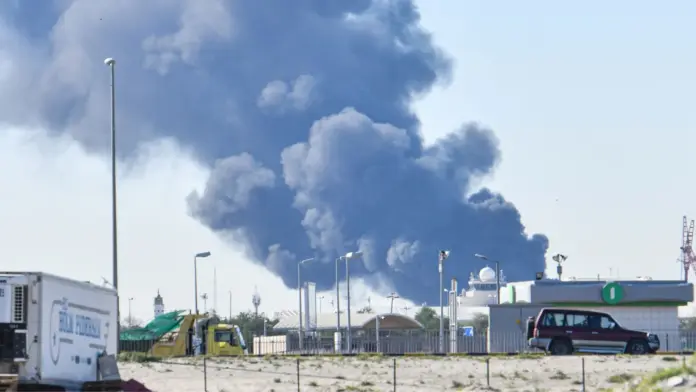
In Kuwait, Iranian drones struck fuel tanks at Kuwait International Airport, igniting a large fire. Abdullah al-Rajhi, spokesman for Kuwait’s General Directorate of Civil Aviation, confirmed the airport was targeted by drones launched from Iran and armed factions it supports. No human casualties were reported, though material damage was significant. Kuwait’s Army General Staff said four Iranian drones were intercepted and destroyed before reaching additional targets.
The United Arab Emirates faced one of the most intense barrages yet. UAE air defenses engaged 16 ballistic missiles and 42 drones on Sunday alone. Emirates Global Aluminium’s Al-Taweelah smelter — located in the Khalifa Economic Zone Abu Dhabi and responsible for producing 1.6 million tonnes of cast metal in 2025 — sustained significant damage. A number of EGA employees were injured, though none suffered life-threatening wounds. Separately, shrapnel from an intercepted Iranian drone killed a Bangladeshi national in Fujairah city, marking one of the conflict’s most direct civilian casualties in the Gulf.
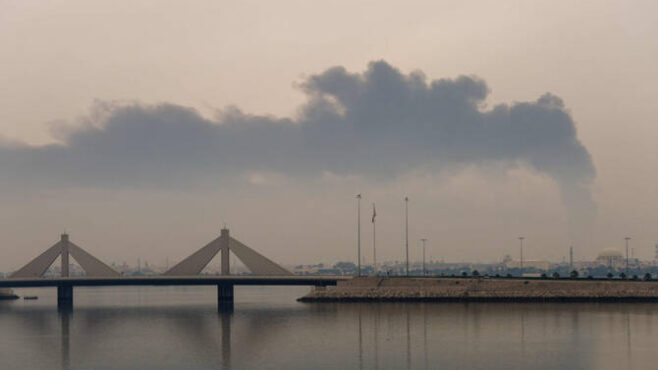
In Bahrain, Iran’s Revolutionary Guards said they struck the main plant of Aluminium Bahrain, one of the world’s largest aluminum producers. Two employees suffered minor injuries in that Saturday strike. A fire also broke out at an undisclosed company facility in Bahrain as a result of Iranian aggression. Bahrain’s Defense Force has now reported engaging a cumulative total of 385 drones and 174 missiles since hostilities began on February 28.
Qatar came under direct missile attack for the second time in as many months. The country’s Ministry of Defence said three cruise missiles were launched from Iran; two were intercepted, while the third struck an oil tanker approximately 17 nautical miles north of the Ras Laffan industrial hub. The vessel, leased to QatarEnergy, sustained hull damage at the waterline. All 21 crew members were evacuated without injury. Ras Laffan, a cornerstone of Qatar’s liquefied natural gas export infrastructure, had already suffered significant damage in an Iranian missile strike the previous month.
Saudi Arabia’s Ministry of Defense reported the interception and destruction of 10 drones on Sunday morning, adding to a sustained pattern of aerial threats against the kingdom since the war erupted.
Iran’s Revolutionary Guards framed the weekend strikes as retaliation for US-Israeli attacks on Iranian industrial infrastructure launched from bases in Gulf states. The Guards said they specifically targeted aluminum plants in Bahrain and the UAE, describing them as industries linked to the US military. In an escalatory warning, the Revolutionary Guards threatened to strike US universities operating in the Middle East, alleging that US-Israeli attacks had destroyed two Iranian universities and demanding a formal US condemnation by noon Monday.
The broader conflict was triggered by a joint US-Israeli assault on Tehran at the end of February. Now in its second month, the war shows no sign of abating despite diplomatic overtures. President Donald Trump said Tuesday that the United States would be leaving the conflict "very soon," suggesting a timeline of two to three weeks. Washington presented Tehran with a 15-point ceasefire framework demanding Iran abandon pursuit of nuclear weapons, halt uranium enrichment, and fully reopen the Strait of Hormuz. Iran dismissed the proposal as "maximalist" and "unreasonable," insisting it does not seek war but requiring compensation for destruction caused by US-Israeli strikes before any agreement could be reached.
The economic toll is mounting rapidly. A United Nations Development Programme report estimated that Arab world GDP could contract between 3.7 and 6 percent after just one month of conflict — a loss equivalent to between $120 billion and $194 billion. With critical energy infrastructure, major industrial producers, and key maritime chokepoints all under sustained attack, analysts warn that each additional week of fighting compounds damage that will take years to reverse.
The conflict erupted at the end of February and has since drawn Gulf states — many of which host US military installations — into the crossfire of a war they did not initiate. Iran’s targeting of civilian industrial assets and commercial shipping signals a deliberate strategy of economic coercion, even as Gulf governments scramble to defend their skies and protect the energy arteries that underpin the global economy.