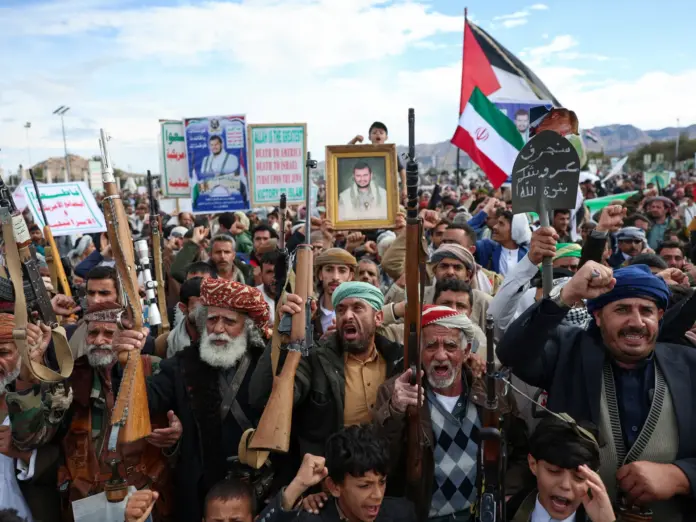
Deep inside Yemen’s Houthi movement, a strategic argument is playing out that could determine the group’s role in the Middle East’s most volatile conflict cycle in decades. Two distinct internal currents are pulling the organisation in opposite directions — one toward restraint, the other toward deeper entanglement — and the tension between them is growing harder to manage.
The Houthis launched military operations in solidarity with Gaza following the Hamas-led Operation Al-Aqsa Flood on October 7, 2023, drawing the group into direct confrontation with both the United States and Israel. That involvement came at a steep price. Senior Houthi figures within the cautious faction now acknowledge the toll: significant military losses, the deaths of key leaders, and civilian casualties that have weighed heavily on the movement’s internal calculus.
The United States and Israel launched coordinated retaliatory strikes in March 2025, a campaign that continued for two months before Oman brokered a ceasefire agreement in May 2025. The deal brought an uneasy halt to the fighting, but it did not resolve the fundamental question dividing Houthi leadership: what comes next?
The cautious current within the movement argues that direct military engagement does not produce strategic gains proportionate to its costs. Advocates of this position push for avoiding open confrontation and protecting the diplomatic understandings the Houthis have cultivated with Saudi Arabia, which put forward a peace roadmap for Yemen in 2022. For this faction, the priority is institutional survival and political positioning in any eventual post-war settlement.
The rival current holds an entirely different view. Its proponents contend that the present moment is historically decisive for the axis of resistance — the network of Iran-aligned groups stretching across the region — and that any retreat or hesitation now would permanently diminish the Houthis’ standing within that alliance. Absence from the battlefield, this faction argues, could cost the group its seat at the table when the post-war regional order is negotiated.
In practice, the Houthis have so far refused to fully embrace either position. Their military spokesperson has publicly identified red lines centred on the Bab al-Mandeb Strait, the critical waterway linking the Red Sea to the Gulf of Aden, signalling both a willingness to act and a desire to define limits. Limited, carefully calibrated operations resumed on March 27, 2025, reflecting the grey zone the movement is attempting to occupy. Political rhetoric was escalated during the first month of the renewed conflict, but full-scale re-engagement has been withheld.
That middle ground is becoming increasingly difficult to hold. As Iranian and Houthi officials intensify their rhetoric around the concept of ‘unity of fronts’ — the idea that allied groups should act in coordinated solidarity — pressure on the cautious faction is mounting. The longer the regional conflict persists and the wider it spreads, analysts warn, the less viable the Houthis’ position of limited involvement becomes.
The movement’s accumulated battlefield experience from years of confronting both the US-led coalition and domestic adversaries has sharpened its awareness of what sustained conflict costs. That institutional memory is the cautious current’s strongest argument. But it competes against the ideological and political imperatives driving the second faction, for whom strategic credibility within the resistance axis is non-negotiable.
The equilibrium between these two currents, already strained, may not survive a significant escalation. Should the broader regional conflict deepen — drawing in more actors or triggering a wider Iranian response — the Houthis will face a moment of decision that their current ambiguous posture cannot accommodate. Whether the cautious voices or the committed ones prevail will shape not only Yemen’s trajectory but the cohesion of the entire resistance network Iran has spent years constructing.