THE HAGUE, Netherlands — Europol has identified 45 Ukrainian children forcibly transferred to Russia, Belarus, or Russian-occupied Ukrainian territory, following a two-day open-source intelligence hackathon held in The Hague. The European law enforcement agency announced the findings on Monday, stating that all information gathered had been shared directly with Ukrainian authorities.
The investigation was conducted by 40 experts drawn from 18 countries, working alongside representatives from the International Criminal Court (ICC) and several non-governmental organisations. Using open-source intelligence — commonly known as OSINT — the assembled specialists were able to trace the whereabouts and circumstances of the children within the compressed timeframe of the event.
The 45 children identified represent a fraction of a far larger crisis. Kyiv has documented 19,546 children forcibly removed from occupied Ukrainian regions since Russia launched its full-scale invasion in February 2022. Among those transferred, some have been adopted by Russian nationals, while others are being held in re-education camps or psychiatric hospitals, according to Ukrainian officials.
Daria Herasymchuk, a presidential adviser on children’s rights in Ukraine, described the transfers in stark terms in June 2025, stating that they constitute genocide of the Ukrainian people through Ukrainian children — a characterisation that reflects the gravity with which Kyiv views the ongoing removals.
The international legal community has reached similar conclusions. A United Nations international commission of inquiry formally accused Moscow of committing crimes against humanity through the forcible deportation of Ukrainian children. The ICC went further, issuing arrest warrants for Russian President Vladimir Putin and Maria Lvova-Belova, the Kremlin’s Commissioner for Children’s Rights, on charges of unlawful deportation and transfer of children — acts classified as war crimes under international law.
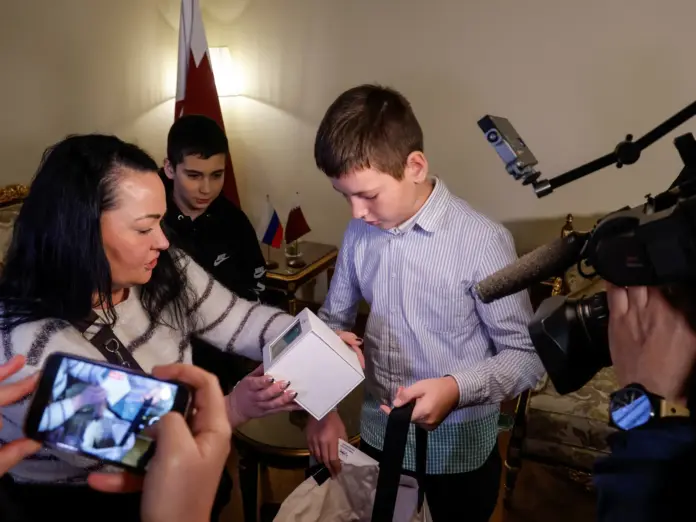
Moscow categorically denies the allegations. Russian officials maintain that children were transferred voluntarily and for their own safety, describing the movement of minors as an evacuation from an active warzone. Russia has also stated it is prepared to return children to their families, though only under conditions it deems appropriate — a position that has drawn sharp criticism from Ukrainian officials and international human rights bodies.
The fate of the transferred children has become one of the most contentious issues in any framework for a potential peace agreement between Kyiv and Moscow. Ukraine has consistently demanded the unconditional return of all children as a prerequisite for broader negotiations, while Russia’s conditional stance has created a significant obstacle to progress on this front.
The Europol hackathon underscores a growing reliance on open-source digital tools to document and investigate alleged violations in conflict zones where traditional evidence-gathering is difficult or impossible. By aggregating publicly available data — including social media posts, satellite imagery, and online records — investigators were able to build traceable profiles of individual children and their current locations.
The collaboration between Europol, the ICC, and civil society partners signals an increasingly coordinated international effort to hold accountable those responsible for the transfers. With ICC arrest warrants already in place for Putin and Lvova-Belova, the legal architecture for prosecution exists; the challenge remains gathering sufficient evidence and securing custody of the accused.
For the families of the nearly 20,000 children Kyiv says have been taken, the identification of even 45 more represents a measure of progress in what Ukrainian officials describe as one of the most devastating dimensions of the war — the systematic removal of an entire generation from their homeland.