Europe is confronting a severe aviation fuel crisis, with the head of the International Energy Agency warning Thursday that the continent has roughly six weeks of jet fuel remaining — a direct consequence of the ongoing US-Israel war on Iran and the closure of the Strait of Hormuz.
Fatih Birol, the IEA’s director general, cautioned that European airlines could begin cancelling flights within weeks if oil supplies through the strategically vital waterway remain disrupted. The warning underscores the fragility of a global aviation system that consumed 7.788 million barrels of jet fuel per day in 2025 — a figure that was projected to climb a further 2.6 percent to 7.988 million barrels per day in 2026 before the conflict erupted.
Approximately 75 percent of Europe’s jet fuel imports originate in the Middle East, making the region acutely vulnerable to any sustained closure of the Strait of Hormuz — the narrow waterway through which one-fifth of the world’s oil and liquefied natural gas passes during peacetime. Several European airports have already cautioned that they could face critical fuel shortfalls within three weeks if the strait remains blocked.
The Airports Council International Europe escalated its concerns in a formal letter to the European Commission, warning that a prolonged fuel crunch would inflict significant damage on the broader European economy. The stakes are considerable: Europe recorded 747 million international arrivals during the 2024 summer season alone, a figure that reflects the continent’s deep dependence on uninterrupted air travel.
European benchmark jet fuel prices have already spiked to a record $1,800 per ton, reached on March 18, while Brent crude surged above $100 per barrel — up sharply from a pre-war price of $66. The price shock has sent shockwaves through airline boardrooms across the continent.
German aviation giant Lufthansa became the first major carrier to announce a structural response to the crisis, confirming it will shut down its regional subsidiary CityLine, citing the combined pressure of soaring jet fuel costs and the impact of industrial strikes. Lufthansa’s chief technology officer, Grazia Vittadini, disclosed Wednesday that jet fuel suppliers have stopped providing price forecasts beyond a single month — a sign of how deeply uncertainty has penetrated the supply chain.
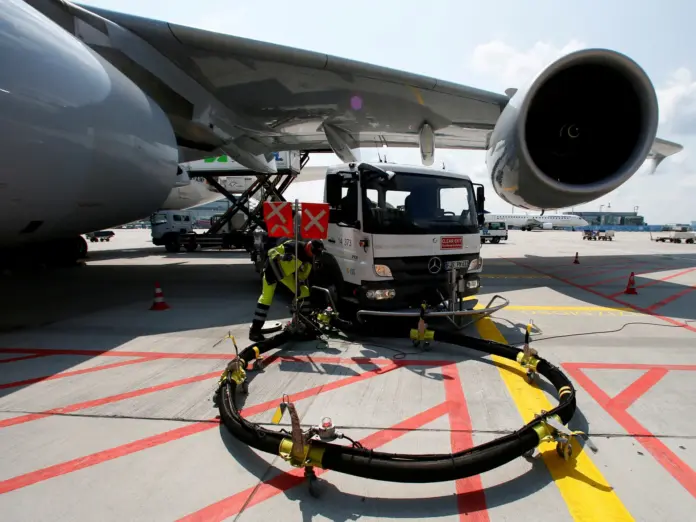
Jet fuel — a colourless, refined kerosene-based petroleum product that powers gas-turbine aircraft engines — is produced primarily at specialised refineries in China, the Middle East and the United States. The most widely used variants, Jet A and Jet A-1, are manufactured by major energy companies including Shell, ExxonMobil and Saudi Aramco. A third variant, Jet B, is deployed in colder climates. The concentration of refining capacity in conflict-adjacent regions has amplified the vulnerability of global aviation to Middle Eastern instability.
Seven weeks into the conflict, airlines operating within the Middle East have begun a slow return to more normal traffic patterns following a two-week truce between Iran and the United States. However, the Strait of Hormuz remains a flashpoint, and the truce has done little to restore confidence in long-term supply chains.
The United Kingdom has taken a leading diplomatic role, convening talks with a coalition of more than 40 countries aimed at finding a mechanism to reopen the strait. The effort reflects growing international alarm that a prolonged closure could cascade beyond aviation into broader energy markets and global trade.
The crisis has exposed structural weaknesses in Europe’s energy supply architecture that predate the current conflict. With the continent relying so heavily on a single geographic corridor for the majority of its aviation fuel, policymakers face mounting pressure to accelerate diversification of supply sources — a process that industry analysts warn cannot be achieved quickly enough to avert the immediate shortfall now confronting European carriers and airports.