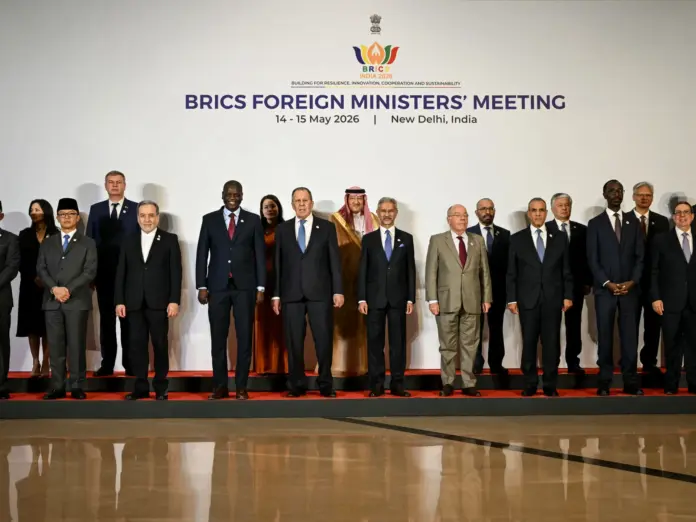
Brics Summit Collapse — A high-stakes gathering of BRICS foreign ministers in New Delhi concluded without a joint communiqué, exposing deep fractures within the bloc over the ongoing Middle East conflict and the increasingly bitter rivalry between Iran and the United Arab Emirates.
The two-day meeting, hosted by India in its capacity as current chair of the alliance, brought together diplomats from the bloc’s core members — Brazil, Russia, India, China, and South Africa — alongside newer entrants including Ethiopia, Egypt, Iran, Indonesia, and the UAE. The failure to produce a unified statement underscored the growing difficulty of maintaining consensus within an increasingly diverse and ideologically fractured grouping.
India acknowledged on Friday that "differing views" among some members over the Middle East had prevented agreement. The admission was a rare public concession from the host nation, which had sought to position the summit as a demonstration of the Global South’s collective diplomatic weight.
Recommended Reading
Iranian Foreign Minister Abbas Araghchi used the platform to call on BRICS member states to formally condemn what he described as violations of international law by the United States and Israel. He also alleged that a BRICS member had blocked portions of India’s draft statement, stopping short of naming the country directly. The implication, however, was widely understood to point toward the UAE.
The accusation drew an immediate and forceful rebuttal. UAE Minister of State Khalifa bin Shaheen Al Marar rejected Araghchi’s remarks outright, accusing the Iranian minister of attempting to justify what he characterised as terrorist attacks against the UAE and other Gulf states. Al Marar stated that Iran had launched approximately 3,000 attacks on the UAE using ballistic missiles, cruise missiles, and drones since the outbreak of the regional conflict on February 28 — striking the Emirates more heavily than any other country involved, including Israel. Araghchi, for his part, maintained that Iran had targeted only American military bases and installations.
The exchange laid bare the fundamental incompatibility of interests within an expanded BRICS that now includes both Iran and the UAE — two nations currently engaged in active hostilities. Saudi Arabia, which has yet to formally join the bloc despite being invited, has also found itself drawn into the widening conflict, further complicating the group’s ambitions to speak with a unified voice on regional security.
Despite the breakdown, ministers did reach agreement on several points. They affirmed that Gaza must remain an inseparable part of any future independent Palestinian state, though one unnamed country registered reservations about specific language in that section of the draft. The ministers also called on all parties to respect the ceasefire in Lebanon and condemned the use of economic sanctions as a tool of political coercion — a position that carries particular resonance for members such as Russia and Iran, both of which face sweeping Western sanctions regimes.
On broader institutional reform, India’s statement called for an overhaul of global governance structures, including the United Nations and the Security Council, and reiterated BRICS’s longstanding demand for greater representation of Global South nations within international bodies.
Brics Summit Collapse: Regional Implications
The ministers also addressed ongoing crises beyond the Middle East. On Syria, whose civil war effectively ended in December 2024 following the overthrow of Bashar al-Assad, the group called for a peaceful and inclusive political transition and stressed the importance of eliminating foreign terrorist fighters from Syrian territory. The situation in Sudan — where a civil war now in its third year has produced what the United Nations has described as the world’s worst humanitarian crisis — was also raised, though no specific measures were agreed upon.
The summit’s failure to produce a joint statement is a significant blow to BRICS’s credibility as a cohesive diplomatic force at a moment when its membership has nearly doubled through an ambitious expansion drive. The bloc’s original five members were united largely by shared economic interests and a common desire to challenge Western-dominated multilateral institutions. The addition of nations with sharply conflicting security interests has tested that foundation severely.
For India, the outcome is a diplomatic setback on home soil. New Delhi had invested considerable prestige in the chairmanship and had hoped the New Delhi meeting would project an image of a confident, reform-minded bloc capable of shaping global affairs. Instead, the session highlighted the limits of consensus diplomacy when member states are, in some cases, actively at war with one another.