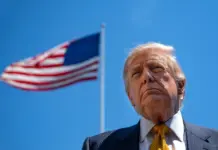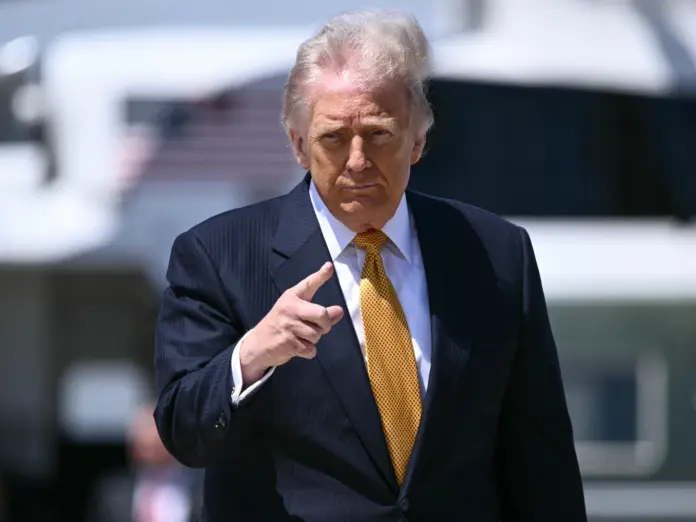
BEIJING/STRAIT OF HORMUZ — Donald Trump flew to Beijing on Tuesday for a high-stakes summit with Chinese President Xi Jinping, carrying an agenda dominated by trade but shadowed by a deepening crisis over Iran that is straining Gulf security, threatening global energy supplies, and drawing in nations from Australia to Turkey.
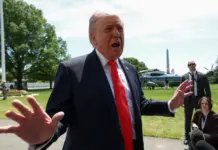
Iran Crisis Gulf Security — Trump told reporters before departing that he and Xi would hold a ‘long talk’ on Iran, signalling that the conflict — now 74 days old and costing Washington at least $29 billion in munitions and equipment, according to Defence Secretary Pete Hegseth — has become impossible to quarantine from any major diplomatic encounter. Trump predicted the war ‘will not be long’ and said its end would trigger a sharp drop in oil prices and inflation, noting that hundreds of tankers were already waiting to leave the region.
The optimism sat uneasily alongside the intelligence picture. Classified US assessments indicate Iran has retained roughly 70 percent of its mobile launchers and pre-war missile stockpile, and has restored access to 30 of its 33 missile sites along the Strait of Hormuz. On Monday, Trump described the US-Iran ceasefire as being on ‘life support’ and said he was weighing a restart of naval escorts through the strait — a move that would mark a significant escalation of the American military footprint in the waterway through which a fifth of the world’s oil flows.
Recommended Reading
The fragility of that passage was underscored on Wednesday when a Chinese crude oil supertanker, the Yuan Hua Hu, transited the Strait of Hormuz past Iran’s Larak Island — a visible reminder of Beijing’s enormous stake in keeping the route open, and of the commercial pressure bearing down on both sides of the Trump-Xi meeting.
Iran’s chief negotiator and Parliament Speaker Mohammad Bagher Ghalibaf issued a blunt warning, declaring that Washington must accept Tehran’s latest peace plan or face failure. Iran has shown no sign of softening its posture despite the military losses it has absorbed. The UAE’s Habshan gas processing complex in Abu Dhabi — a critical node in Gulf energy infrastructure — is operating at just 60 percent capacity after being struck during the conflict, and ADNOC Gas confirmed it will not return to full production until next year.
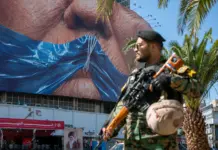
Kuwait delivered one of the week’s sharpest illustrations of Iranian covert activity when authorities arrested four men accused of belonging to Iran’s Islamic Revolutionary Guard Corps after they attempted to infiltrate Bubiyan Island by sea. A Kuwaiti soldier was injured in the operation. The suspects admitted they had been tasked by the IRGC to carry out the mission. Tehran rejected the allegation and condemned the arrest of its nationals.
Against that backdrop, a new multinational maritime coalition is taking shape. Australia announced it would join a ‘strictly defensive’ mission led by France and the United Kingdom to secure shipping through the Strait of Hormuz, contributing a surveillance aircraft to protect the United Arab Emirates from Iranian drone attacks. Qatar’s prime minister, visiting Washington to support Pakistan’s mediation efforts, said Iran must not use the strait as a means of ‘blackmail’ against Gulf states — unusually direct language from a country that has historically maintained careful ties with Tehran.
Iran Crisis Gulf Security: Regional Implications
Turkish Foreign Minister Hakan Fidan offered a more measured assessment, saying both the United States and Iran possess ‘enough will’ to halt the fighting. Ankara has positioned itself as a potential back-channel, though no formal mediation framework has been announced.
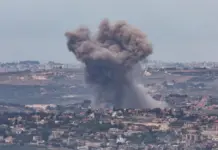
The Lebanon front added another layer of complexity. Israel continued pounding Lebanese territory on Monday despite a nominal ceasefire in the Israel-Hezbollah conflict, killing at least two Lebanese Civil Defence paramedics and a wounded man they were attempting to evacuate near Tyre. Lebanon’s government urged the US ambassador in Beirut to press Israel to halt its attacks. Hezbollah chief Naim Qassem pledged to turn the battlefield into ‘hell’ for Israeli forces and claimed his fighters struck an Israeli Merkava tank near the town of Hula in the Nabatieh region. Qassem also stated categorically that Hezbollah’s weapons would not be part of forthcoming ceasefire negotiations between Lebanon and Israel — a position that complicates the third round of talks scheduled for Thursday and Friday.
The war has already displaced hundreds of thousands of Lebanese students, adding a humanitarian dimension to a crisis that is reshaping the strategic geography of the Middle East. With Trump now in Beijing, the question of whether the world’s two largest economies can align — or at least avoid working at cross-purposes — on Iran may prove as consequential as any battlefield development in the weeks ahead.