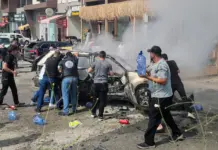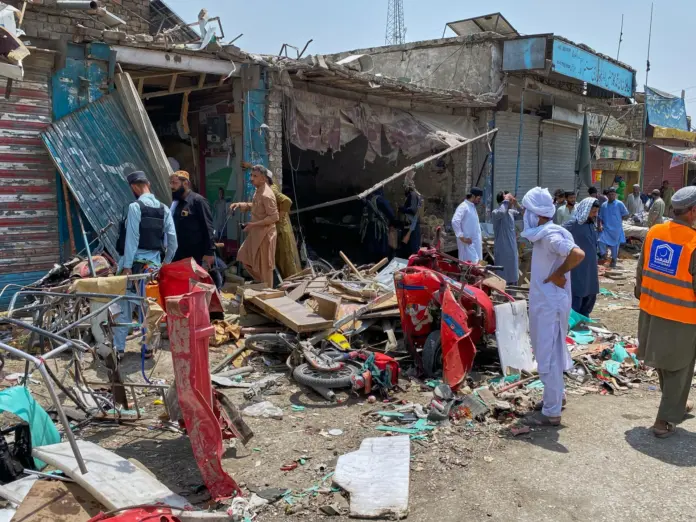
Pakistan Northwest Bombing — A bomb hidden inside a rickshaw detonated Tuesday in a busy market in Sarai Naurang, a town in Lakki Marwat district in northwestern Pakistan, killing at least nine people and wounding around 30 others in one of the deadliest single attacks to strike the area in recent months.
Among the dead were two traffic police officers and a woman, local police chief Azmat Ullah confirmed. The emergency response agency Rescue 1122 recorded approximately 30 wounded, while THQ Hospital medical superintendent Mohammad Ishaq said his facility received 37 patients, several of them in critical condition. The most seriously injured were transferred to hospitals in Bannu, the nearest major city.
No group immediately claimed responsibility for the attack. Sarai Naurang sits close to the porous border with Afghanistan, a corridor long exploited by militant networks operating across both countries.
Recommended Reading
The explosion compounds an already dire security picture in Pakistan’s northwest. Just days earlier, 21 police officers were killed when attackers combined a bombing with a gun assault on a security post in Bannu district. Pakistani authorities attributed that strike to the Tehrik-e-Taliban Pakistan — commonly known as the TTP — a militant organisation that has dramatically escalated its campaign against Pakistani security forces in recent years.
The TTP, while distinct from Afghanistan’s Taliban government, maintains an ideological alliance with Kabul’s rulers. Pakistani officials have repeatedly accused the Afghan Taliban of providing sanctuary to TTP fighters and allowing attacks to be planned from Afghan soil. Kabul has consistently denied those allegations, insisting it does not permit its territory to be used as a launchpad against neighbouring states.
On Tuesday, Afghan Taliban spokesperson Zabihullah Mujahid again rejected Islamabad’s accusations, calling claims that the Bannu security post attack was planned in Afghanistan "baseless." The denial did little to ease tensions between the two governments, which have been locked in a cycle of accusation and counter-accusation as cross-border violence has mounted.
The diplomatic friction has at times spilled into open military confrontation. Since late February, fighting between Pakistani and Afghan forces has killed hundreds of people along the shared frontier. China stepped in as a mediator in early April, brokering negotiations aimed at halting the bloodshed. While those talks produced a reduction in the intensity of clashes, sporadic cross-border incidents have continued in the weeks since.
Security analysts point to the Afghan Taliban’s return to power in Kabul in 2021 as a turning point that emboldened the TTP and contributed to a sustained rise in militant violence inside Pakistan. The northwest, including Lakki Marwat and Bannu districts, has borne a disproportionate share of that violence, with markets, checkpoints, and security installations repeatedly targeted.
Pakistan Northwest Bombing: Regional Security Implications
Tuesday’s market bombing underscores the vulnerability of civilian spaces in the region. A rickshaw — an ubiquitous form of transport across Pakistani towns and cities — was turned into a weapon capable of causing mass casualties in a densely populated public area, a tactic designed to maximise both physical harm and psychological impact on local communities.
Pakistani authorities have pledged intensified counter-terrorism operations in the northwest, though the frequency and lethality of recent attacks suggest those efforts have yet to suppress the militant campaign. The back-to-back strikes in Lakki Marwat and Bannu districts within days of each other signal a coordinated effort to stretch security forces and demonstrate operational reach across the region.
Investigations into Tuesday’s bombing are ongoing. Officials have not ruled out a TTP connection, and security forces have launched search operations in the surrounding area in an effort to identify those responsible.