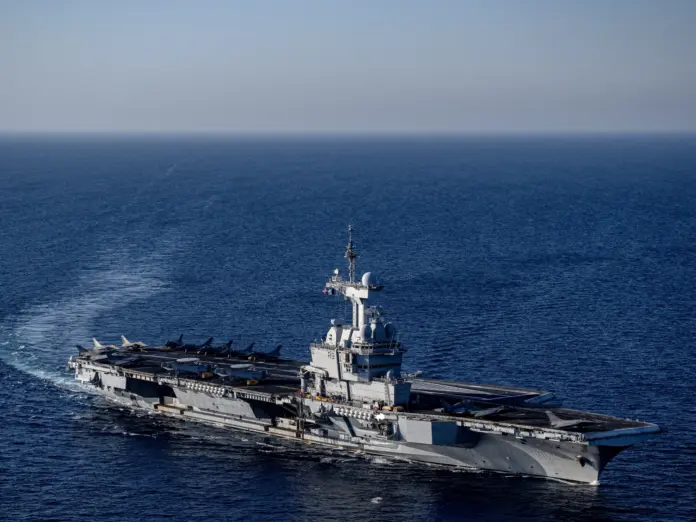
Iran Nuclear Deal Talks — France’s nuclear-powered aircraft carrier Charles de Gaulle is steaming south through the Red Sea toward the Strait of Hormuz, the French Ministry of Armed Forces confirmed Wednesday, as Western powers accelerate diplomatic efforts to reopen one of the world’s most critical maritime chokepoints.
The carrier’s deployment comes amid an effective blockade of the strait following the US-Israel war on Iran. Before the conflict, roughly 20 percent of all globally traded oil passed through the narrow waterway between Iran and the Arabian Peninsula. Its closure has sent shockwaves through energy markets and global supply chains.
French President Emmanuel Macron and British Prime Minister Keir Starmer are jointly leading a proposed multinational mission designed to restore freedom of navigation in the strait. French officials have been careful to characterise the initiative as entirely defensive in nature, stressing it would only be deployed once active hostilities had ceased.
Recommended Reading
Macron spoke directly with Iranian President Masoud Pezeshkian on Wednesday, raising the Hormuz situation as a central concern. The French proposal, as outlined by Paris, would see Iran granted safe passage for its own vessels through the strait in exchange for a formal commitment to enter negotiations with Washington covering nuclear materials, ballistic missiles, and broader regional security issues. In return, the United States would lift its blockade of the waterway. Macron has also indicated he intends to raise the matter directly with US President Donald Trump.
The diplomatic flurry surrounds a proposed one-page memorandum that, if signed, would formally end the conflict. Pakistani mediators have been shuttling between the parties, and Pakistani sources indicated the two sides were approaching agreement on the document’s terms. Trump signalled progress in negotiations Wednesday, though he simultaneously threatened to resume bombing operations if Tehran failed to accept the American plan.
The proposed memorandum’s reported terms are sweeping. Under the framework, Iran would commit to never developing a nuclear weapon and would halt all uranium enrichment for a minimum of 12 years. Washington, in turn, would lift sanctions and release billions of dollars in frozen Iranian assets. Critically for global energy markets, both parties would agree to reopen the Strait of Hormuz within 30 days of the memorandum being signed.
Tehran, however, moved quickly to temper expectations. Esmaeil Baghaei, spokesperson for Iran’s Ministry of Foreign Affairs, stated plainly that Iran had yet to deliver its formal response to the US proposal, adding that examination of the exchanged texts remained ongoing. Iran played down characterisations that a deal was imminent, underscoring the fragility of a process that remains in flux.
Iran Nuclear Deal Talks: Regional Implications
The Charles de Gaulle’s passage through the Suez Canal and into the Red Sea represents a significant show of Western resolve. France’s decision to position its flagship carrier in proximity to the strait gives Macron tangible military weight behind his diplomatic push — a signal to both Washington and Tehran that European powers are prepared to play an active role in any post-conflict security architecture.
The convergence of military positioning and high-stakes diplomacy reflects the acute pressure building around the Hormuz blockade. With global oil flows disrupted and no formal ceasefire yet in place, the coming days of negotiation — mediated through Pakistan and shaped by direct leader-to-leader calls — will determine whether the waterway can be reopened before further economic damage accumulates. Trump’s threat to resume strikes if Iran stalls adds a sharp deadline to talks that, for now, remain unresolved.