BAMAKO — Jihadist fighters from Jama’at Nusrat al-Islam wal-Muslimin (JNIM) stormed the Kenieroba Central Prison, a fortified detention complex located approximately 60 kilometres southwest of Bamako that Malian authorities had promoted as one of the continent’s most secure facilities. The assault on the prison — informally dubbed ‘Africa’s Alcatraz’ — targeted a site holding 2,500 inmates, including at least 72 individuals classified as high-value detainees by the Malian state.
Jnim Militants Mali — Among those held at Kenieroba are JNIM fighters captured in previous operations, as well as individuals arrested in the aftermath of a sweeping coordinated offensive launched on April 25 and 26. That assault, carried out jointly by JNIM and the Azawad Liberation Front (FLA), struck military bases across multiple cities and resulted in the seizure of the northern city of Kidal. The attacks also claimed the life of Defence Minister Sadio Camara, who was killed along with his family at their home in Kati, a garrison town on the outskirts of the capital. At least 23 additional people died in the violence.
In the immediate wake of the attacks, Assimi Goita, the head of Mali’s military government, assumed the defence portfolio himself, consolidating authority as the junta moved to contain the fallout. The military prosecutor’s office announced on May 1 that it possessed ‘solid evidence’ of complicity by certain military personnel in the April offensive — a disclosure that deepened anxieties about the integrity of the armed forces.
Recommended Reading
The crackdown that followed has drawn sharp international concern. Security forces abducted several prominent opposition figures in the days after the attacks. Mountaga Tall, a lawyer, was seized by hooded men in Bamako on May 2 and has since been questioned at least once on charges of ‘attempted destabilisation.’ Authorities accused him of conspiring with opposition figures in Dakar, Senegal, to overthrow the military government. Two other figures, Youssouf Daba Diawara and Moussa Djire, were also detained, suspected of links to exiled opposition leaders Mahmoud Dicko and Oumar Mariko respectively. At least two civilians with ties to Mariko were separately arrested.
The UN Office of the High Commissioner for Human Rights (OHCHR) published a report on Tuesday documenting what it described as ‘gravely concerning reports of extrajudicial killings and abductions’ allegedly carried out by Malian security forces in the aftermath of the April attacks. The findings intensified pressure on Bamako at a moment when the junta is already struggling to project control.
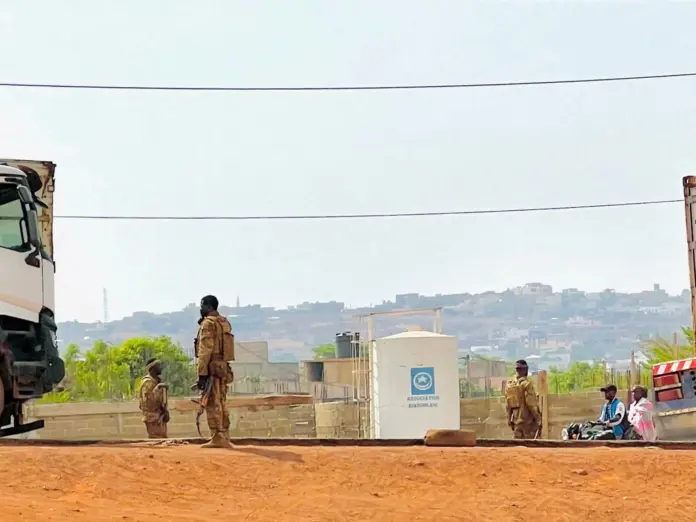
JNIM has escalated its rhetoric alongside its military operations. The group has called on Malians to rise up against the government and embrace a transition to Islamic law, and has pledged to besiege Bamako, home to four million people. Fighters were reported to have established checkpoints equipped with 12.7mm machine guns mounted on motorbikes around the capital on Friday, a show of force that underscored the group’s growing operational reach in the country’s heartland.
Jnim Militants Mali: What This Means for the Sahel
The humanitarian consequences of the conflict are already being felt beyond the front lines. The mayor of Diafarabe, a village in the Mopti region, issued an urgent appeal to authorities on May 3, warning that the community had exhausted its food supplies and that residents faced starvation if assistance did not arrive swiftly.
The prison raid and the siege of Bamako’s outskirts represent a significant escalation in JNIM’s campaign against Mali’s military rulers, who seized power in a 2021 coup and have since expelled French and United Nations peacekeeping forces in favour of closer ties with Russian security contractors. The group’s ability to strike a facility specifically designed to hold its senior operatives signals both a tactical and symbolic blow to the junta’s authority — and raises urgent questions about the government’s capacity to defend the capital itself.