PYONGYANG — North Korean leader Kim Jong Un delivered a speech this week honouring soldiers who detonated grenades to kill themselves rather than be taken prisoner by Ukrainian forces, framing their deaths as acts of supreme loyalty in a war fought thousands of kilometres from home.
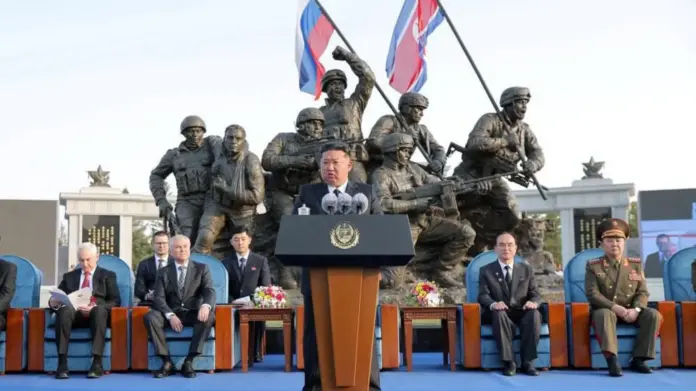
Speaking at a memorial ceremony in Pyongyang on Monday, Kim praised troops who "unhesitatingly opted for self-blasting, suicide attack, in order to defend the great honour," describing the fallen as "the party’s faithful warriors and patriots." State media outlet KCNA reported on the address, which coincided with the unveiling of a memorial dedicated to North Korean soldiers killed in combat.
The ceremony carried unmistakable diplomatic weight. Russian Defence Minister Andrey Belousov and Vyacheslav Volodin, speaker of Russia’s parliament, both attended the event in Pyongyang — a visible demonstration of the military partnership binding the two nations.
South Korea estimates that at least 15,000 North Korean soldiers have been deployed to help Russian forces recapture territory in the western Kursk region. Of those, more than 6,000 are believed to have been killed — a casualty rate that, if accurate, would represent one of the most devastating losses sustained by any single contributing force in the broader conflict. Neither Pyongyang nor Moscow has confirmed troop numbers or acknowledged casualties.
The practice of self-detonation among North Korean soldiers is not incidental. Intelligence agencies and defectors have established that troops were operating under explicit orders from Pyongyang to take their own lives rather than allow themselves to be captured. In North Korea, surrender is not merely discouraged — it is classified as an act of treason, a doctrine drilled into soldiers from the earliest stages of military training.
Physical evidence has reinforced those accounts. Seoul’s National Intelligence Service recovered memos found on deceased North Korean soldiers that directly referenced the self-detonation practice, providing documentary confirmation of what had previously been described through testimony alone.
Perhaps the most striking corroboration came from the soldiers themselves. South Korean broadcaster MBC aired a programme featuring two North Korean prisoners of war currently held in Ukraine. One soldier, speaking on camera, expressed not relief at having survived but shame at having failed to die. "Everyone else blew themselves up," he said. "I failed." The statement offered a rare and disturbing window into the psychological conditioning imposed on North Korean combatants.
The deployment to Kursk sits within a broader strategic framework that has been formalised at the highest levels. In June 2024, Russian President Vladimir Putin and Kim Jong Un signed a bilateral treaty committing each country to assist the other in the event of armed aggression. Kim subsequently described the agreement as the "strongest ever" concluded between the two states. Beyond combat troops, North Korea has also pledged to send thousands of workers to assist in rebuilding areas of Kursk damaged or destroyed during the fighting.
The memorial ceremony and Kim’s speech represent the most explicit public acknowledgement yet by Pyongyang that its soldiers have died in Russia’s war against Ukraine — even as the regime stops short of confirming the scale of the commitment or the extent of the losses. By casting suicide attacks as honourable sacrifice rather than battlefield desperation, Kim is simultaneously managing domestic perception of a costly foreign deployment and signalling to Moscow that the alliance remains firm.
For Ukraine and its Western partners, the ceremony adds a new dimension to an already complex conflict. The presence of senior Russian officials at a Pyongyang memorial for soldiers killed fighting under Russian command blurs the line between allied support and direct co-belligerence, raising questions about the legal and strategic implications of the partnership as the war in Kursk continues.