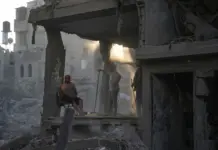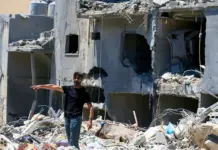
ASADABAD, Afghanistan — Pakistani mortars and missiles tore through the provincial capital of Kunar on Monday, striking a university campus and residential neighbourhoods in an assault that killed at least seven people and left more than 80 wounded, Afghan Taliban authorities said.
The strikes hit Asadabad, the capital of the border province of Kunar, as well as surrounding districts. Sayed Jamaluddin Afghani University sustained extensive structural damage to its buildings and grounds, and Afghanistan’s Ministry of Higher Education confirmed that roughly 30 students and professors were among the casualties.
Taliban deputy spokesperson Hamdullah Fitrat condemned the bombardment in unsparing terms, calling the attacks ‘unforgivable war crimes’ deliberately directed at civilians and academic institutions. Afghan Foreign Minister Amir Khan Muttaqi, who had described peace talks held in the Chinese city of Urumqi in early April as ‘positive’, now faces renewed pressure to respond to an escalation that has rendered those diplomatic gains fragile.
Pakistan’s Ministry of Information and Broadcasting flatly rejected the Taliban’s account, dismissing claims that Pakistani forces struck the university as a ‘blatant lie’ and insisting that all targeting is ‘precise and intelligence based.’ Islamabad did not elaborate on what it said it was actually targeting in Kunar.
The denial follows a pattern that has defined months of increasingly open hostilities. Both Afghan and Pakistani officials have separately acknowledged that the two sides have been exchanging fire along their shared border even while formally observing a ceasefire — a contradiction that underscores how tenuous any truce between the two governments has become.
The Urumqi talks, though described positively by Kabul, concluded without a formal agreement or joint statement, leaving the underlying grievances unresolved. Qatar, Saudi Arabia, Turkey and China have all attempted to broker a durable arrangement, with limited success. A ceasefire mediated by Qatar and Turkey in October 2025 was followed by continued low-level clashes, and a temporary Eid truce in March — brokered at the request of Saudi Arabia, Qatar and Turkey — was allegedly violated when Pakistan carried out dozens of mortar strikes in Kunar while the ceasefire was still nominally in effect.
The most devastating single incident in the current conflict remains the March 16 air strike on Omar Hospital in Kabul, a 2,000-bed addiction treatment facility. Afghan officials put the death toll from that strike at more than 400, while the United Nations recorded 143 deaths. Pakistan maintained that its intended target was not the hospital itself but nearby military installations and an ammunition depot.
Earlier this year, Pakistan struck Kabul multiple times in February and March and declared itself in ‘open war’ with Afghanistan — an extraordinary statement between two neighbouring states that share a long and porous frontier.
At the heart of the dispute is Pakistan’s accusation that the Afghan Taliban is providing sanctuary to the Pakistan Taliban (TTP), a militant organisation that emerged in 2007 and has carried out a sustained campaign of attacks across Khyber Pakhtunkhwa and Balochistan. Afghanistan categorically rejects those accusations, denying that it shelters or aids the TTP or any other anti-Pakistan group. In a gesture toward Islamabad, the Taliban did arrest a significant number of TTP members and their families and transferred them from eastern provinces deeper into Afghan territory — a move that fell short of satisfying Pakistani demands.
Kabul, for its part, has pressed Pakistan to keep border crossings open, resume visa issuance, allow trade to flow and accommodate Afghan refugees already residing in the country — demands that remain largely unmet.
Pakistan has also pointed to the Doha Agreement, signed in February 2020 between the United States and the Afghan Taliban, which committed the Taliban to preventing Afghan soil from being used by any group to threaten the security of any country. Islamabad argues the Taliban has violated that commitment, a charge Kabul disputes.
Monday’s strike on Sayed Jamaluddin Afghani University adds a new and symbolically charged dimension to the conflict. Attacks on educational infrastructure carry particular weight in a country where access to higher education has already been severely curtailed under Taliban governance. The targeting — or collateral destruction — of an academic institution is likely to intensify international scrutiny of Pakistan’s military campaign and complicate any renewed diplomatic effort to bring the two sides back to the negotiating table.