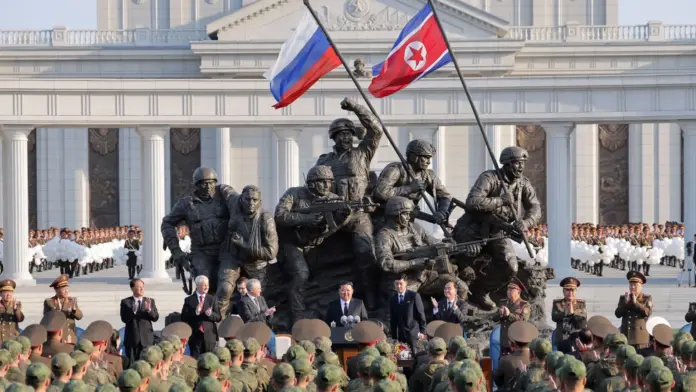
PYONGYANG — North Korean leader Kim Jong Un and Russian Defence Minister Andrey Belousov stood together Sunday beneath a sky filled with white balloons and the roar of military jets to unveil a monument to the North Korean soldiers who have died fighting Russia’s war in Ukraine — a ceremony that laid bare the extent of a partnership both governments have long sought to obscure.
The Memorial Museum of Combat Feats at the Overseas Military Operations opened in Pyongyang with the unveiling of both a statue and a dedicated museum, marking what Moscow framed as the first anniversary of its recovery of the Kursk region. Ukraine launched a surprise cross-border incursion into Kursk in August 2024; Russia declared full control restored a year later.
The timing was deliberate. By anchoring the memorial’s opening to Kursk, both governments cast North Korea’s battlefield losses not as a covert liability but as a shared victory — a cornerstone of an alliance they are now celebrating openly.
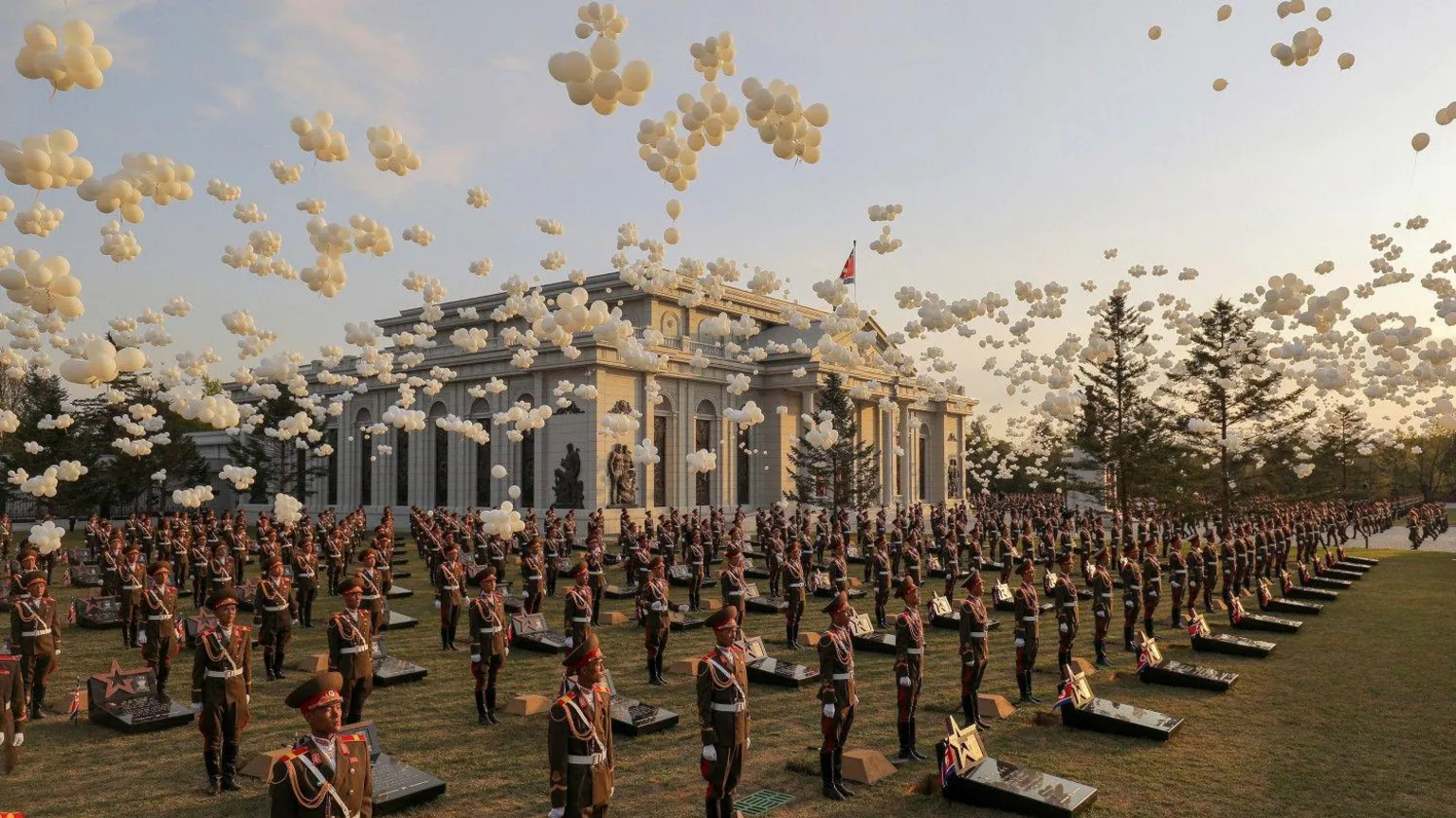
South Korean intelligence estimates that at least 15,000 North Korean soldiers have been dispatched to support Russian forces, with roughly 2,000 believed to have been killed. Neither Pyongyang nor Moscow has released official casualty figures, and the ceremony offered no accounting of the dead beyond the symbolic weight of the monument itself.
Standing beside Belousov, Kim pledged that North Korea would fully support Russia’s policy of defending its national sovereignty and territorial integrity — language that closely mirrors the mutual defence commitments the two leaders formalised in June 2024. Kim described that treaty, which pledges military assistance in the event of aggression against either country, as the strongest alliance agreement his country has ever signed.
Belousov, for his part, used the visit to hold broader discussions with North Korean officials on long-term military cooperation, signalling that the relationship extends well beyond the current deployment of troops.
The ceremony was not the only high-level Russian presence in Pyongyang. Vyacheslav Volodin, speaker of Russia’s parliament and a close ally of President Vladimir Putin, also met with Kim during the visit. The convergence of senior Russian officials in the North Korean capital underscores how central the Pyongyang relationship has become to Moscow’s wartime strategy.
The alliance has been built on mutual need. North Korea is widely believed to have received food, financial payments and technical assistance from Moscow in exchange for its soldiers. North Korea has also pledged to send thousands of workers to help rebuild the Kursk region, extending its contribution beyond the battlefield into reconstruction.
The relationship between the two leaders has been cultivated at the highest levels. When Putin and Kim met as guests at China’s military parade in Beijing the previous year, Putin publicly thanked Kim for his country’s support of the war effort, telling him that North Korean soldiers had fought with courage and heroism. That public praise, delivered on Chinese soil, was a striking departure from the studied ambiguity both governments had previously maintained about the deployment.
The Pyongyang memorial now gives that partnership a permanent physical form — a monument that serves as both a tribute to the fallen and a statement of strategic intent. For Kim, it is an assertion that North Korea has graduated from arms supplier to combat ally, its soldiers’ sacrifice now commemorated in stone and bronze.
For the international community, the ceremony removes any remaining pretence. The deployment of North Korean troops to a European war zone, the formalisation of a mutual defence treaty, and now the construction of a dedicated war memorial together constitute a military alignment with consequences that stretch far beyond the battlefields of eastern Ukraine. South Korea, which has watched the partnership develop with mounting alarm, faces the prospect of a neighbour whose military has gained live combat experience against a modern, Western-armed opponent — experience that will not be forgotten when those soldiers return home.